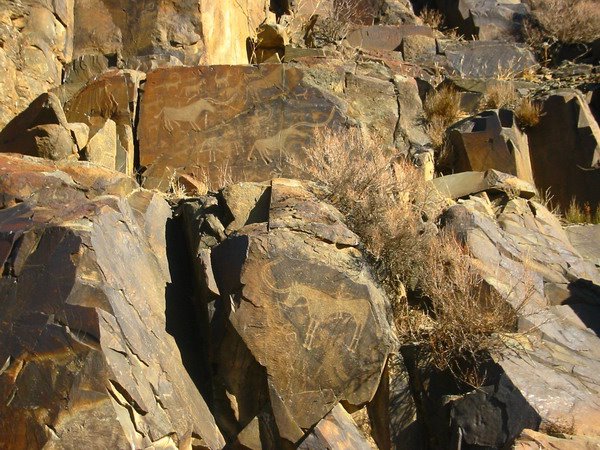
A gallery of sun-headed gods
Amidst the arid Chu-Ili mountains, 170 kilometers northwest of Almaty, lies the Tamgaly Gorge, a UNESCO World Heritage site. This open-air gallery contains a remarkable concentration of some 5,000 petroglyphs, or rock carvings. The images span millennia, from the Bronze Age (beginning in the second half of the second millennium BC) to the early 20th century, documenting the beliefs and social organization of the pastoral peoples who lived here.
The densest collection of engravings is in the central canyon, which also contains what are believed to be altars for sacrificial offerings. Among the most striking images are large, deeply-cut figures from the Bronze Age known as the "sun-headed" deities. These unique, anthropomorphic figures, sometimes depicted among dancing and praying people, show the gorge was a sacred space for rituals. The physical shape of the canyon itself—a narrow space between 20 and 100 meters wide—was likely as important to these rituals as the art on its walls.
The sound below sound
The field of archaeoacoustics investigates how sound behaved in ancient spaces and how it might have influenced human activity. At Tamgaly Gorge, the rock walls create specific and unusual acoustic effects. When the sounds of percussive instruments like shamanic drums are simulated within acoustic models of the gorge, the canyon's geometry produces a powerful resonance at a very specific frequency: 4 Hertz (Hz).
This frequency is a form of infrasound, far below the typical 20 Hz threshold of human hearing. While the sound is not consciously heard, it is perceived by the body as a pressure wave. This particular frequency is significant because it aligns with the brain's own theta wave activity, which occurs in the 4-8 Hz range. Theta waves are associated with deep states of meditation, internal focus, dreamlike imagery, and the boundary between wakefulness and sleep.
Scientific studies on infrasound confirm that exposure can have distinct physiological and psychological effects. The intentional or accidental creation of a 4 Hz standing wave within Tamgaly Gorge could have been a powerful tool for ancient rituals. The continuous, unfelt vibration would have helped induce the altered states of consciousness and trance-like conditions central to shamanic practice, effectively turning the entire canyon into a psychoacoustic instrument.