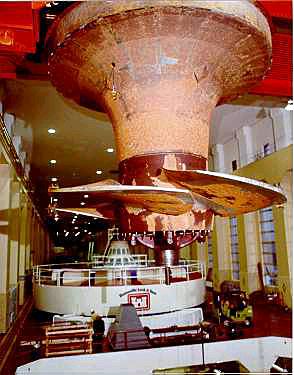
Dam turbines damaged by bubble collapse. High-speed imaging shows cavitation erosion removes 2mm of steel per year, requiring blade replacement twice as often as designed.
uploaded by Duk, Public domain, via Wikimedia Commons
The Physics of Destructive Bubbles
At the Kapshagai Hydroelectric Power Plant on the Ili River, a peculiar and destructive phenomenon is constantly at work. The plant, commissioned in stages starting in 1970, harnesses the river's energy to generate 364 MW of power. This process, however, creates the conditions for cavitation—a phenomenon where water essentially boils at low pressure and eats away at solid steel.
As water accelerates through the plant's turbines, likely Kaplan-type turbines common for this kind of dam, the local pressure can plummet. If the pressure drops below water's vapor pressure, the liquid spontaneously forms tiny vapor-filled bubbles, or cavities. These bubbles are fleeting. As they are swept into areas of higher pressure just milliseconds later, they collapse with incredible violence. The implosion of each bubble generates a powerful micro-jet of water and a shockwave, hammering the turbine blades with immense localized force.
A 2mm Per Year Problem
The cumulative effect of these microscopic implosions is substantial. The constant hammering causes surface fatigue and pitting on the turbine blades, a type of damage known as cavitation erosion. At Kapshagai, this erosion is reported to remove up to 2 millimeters of steel from the turbine blades each year. This rate of material loss is significant, forcing the plant to replace the massive turbine runners twice as frequently as their original design specifications intended.
This accelerated wear schedule has major operational consequences. It reduces the turbine's efficiency, increases vibrations throughout the machinery, and generates a distinct noise often described as sounding like gravel passing through the system. Each time a turbine is taken offline for repair, the plant faces costly downtime. To combat this, maintenance involves extensive repairs, often by welding new material onto the damaged areas and grinding it back to the precise, original blade profile. Researchers use high-speed imaging and computational fluid dynamics to study the bubble dynamics in detail, hoping to inform new blade designs or protective coatings that can better withstand the relentless attack of bubble collapse.
💡Fun Facts
The shockwaves from a collapsing cavitation bubble can produce localized pressures of several hundred megapascals.
Severe cavitation in turbines or pumps can produce a loud, distinct noise often compared to pumping rocks or gravel.
Cavitation is not limited to dams; it is a significant problem for ship propellers, pump impellers, and even some medical devices like artificial heart valves.
The Kapshagai Reservoir, created by the dam in 1970, is one of the largest in Kazakhstan, with a surface area of 1,847 square kilometers.
The Kapshagai Hydroelectric Power Plant is an active industrial facility and is not open to the public for tours. The surrounding Kapshagai Reservoir is a popular recreation area.
Admission
Free to view the dam and reservoir from public areas.
Accessibility
The dam can be viewed from nearby public roads. The terrain around the reservoir's beaches and recreational areas varies.