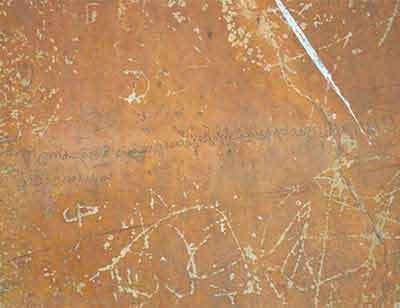
A polished plaster wall so reflective it once mirrored the rock fortress. Visitors from the 6th-14th centuries scratched over 1,800 poems and messages into it, creating the world's oldest known graffiti archive.
RomeshD, CC BY-SA 3.0
A wall that reflects history
Along the western face of the Sigiriya rock fortress, about 100 meters above the ground, runs a unique brick parapet. This is the Mirror Wall, or Katapath Paura. Constructed in the 5th century CE under King Kashyapa, its surface was made from a special plaster containing fine lime, egg whites, and honey, which was then polished with beeswax to a brilliant sheen. The finish was so reflective that it mirrored the famous frescoes of celestial women painted on the rock face opposite. Today, only about 100 meters of the original 200-meter wall remains, but its remarkable luster is still visible after more than 1,500 years.
The wall's construction shows advanced engineering. Builders carved niches into the near-vertical rock to support the brickwork and angled the bricks slightly inward, using the structure's own weight to press it against the rock face for stability.
Voices from a thousand years ago
Between the 6th and 14th centuries, visitors to the abandoned fortress were compelled to record their thoughts on the wall's polished surface. These inscriptions, known as the Sigiri graffiti, are the earliest known examples of poetry in the Sinhala language. Over 1,800 individual pieces of graffiti have been identified, written in an early form of the Sinhala script which evolved from Brahmi.
The writers came from all levels of society, including monks, nuns, officials, and artisans. Their verses are short, often witty and emotional, frequently address the painted figures of women on the rock face. The themes range from admiration and longing to jealousy and philosophical reflection. One female visitor wrote: "A deer-eyed maiden of the mountain side arouses anger in my mind. In her hand she holds a string of pearls, And in her eyes she assumes rivalry with me…"
The pioneering work of archaeologist Senarath Paranavithana in the mid-20th century helped researchers understand this ancient archive. He deciphered and published 685 of the most complete verses in his two-volume work, "Sigiri Graffiti". Later scholarship by Benille Priyanka added another 800 shorter or incomplete inscriptions to the record. Together, these writings record language development and the personal responses of people who lived a millennium ago.
💡Fun Facts
The special plaster that gave the wall its sheen was a mix of lime, egg whites, and honey, polished with beeswax.
The graffiti includes some of the earliest and most extensive examples of vernacular poetry in South Asia.
Some verses are complaints; one woman expresses jealousy toward a painted figure who she feels is flirting with her husband.
To preserve the ancient inscriptions, adding new graffiti to the wall has been prohibited since the mid-20th century.
The site is open daily from 5:00 AM to 6:30 PM. The ticket counter closes at 5:00 PM.
Admission
US$ 35 for foreign adults, which includes museum entry. Prices vary for SAARC nationals and local tourists.
Accessibility
The site is not wheelchair accessible. Reaching the Mirror Wall requires climbing approximately halfway up the rock fortress, which has around 1,200 steep steps in total to the summit.