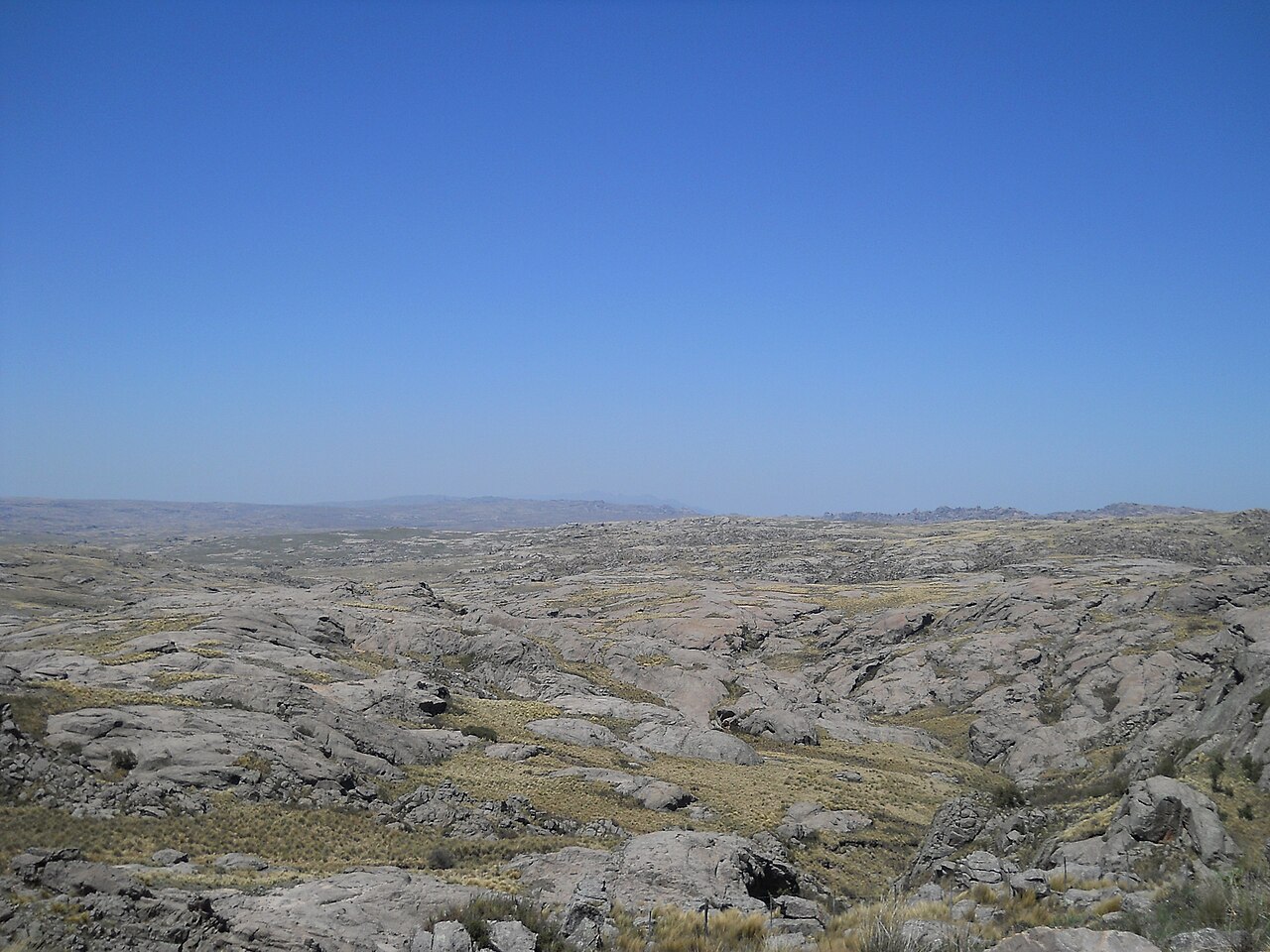
Distinctive rounded boulder landscapes form where granite weathers along joint patterns. Cosmogenic isotope dating shows boulders have remained exposed for 100,000 years during climate cycles.
Arianza1, CC BY 3.0, via Wikimedia Commons
A landscape shaped underground
The striking boulder-strewn fields of the Sierras de Córdoba are the product of a two-stage process that begins deep underground. The bedrock is predominantly a Paleozoic-era granite, part of the large Achala batholith, which formed hundreds of millions of years ago. This granite is not a uniform mass. It is crisscrossed by a network of fractures called joints, which formed as the molten rock cooled or from later tectonic stresses associated with the rise of the Andes mountains. These joints create a grid of rectangular blocks, led to for the weathering process.
Water seeps down through the soil and into these joints, initiating a form of chemical decay known as spheroidal weathering. The water chemically alters minerals in the granite, particularly feldspar, turning them into clay. This process attacks the rock blocks from all sides, but it is most effective at the corners and edges, which have a greater surface area. Over immense periods, the sharp angles are chemically weathered away, and the rectangular blocks are sculpted into rounded, onion-like forms called corestones, all while still buried beneath the surface. The heavily weathered, decomposed rock surrounding the corestones is called saprolite.
A clock made of cosmic rays
The second stage of this landscape's creation happens when physical erosion strips away the soft, decomposed saprolite, exposing the hard, unweathered granite corestones. This leaves behind the fields of rounded boulders, or "berrocales," that define high-altitude areas like the Pampa de Achala. To understand how long these boulders have been sitting on the surface, scientists use a technique called cosmogenic nuclide dating.
Earth is constantly bombarded by high-energy cosmic rays. When these rays strike atoms within the top few centimeters of exposed rock, they can trigger nuclear reactions that create extremely rare isotopes, such as Beryllium-10 (¹⁰Be) and Aluminum-26 (²⁶Al). These isotopes are produced at a known, slow rate. By measuring the concentration of ¹⁰Be and ²⁶Al in the quartz crystals of a granite boulder, scientists can calculate how long that rock surface has been exposed to the sky.
Studies in the Sierras de Córdoba show that many of these granite surfaces have exposure ages exceeding 100,000 years. This indicates an incredibly slow rate of erosion and a remarkably stable landscape. These boulders have remained in place, largely unchanged, through multiple cycles of Ice Age glaciations and warmer interglacial periods, recording the deep geological time of central Argentina.
💡Fun Facts
The Spanish term for this type of boulder-strewn landscape is "berrocal."
The Pampa de Achala, a high plain within the Sierras de Córdoba, sits at an altitude between 1,900 and 2,300 meters (6,200 to 7,500 feet).
The Quebrada del Condorito National Park was established in the region in 1996 to protect the unique biodiversity, including a major population of Andean condors.
The granite of the Achala batholith is notably high in certain elements like fluorine, rubidium, and uranium.