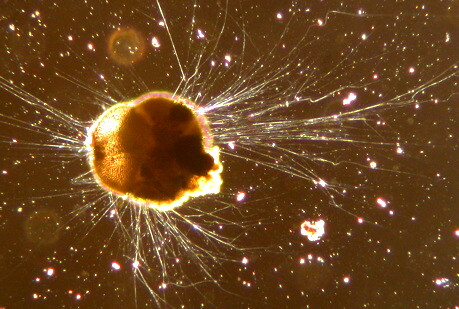
These single-celled organisms build elaborate shells that accumulate on the ocean floor. Their fossils are so abundant and climate-sensitive that oil geologists use them to date rock layers and paleoclimatologists reconstruct ancient climates.
Scott Fay, CC BY 2.5, via Wikimedia Commons
Earth's climate archivists
In the sunlit upper layers of the ocean live countless single-celled organisms called planktonic foraminifera. These protists, a type of amoeba, construct shells, called "tests", primarily from calcium carbonate (CaCO₃). When these organisms die, their tiny shells, typically less than 1 millimeter in size, sink to the ocean floor. Over millions of years, these tests accumulate in thick layers, forming a sediment known as calcareous ooze. This ooze eventually solidifies into limestone and chalk, recording Earth's past climate.
Scientists retrieve this record by drilling long cylinders of sediment, called cores, from the deep ocean floor. International collaborations like the International Ocean Discovery Program (IODP) and its predecessors have collected kilometers of these cores from across the globe. Within these cores, the layers of foraminifera shells provide a high-resolution timeline stretching back over 100 million years. By analyzing the shells in each layer, researchers can reconstruct past environmental conditions with remarkable precision.
Reading the chemical clues
The chemical composition of a foraminifera shell shows the ocean water in which it formed. a common tool for paleoclimatology is the analysis of oxygen isotopes within the calcite (CaCO₃) of the shells. Oxygen comes in two main stable forms: a lighter isotope, Oxygen-16 (¹⁶O), and a heavier one, Oxygen-18 (¹⁸O). Water molecules containing the lighter ¹⁶O evaporate more readily from the ocean surface.
During colder climatic periods, or ice ages, this evaporated water falls as snow and becomes trapped in massive continental ice sheets. This process removes large quantities of ¹⁶O from the oceans, leaving the remaining seawater enriched with the heavier ¹⁸O. Foraminifera building their shells at this time incorporate this higher ratio of ¹⁸O. Conversely, during warmer periods with less global ice, the ¹⁶O returns to the oceans through meltwater, and the shells reflect a lower ¹⁸O to ¹⁶O ratio. By measuring this ratio in fossil shells from a deep-sea core, scientists can track the waxing and waning of ice ages through geologic time.
These tiny fossils are important for commercial geology. The rapid evolution and wide distribution of planktonic foraminifera make their fossils excellent "index fossils". Oil exploration companies rely on identifying specific foraminifera species in drill cores to determine the precise age of rock layers. This biostratigraphy helps them correlate rock formations between different drill sites and locate oil-bearing strata.
💡Fun Facts
The building blocks for the Great Pyramid of Giza are limestone blocks composed almost entirely of the fossilized shells of a large, coin-shaped foraminifera called *Nummulites*.
While most foraminifera are microscopic, some deep-sea benthic (seafloor-dwelling) species are giants, growing up to 20 centimeters (8 inches) in diameter.
The name "foraminifera" is Latin for "hole bearers," referring to the pores and openings (foramina) that connect the chambers of their shells.
When foraminifera die and their shells blanket the seafloor, they create a sediment called calcareous ooze; this covers about one-third of the Earth's surface.
The ocean floor is always open, but access to the physical sediment cores is restricted to researchers through programs like the IODP. Core repositories have specific operating hours.
Admission
Not applicable for direct visitation. Sample requests for scientific research can be made through the IODP.
Accessibility
The deep North Atlantic is not accessible to the public and requires a scientific drilling vessel like the JOIDES Resolution.