A Magmatic Intrusion Below the Coast
The ground beneath San Vincenzo and the surrounding Tuscan coast is unusually hot. This thermal anomaly is caused by a large body of granitic rock, or a pluton, that pushed its way into the Earth's crust during the Pliocene and Pleistocene epochs. This mass of molten rock never reached the surface to become a volcano. Instead, it stalled at a shallow depth, with its top estimated to be just 3 to 6 kilometers below ground. As this intrusion has slowly cooled over the last 1.6 to 4.5 million years, it has released an immense amount of heat into the surrounding rocks.
This process creates an extremely high geothermal gradient, a measure of how quickly temperature increases with depth. While a typical continental gradient is around 25-30°C per kilometer, here it can be much higher. The heat flow to the surface in this region can exceed 200 milliwatts per square meter (mW/m²), with some localized spots reaching over 1000 mW/m². This is substantially higher than the average heat flow for continental crust, which is about 60-70 mW/m². The intrusion baked the surrounding metamorphic rocks at temperatures around 650°C, fundamentally altering their structure.
Geothermal Fields and Seismic Clues
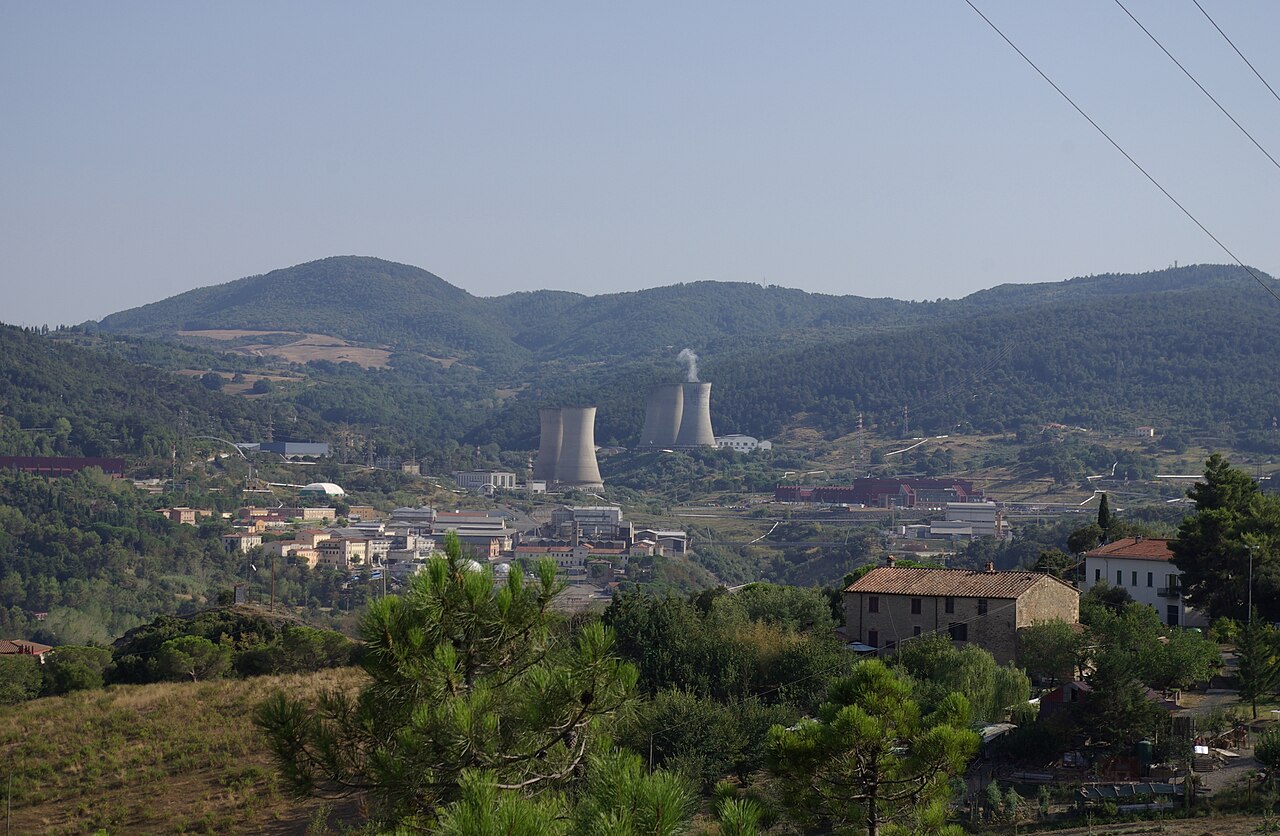
This intense subterranean heat source powers the famous Larderello-Travale geothermal field, located just southeast of San Vincenzo. This area is the birthplace of geothermal power generation; the first successful experiment to produce electricity from geothermal steam happened here in 1904, lighting five bulbs. By 1913, the world's first commercial geothermal power plant was in operation at Larderello. Today, dozens of plants in Tuscany tap into this natural heat reservoir, drilling deep wells to extract super-heated steam that drives turbines. The deep reservoirs contain steam with temperatures of 300–350°C.
Geologists map this hidden magma body using seismic data. A distinct seismic reflector, known as the K-horizon, is present at depths of 3 to 6 kilometers throughout the region. This horizon marks the top of the hot, fractured rock layer associated with the granitic intrusion. Seismic waves, particularly shear waves (S-waves), slow down significantly when they pass through this zone, which indicates the presence of partially molten or ductile rock. This "low-velocity zone" is an important piece of evidence that delineates the size and depth of the cooling pluton.