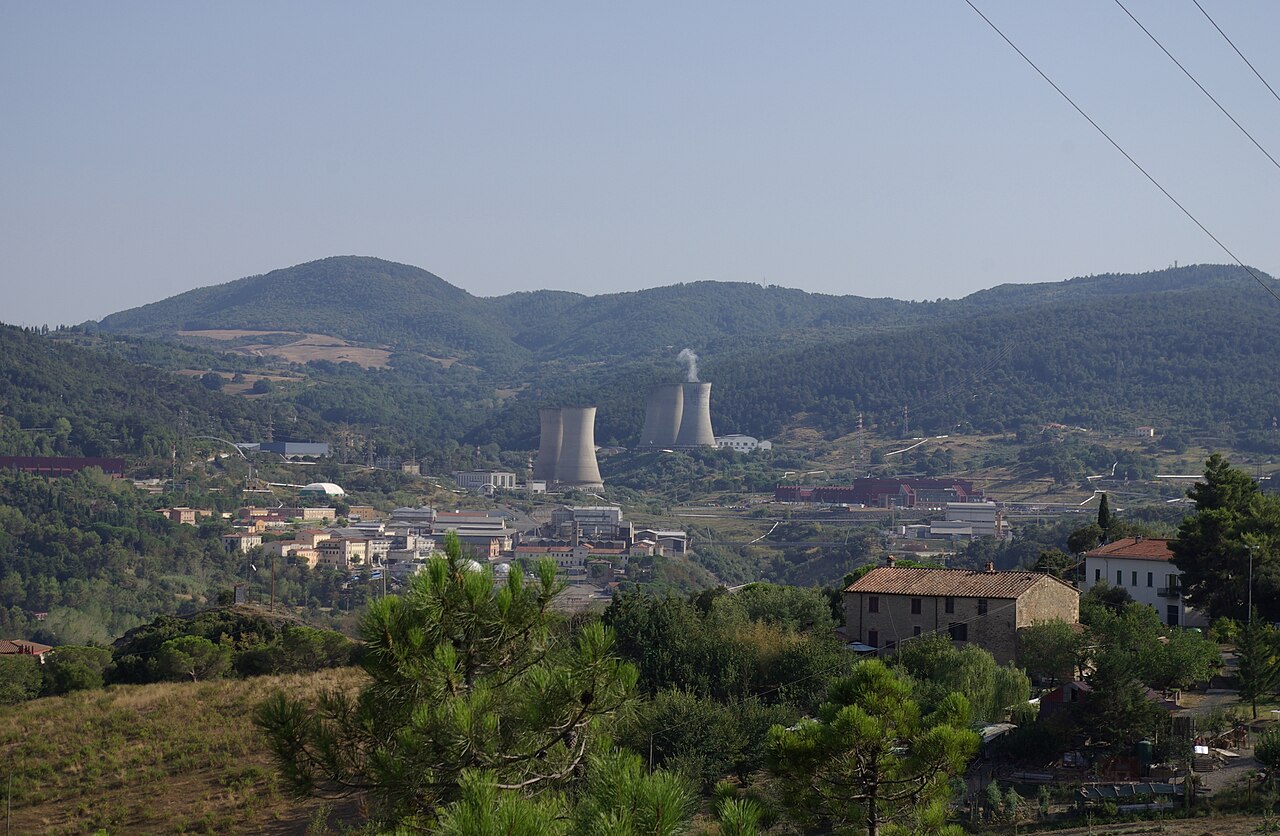
The Devil's Valley gives birth to an industry
The Larderello geothermal field is the birthplace of the world's geothermal power industry. On July 4, 1904, Prince Piero Ginori Conti used steam emerging from the ground to power a small dynamo that successfully lit five light bulbs. This experiment was the first practical use of geothermal electricity. Following this success, the first commercial geothermal power plant was completed here in 1913 with a capacity of 250 kW. It supplied electricity to the Italian railway system and the nearby towns of Larderello and Volterra.
Long before electricity generation, the area was known for its natural steam vents (soffioni) and boiling mud puddles (lagoni). The area, with its hissing steam and sulfurous smells, earned it the name "Valle del Diavolo" (Devil's Valley). This dramatic scenery likely influenced Dante Alighieri's depiction of Hell in his "Inferno". The industrial history of the area began in 1818, when French engineer François Jacques de Larderel, for whom the town is named, developed a method to extract boric acid from the hot springs. The geothermal steam itself was first used in 1827 to heat the evaporation vats, replacing wood-fired boilers.
The geology of a superheated system
The Larderello field is a vapor-dominated hydrothermal system, where the reservoir contains superheated steam rather than hot water. The heat source is a young granitic intrusion, a mass of cooled magma that sits at a depth of approximately 6 kilometers. This intrusion heats the overlying rocks and fluids. The main geothermal reservoir is located in carbonate and evaporite formations from the Triassic period, as well as a deeper reservoir in a fractured metamorphic basement. Modern wells are drilled to depths of up to 4,000 meters to tap into this deep reservoir, where temperatures can reach 300–350°C and pressures up to 70 bar.
The steam is primarily water (>90%) but contains other gases, including carbon dioxide (CO2), methane (CH4), hydrogen sulfide (H2S), and ammonia (NH3). It also carries boric acid (H3BO3), the compound that was the basis of the region's first industry. Today, the Larderello complex consists of 34 power plants operated by Enel Green Power. Total installed capacity is around 800 MWe, which meets over 33% of Tuscany's electricity needs. The steam is also used directly for district heating, warming greenhouses, and powering local businesses, including a craft brewery.