An ocean of fish
When the explorer John Cabot arrived off Newfoundland in 1497, he reported waters so full of Atlantic cod (Gadus morhua) that they could be caught by lowering a weighted basket into the sea. For nearly five centuries, the Grand Banks and adjacent waters like the Saint Pierre Bank were among the world's most productive fishing grounds, fueling the economies of Europe and North America. The fishery was so productive that it was widely seen as inexhaustible.
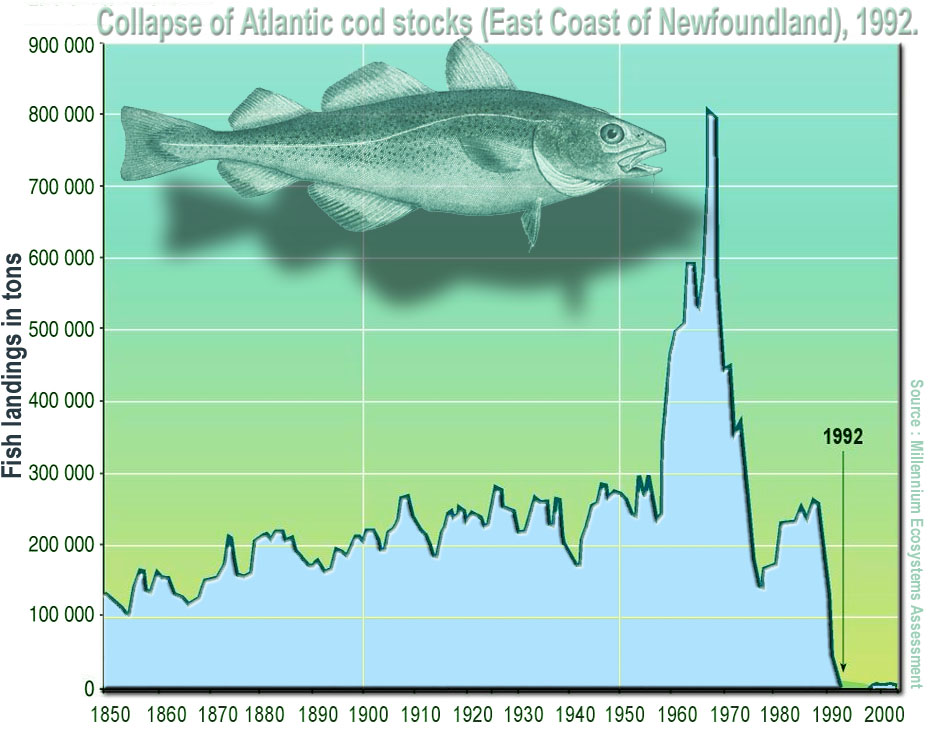
This perception of endless abundance began to unravel after the 1950s. The introduction of industrial-scale fishing technology created a fleet capable of catching fish far faster than nature could replenish them. Large factory freezer trawlers, floating processing plants, could stay at sea for weeks. Equipped with powerful sonar to locate schools and massive nets called otter trawls that scraped the seabed, these vessels dramatically increased the annual catch. The cod harvest skyrocketed to a peak of 810,000 tonnes in 1968 before falling steeply as the population buckled under the pressure.
The silent collapse
On July 2, 1992, the Canadian government took a drastic step, announcing a moratorium on all northern cod fishing. Scientific surveys revealed a catastrophic decline: the spawning biomass, the total weight of fish able to reproduce, had fallen by over 97% from its historical levels. In what became the largest single mass layoff in Canadian history, more than 35,000 fishers and plant workers in over 400 coastal communities lost their jobs overnight. The two-year ban was extended indefinitely as the scale of the ecological disaster became clear.
The cod disappearance triggered a cascade of changes in the ocean ecosystem. As the top predator vanished, populations of its prey, such as snow crab and northern shrimp, exploded. This created a new, valuable shellfish industry, but it also fundamentally altered the food web. These newly abundant crustaceans and small fish now prey on juvenile cod, creating an ecological trap that has hindered the stock's recovery. More than thirty years after the moratorium, the northern cod population is a small fraction of its former size, and the ecosystem has shifted to a new state where cod are no longer the dominant species.