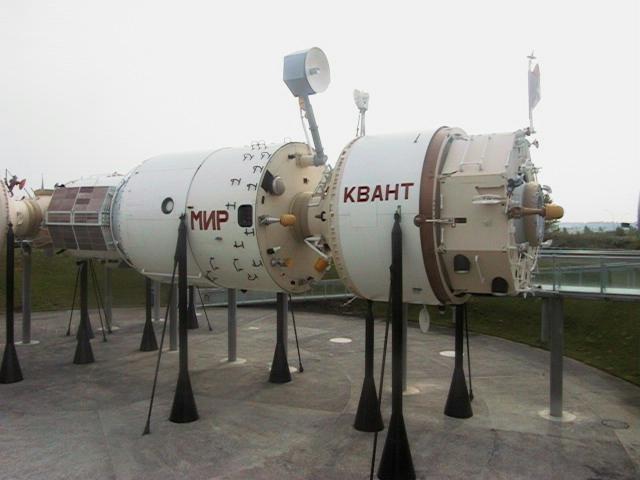
A terrestrial twin
The centerpiece of the Cité de l'Espace gardens is a full-scale model of the Mir space station. While the original station famously re-entered Earth's atmosphere in 2001, this exhibit is no simple replica. It is a "terrestrial twin"—an authentic engineering model built by the Khrunichev State Research and Production Space Center. These modules were used to test materials, electronics, and interior equipment layouts before the flight-ready components were sent into orbit.
Inside, you can move through the core module, the Kvant-2 scientific module, and the Kristall technological module. The interior is a faithful reconstruction of the cramped environment where cosmonauts lived and worked for fifteen years. Authentic objects loaned by the French space agency, CNES, complete the scene. These include a space exercise bike used for physical conditioning and components from the "FERTILE" experiment, which studied amphibian embryonic development in microgravity. The entire installation shows the station as it was configured between 1990 and 1995.
Rockets and rovers
The gardens contain several other full-scale space hardware exhibits. A 53-meter-tall model of an 53-meter-tall model of an Ariane 5 rocket, the workhorse of the European Space Agency for decades. This heavy-lift launcher could carry over 20 tonnes into low Earth orbit and was deployed major scientific instruments like the James Webb Space Telescope.
Visitors can also inspect a Soyuz spacecraft, the Russian vehicle for transporting crews to and from orbit. Nearby are models of the Apollo Lunar Module and a Chinese Chang'e lunar rover. A reconstructed Martian landscape features life-sized replicas of the Perseverance and Zhurong rovers, the robotic explorers currently investigating the red planet. The indoor exhibitions cover 4,000 square meters and contain genuine celestial artifacts, including a 163-gram lunar sample brought to Earth by the Apollo 15 mission and a meteorite confirmed to have originated from Mars.