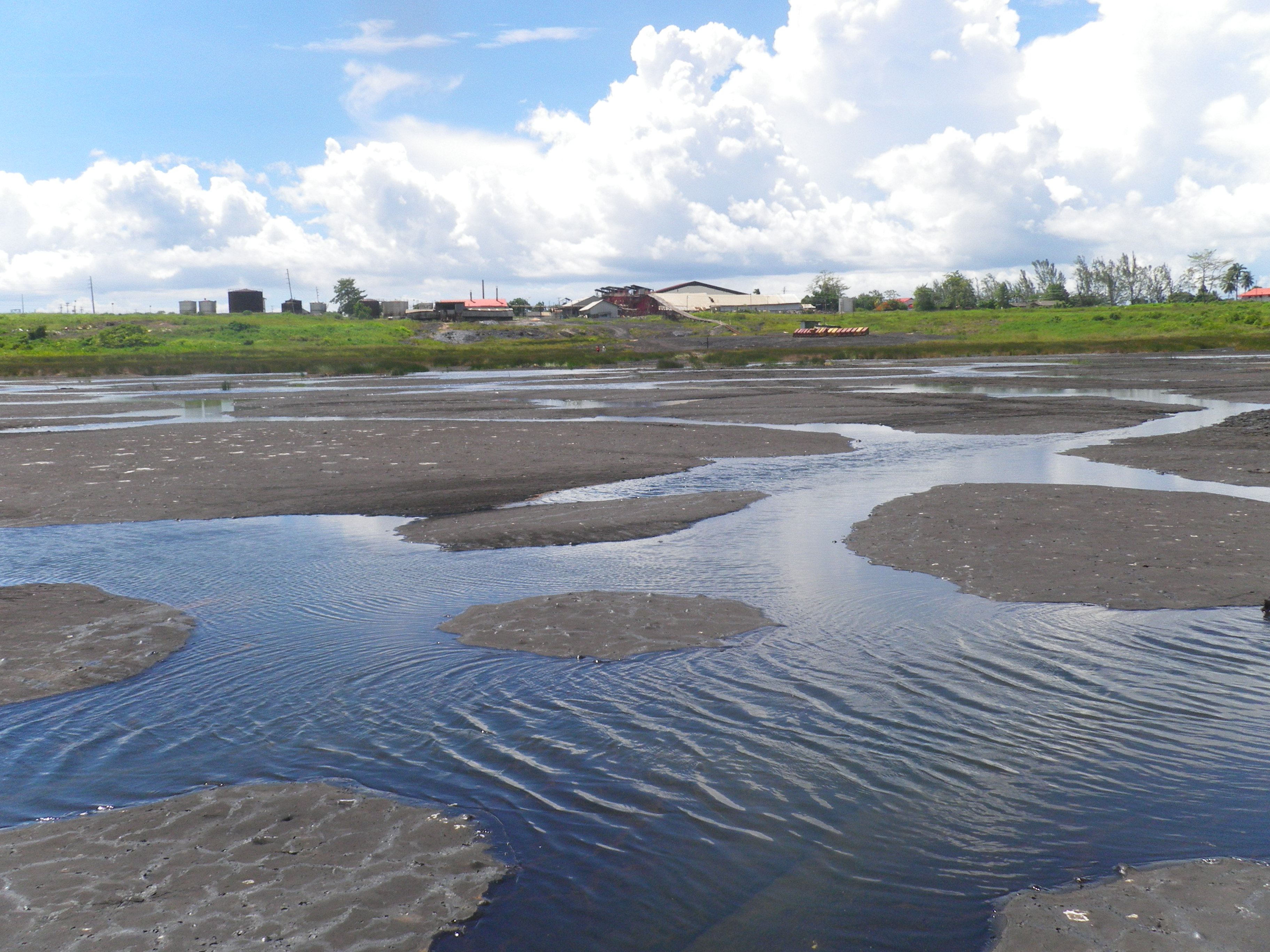
A life-sustaining tar pit
The Pitch Lake in La Brea is the world's largest natural deposit of asphalt, covering about 100 acres (40 hectares) and reaching a depth of around 250 feet (76 meters). The surface is a strange, semi-solid expanse of black, viscous asphalt that can be walked upon, though standing still for too long might cause you to sink slowly. Bubbles of hydrocarbon gases and carbon dioxide constantly rise to the surface, a sign of the geological and biological activity below.
This seemingly toxic environment, full of hydrocarbons, was long thought to be sterile. Scientific investigations revealed the opposite: an active microbial ecosystem thrives within the asphalt. Life exists inside minuscule droplets of water, which are trapped within the hydrocarbon matrix. These microbes, a mix of bacteria and archaea, are found in surprisingly high densities, with populations reaching between 10 million and 100 million cells per gram of asphalt. Many of these species are novel to science, adapted to this extreme habitat. They survive without oxygen by feeding on hydrocarbons and respiring using metals, a process known as anaerobic metabolism.
Earthly analogue for Titan
The discovery of a self-sustaining ecosystem in a hydrocarbon-rich environment has significant implications for astrobiology. Saturn's largest moon, Titan, is covered in lakes and seas of liquid methane and ethane. While its surface temperature of around -180 degrees Celsius is far colder than Pitch Lake, the Trinidadian ecosystem is a terrestrial analogue for how life might function in a non-water-based, hydrocarbon solvent.
NASA-supported researchers study Pitch Lake to understand the absolute limits of life and to model the biotic potential of Titan's hydrocarbon lakes. The microbes in Pitch Lake demonstrate that a hydrophobic environment is not a barrier to life. It suggests that if geothermally active areas exist on Titan, warming the hydrocarbon reservoirs from below, conditions could potentially support microbial growth. The unique metabolisms of the Pitch Lake extremophiles—consuming hydrocarbons and breathing metals—show what astrobiologists might look for when searching for life on other worlds. The study of these novel archaea and bacteria gives scientists insights into the possible adaptation mechanisms for any putative life on Titan.