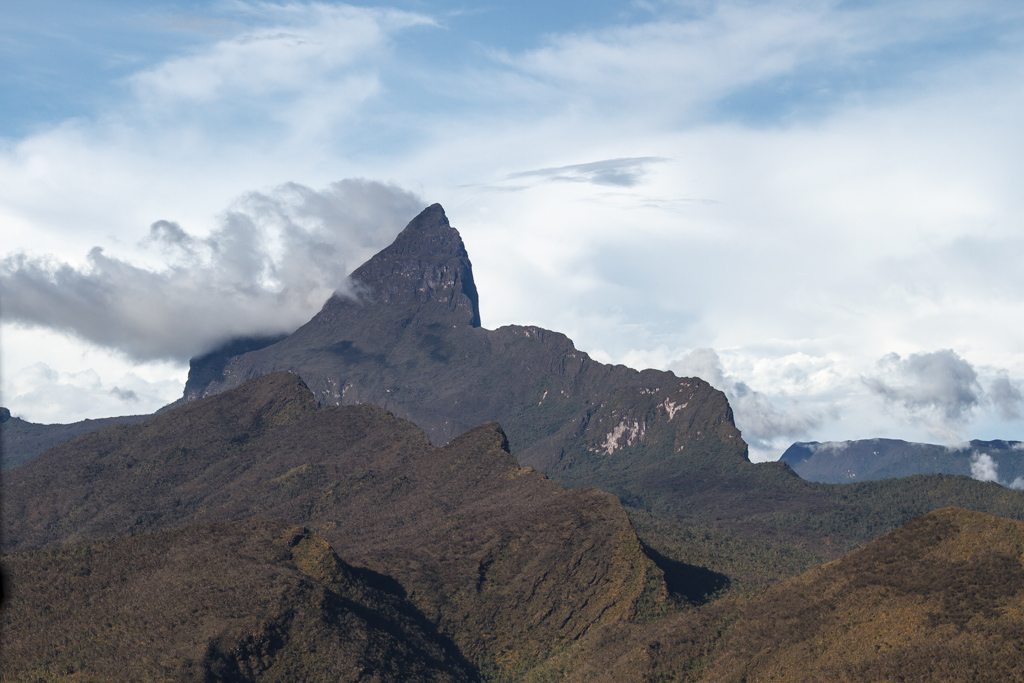
The Mountain of Mists
Pico da Neblina, which translates to "Peak of the Mists," is Brazil's highest mountain, reaching 2,995.3 meters above sea level. Located in the Imeri mountain range within the Guiana Highlands, its summit sits entirely within Brazil, just 687 meters from the Venezuelan border. The mountain is composed of Precambrian sandstone, part of the ancient Guiana Shield geological formation. This structure rises abruptly from the Amazonian lowlands, which are only about 100 meters above sea level, to a base of 2,000 meters before the final sharp peak ascends into the clouds.
The peak’s existence was not widely known until the 1950s, and its status as Brazil's highest point was only confirmed in 1965 after an expedition by the Brazilian Army. Before this, Pico da Bandeira was considered the nation's tallest mountain. The name is fitting, as the summit is shrouded in dense clouds for most of the year. The indigenous Yanomami people, who have inhabited this land for centuries, call the mountain Yaripo, meaning "Place of the Winds". The entire area is protected within the Pico da Neblina National Park, which, combined with adjacent parks in Venezuela, forms one of the largest protected tropical rainforest areas in the world, covering about 80,000 square kilometers.
A Biological Island in the Sky
The extreme altitude and long-term isolation of Pico da Neblina have created a unique biological laboratory. The summit is a "sky island," an ecosystem separated from the surrounding lowlands, leading to high rates of endemism. The flora and fauna on its slopes and summit have evolved independently for millions of years. This results in a collection of plants and animals found nowhere else on Earth.
The mountain's slopes transition from dense rainforest to high-altitude cloud forests and meadows. These upper zones harbor specialized species adapted to the misty and nutrient-poor conditions. Among the endemic plants are carnivorous species like Heliamphora neblinae, Drosera meristocaulis, and Heliamphora ceracea. Recent expeditions continue to discover new life. In 2017, scientists found two new families of frogs near the summit. One, a tiny brown frog just 2 centimeters long, was named Neblinaphryne mayeri. The primate, the Neblina uakari (Cacajao hosomi), and amphibians like Stefania neblinae are also exclusive to this environment.