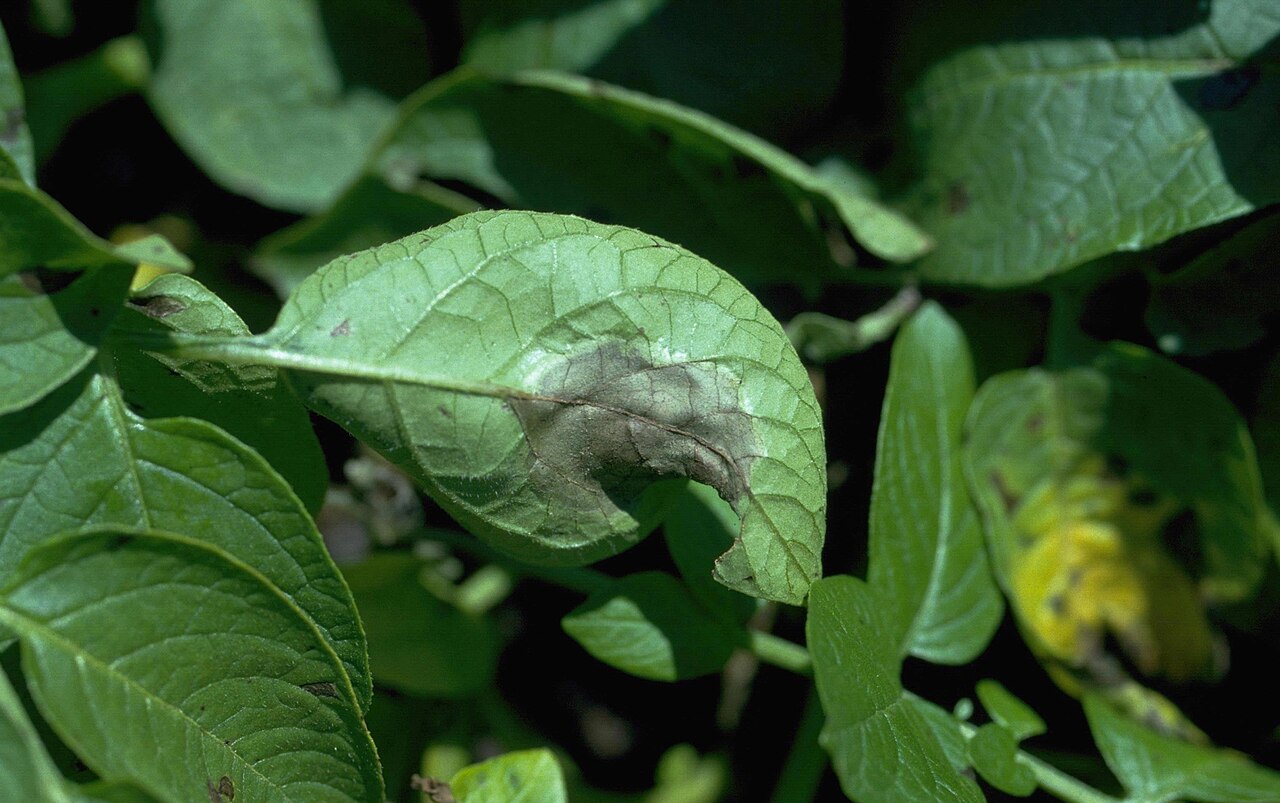
The water mold (not a fungus) that caused the Irish Potato Famine, killing a million people. It spreads via swimming zoospores in wet conditions and evolves rapidly to overcome plant resistance, remaining a major crop threat worldwide.
Howard F. Schwartz, Colorado State University, United States, CC BY 3.0 us, via Wikimedia Commons
The plant destroyer
The organism that triggered the Great Famine is Phytophthora infestans. Its name comes from Greek roots: phyton for "plant" and phthora for "destruction" or "decay". It is not a fungus but an oomycete, or water mold. Oomycetes are more closely related to brown algae and diatoms. A major difference is in their cell walls, which are made of cellulose, like plants, rather than the chitin found in fungi. Their vegetative state is diploid, meaning their cells contain two sets of chromosomes, whereas fungi are typically haploid.
P. infestans spreads with remarkable speed. Under cool, moist conditions—temperatures above 10°C (50°F) and humidity over 75%—its asexual life cycle can complete in about five days. It produces structures called sporangia, which are dispersed by wind and rain. In cool water, a single sporangium can release multiple motile zoospores. These biflagellate spores, equipped with two distinct flagella, swim through water films on leaves to find an infection site. Once attached, they penetrate the plant tissue, causing the dark lesions of late blight. The pathogen can also infect tubers, which may rot in the ground or later in storage.
A famine of monoculture
The Great Famine began in 1845 and lasted until 1852. The blight's arrival in Ireland was devastating due to a near-total reliance on a single potato variety: the "Irish Lumper". This potato grew well in poor soils and produced high yields, making it a staple food for a third of the population. The Lumper was highly susceptible to P. infestans, and its clonal propagation meant there was no genetic diversity to resist the pathogen.
The blight spread rapidly, wiping out up to half the potato crop in 1845 and nearly all of it in subsequent years. The results were catastrophic. In a population of over 8 million, about one million people died from starvation and related diseases like typhus and cholera. Over a million more emigrated, often on crowded and disease-ridden "coffin ships," beginning a massive population decline that would last for decades. The worst year was 1847, known as "Black '47". Today, the pathogen continues to be a global threat, causing an estimated $6.7 billion in annual crop losses and control costs worldwide. Its ability to rapidly evolve new strains, some with fungicide resistance, makes it a persistent challenge for agriculture.
💡Fun Facts
The name *Phytophthora infestans* literally means "the infesting plant-destroyer".
It is more closely related to kelp and diatoms than to true fungi.
Under cool conditions, its spores grow two flagella and swim through water on leaves to infect the plant.
The blight remains a major agricultural threat, costing the global economy billions of dollars each year.