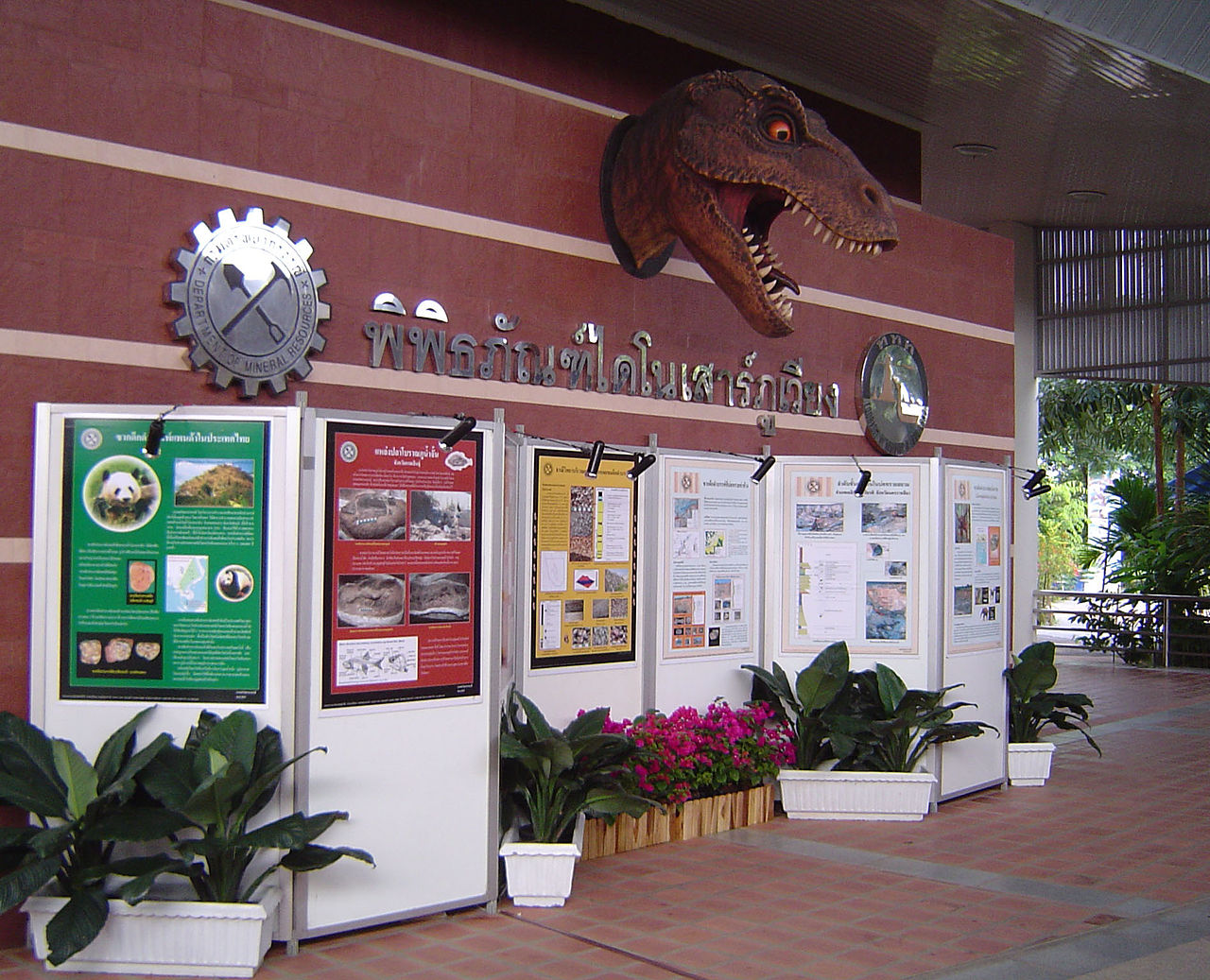
A Fortunate Find
In 1976, geologist Sudham Yaemniyom was surveying for uranium ore in the hills of Phu Wiang when he found a bone fragment on a streambed. It was later identified by French paleontologists as the distal end of a sauropod femur, the first confirmed dinosaur fossil found in Thailand. This accidental discovery triggered decades of paleontological work in the area, leading to the establishment of Phu Wiang National Park in 1992 to protect its fossil wealth. The park now contains nine main excavation sites. Quarry 9 is important for the fossils discovered there.
The fossils of Phu Wiang are embedded in the Sao Khua Formation, a layer of reddish-brown siltstone and sandstone deposited during the Early Cretaceous period. This formation, dating from approximately 133 to 132 million years ago, preserves a record of a floodplain environment crisscrossed by meandering rivers.
The "Tyrant of Siam"
Excavations at Quarry 9 in 1993 uncovered the partial skeleton of a large carnivorous dinosaur. Named Siamotyrannus isanensis in 1996, the find consisted of a left hip, five rear back vertebrae, a sacrum, and thirteen tail vertebrae. The generic name means "Siamese tyrant," and the specific name "isanensis" refers to the Isan region of northeastern Thailand where it was found.
Initially, Siamotyrannus was thought to be an early ancestor of Tyrannosaurus rex. More recent analyses place it within a group of carnosaurs called Metriacanthosauridae. This theropod measured an estimated 6 to 7 meters in length. Its discovery showed the diversity of large predators in Southeast Asia during the Early Cretaceous.
Other quarries in the park have yielded the bones of Phuwiangosaurus sirindhornae, a titanosauriform sauropod that grew to between 15 and 20 meters long. Its species name honors Princess Maha Chakri Sirindhorn of Thailand for her interest in the country's paleontology. The ecosystem preserved in the Sao Khua Formation also included the spinosaurid Siamosaurus suteethorni and the small ornithomimosaur Kinnareemimus khonkaenensis.