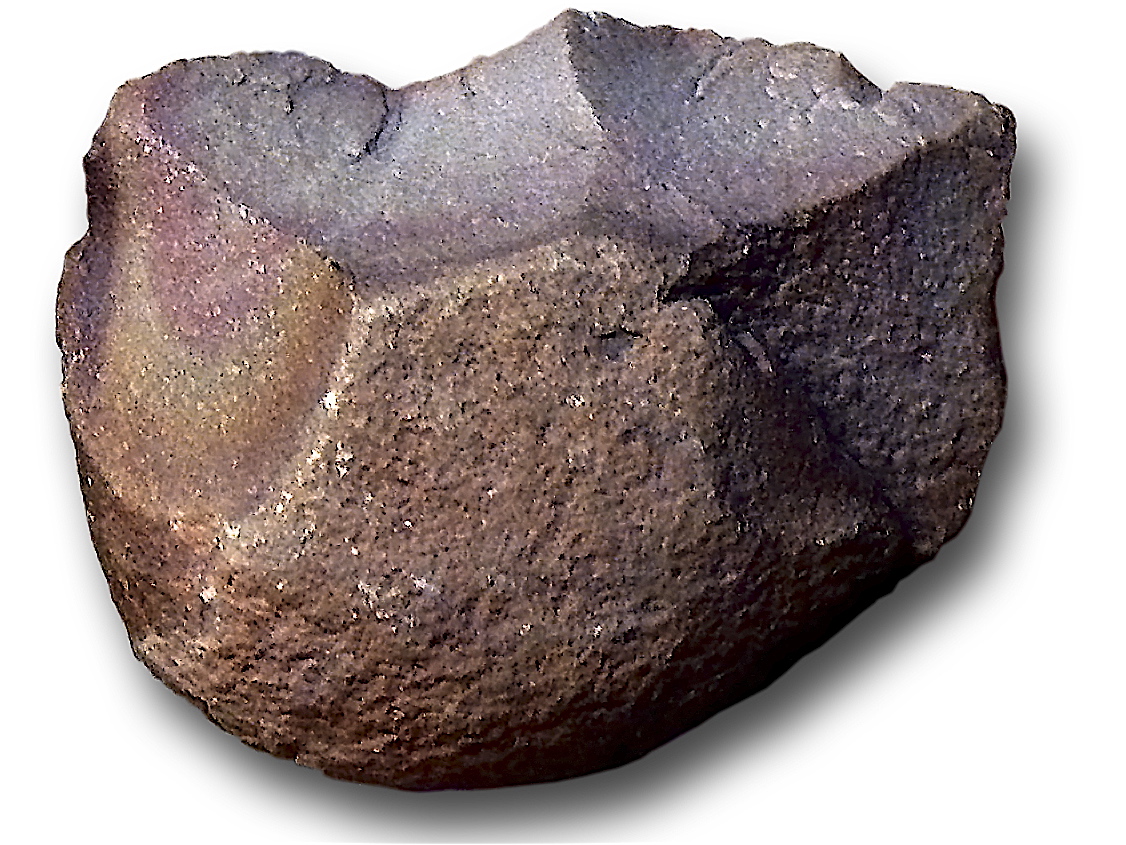
The oldest stone tools on Earth; 2.6 million years old. Flakedcobbles so crude that spotting them required training. Yet they changed everything.
José-Manuel Benito Álvarez (España) —> Locutus Borg, Public domain, via Wikimedia Commons
The first stone knives
In the dry expanse of the Ledi-Geraru research area, sediments hold some of the oldest evidence of systematic tool making. Dated to 2.6 million years ago, these artifacts represent the earliest known Oldowan toolkit. The tools are simple, often just sharp-edged flakes struck from a larger stone core using another rock as a hammer. At the nearby Gona river system, similar assemblages from the same period have been found.
The hominins who made them showed a clear understanding of fracture mechanics. They selected suitable raw materials like trachyte, rhyolite, and basalt, and used a technique called hard-hammer percussion. By striking a core stone at an acute angle, they could detach a flake with a razor-sharp cutting edge. These flakes and not the 'chopper' cores were likely the primary instruments. The entire process was methodical, with knappers often striking multiple flakes from a single core. These artifacts are technologically distinct from, and more advanced than, the more rudimentary 3.3-million-year-old Lomekwian tools found in Kenya.
A butcher's revolution
The appearance of Oldowan tools coincides with changes in the hominin diet and even their anatomy. Fossilized animal bones found with the tools show cut marks, indicating they were used to butcher carcasses and access meat and marrow. This new technology gave early hominins an advantage, allowing them to process large animals and access high-calorie food sources. This dietary shift is thought to be connected to changes in hominin teeth, which became smaller as tools took over some of the processing work.
The identity of the toolmakers is still debated. No hominin fossils have been found in direct association with the oldest Oldowan tools. A 2.8-million-year-old partial jaw of the genus Homo was discovered just a few kilometers away from the Ledi-Geraru tool site, making early Homo a strong candidate. Another possibility is Australopithecus garhi, a species found near other 2.5-million-year-old sites with cut-marked bones. The environment they inhabited was a mix of open grasslands and woodlands, with access to rivers and lakes. This technology was remarkably successful, spreading across Africa and persisting for nearly a million years before the arrival of the more sophisticated Acheulean hand-axes.
💡Fun Facts
Many Oldowan tools are so simple that for years, some archaeologists argued they were indistinguishable from naturally broken rocks.
The name "Oldowan" comes from Olduvai Gorge in Tanzania, where the first examples were found by Mary Leakey in the 1930s.
The sharp flakes were likely the main goal of production, effectively creating the first scalpels for butchering animals like antelopes and even hippos.
For about 900,000 years, the Oldowan toolkit was the dominant technology used by our ancestors across Africa and into Asia and Europe.
The paleoanthropological sites are in a remote, open region and are not formal tourist attractions.
Admission
Access to the specific excavation sites is restricted to permitted research teams.
Accessibility
The terrain is extremely remote, arid, and rugged desert. Travel requires fully-equipped 4x4 vehicles and expert local guides. There are no facilities or paved roads.