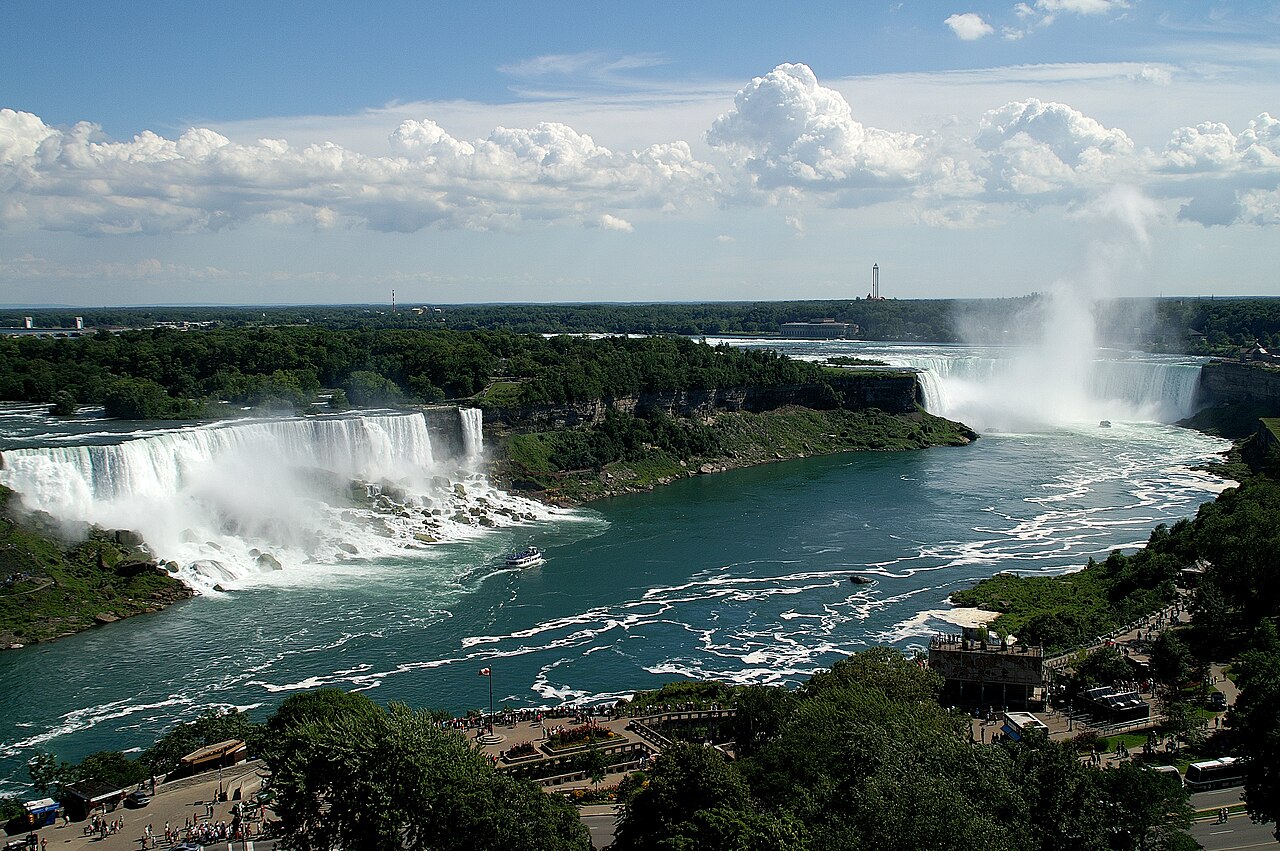
The falls have retreated 11 kilometers upstream since they formed 12,000 years ago. At the current rate of 30cm per year, they will reach Lake Erie in about 50,000 years.
Saffron Blaze, CC BY-SA 3.0, via Wikimedia Commons
A 12,000-year retreat
Niagara Falls is a geologically young formation that began forming around 12,500 years ago as the last ice age ended. As the massive Wisconsin ice sheet melted and receded, it carved out the Great Lakes. Water from the newly formed lakes found an outlet, flowing over the Niagara Escarpment, a steep cliff-like formation, and the first falls were born near modern-day Lewiston, New York, and Queenston, Ontario. Since then, the river has chewed its way 11 kilometers (about 7 miles) upstream to its present location.
The main cause of this retreat is differential erosion. The falls' caprock is a hard layer of Lockport Dolostone, a type of limestone laid down in a tropical sea over 400 million years ago during the Silurian Period. Beneath this hard layer lie softer rocks, primarily the Rochester Shale. The sheer force of the water plunging over the edge scours the softer shale at the base, undercutting the hard dolostone cap. Left without a foundation, massive blocks of the dolostone eventually collapse into the gorge below, and the falls move a step further upstream. This process, repeated over millennia, carved the large Niagara Gorge.
Engineering a slower pace
Historically, the rate of erosion was much faster, averaging around one meter (3 feet) per year. Observers in the 19th century documented retreats of up to 1.5 meters (5 feet) annually. The 20th century saw a significant slowdown in this natural process. The 1950 Niagara Treaty between the U.S. and Canada authorized massive diversions of the river's flow for hydroelectric power generation. Today, between 50% and 75% of the Niagara River's water is redirected through large tunnels to power plants like the Robert Moses Niagara Power Plant in the U.S. and the Sir Adam Beck stations in Canada before being returned to the river downstream.
This diversion has reduced the erosion rate at the Horseshoe Falls to about 30 centimeters (1 foot) per year. Human intervention has also directly addressed the stability of the rock face. In 1969, the U.S. Army Corps of Engineers completely dewatered the American Falls by building a 183-meter (600-foot) cofferdam. This allowed geologists to study the rock face, install steel bolts and cables to stabilize it, and drill drainage holes to relieve hydrostatic pressure. The project concluded that the pile of fallen rock, or talus, at the base of the American Falls actually helps to support the cliff face, so it was left in place.
💡Fun Facts
Before human intervention, Niagara Falls eroded at an average rate of over one meter (3 feet) per year.
In 1969, the American Falls was completely stopped for six months for geological study and stabilization work.
The deep green color of the Niagara River is caused by "rock flour"—finely ground stone and dissolved minerals eroded by the water's force.
The plunge pool below the Horseshoe Falls is incredibly deep, reaching approximately 52 meters (170 feet), which is nearly the same height as the falls itself.
Niagara Falls State Park (USA) and Queen Victoria Park (Canada) are open 24 hours a day, 365 days a year for viewing the falls. Individual attractions have their own seasonal hours.
Admission
It is free to enter both parks to see the falls. Attractions such as the Maid of the Mist boat tour and the Cave of the Winds require tickets.
Accessibility
Paved pathways along the gorge on both sides of the border offer accessible viewing areas. The WEGO bus system in Canada is fully accessible.