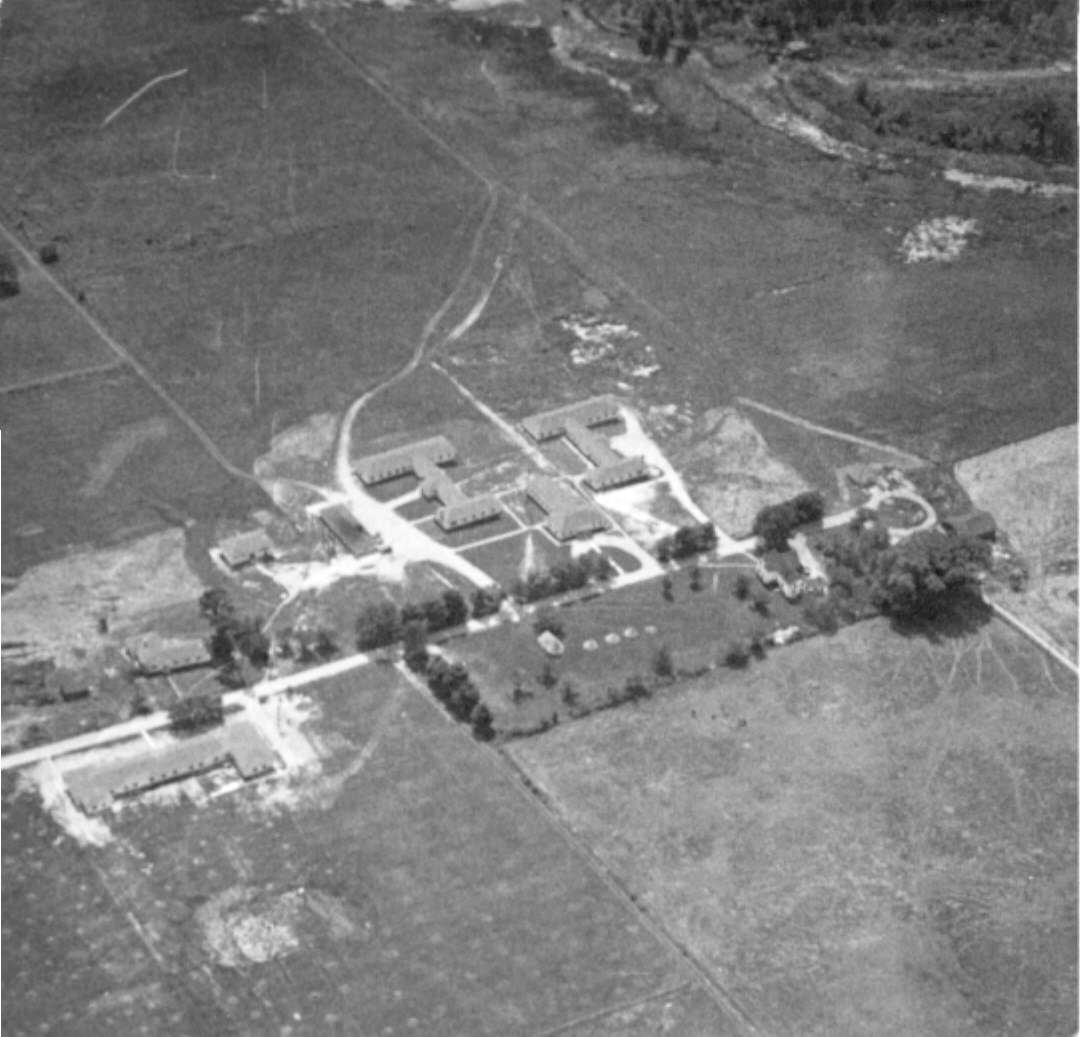
This quiet Canadian park was once Camp X, where Ian Fleming trained as a spy and the technology for sending secret messages directly to Winston Churchill was developed.
Unknown authorUnknown author, Public domain, via Wikimedia Commons
The Hydra Network
Intrepid Park occupies the former site of Camp X, a top-secret installation for Allied covert operations during World War II. Officially known as Special Training School No. 103 (STS 103), its most important scientific contribution was a sophisticated telecommunications center codenamed "Hydra". Established in May 1942, Hydra was the main communications link between British Security Co-ordination (BSC) in New York, London, and Ottawa.
Engineered by Benjamin deForest Bayly, Hydra was a complex radio station. Its main transmitter was a refurbished unit from a former American shortwave station, W3XAU. The system was powerful enough to transmit 30,000 message groups and receive 9,000 daily by mid-1944. This immense volume of traffic included encoded intelligence from Bletchley Park, Britain's famous code-breaking center. To handle this, operators used advanced cryptographic machines like the Rockex, also invented by Bayly, which employed a one-time tape cipher system for secure telegraph transmissions. The location on Lake Ontario was chosen for its excellent topography for receiving radio signals from Europe and South America.
The Science of Espionage
Besides being a communications hub, Camp X provided comprehensive training in the scientific arts of espionage for over 500 agents. The curriculum, which later formed a template for the American Office of Strategic Services (OSS), was a practical application of physics, chemistry, and human psychology. Trainees learned the chemistry of explosives for sabotage, the physics of lock picking, and the technical skills of radio operation and Morse code.
Instructors like William E. Fairbairn taught a brutal form of close-quarters combat based on biomechanics, which he called "gutter fighting". Fairbairn, along with Eric A. Sykes, designed the double-edged Fairbairn-Sykes fighting knife, a weapon engineered for maximum effectiveness in silent killing. Another part of the operation, Station M, located for a time in Toronto's Casa Loma, focused on the production of covert devices. Scientists and technicians there developed items like compasses hidden inside combs and silk scarves printed with detailed maps. The camp's existence was such a well-kept secret that even Canadian Prime Minister William Lyon Mackenzie King was not fully aware of its operations.
💡Fun Facts
The park is named "Intrepid Park" after the telegraphic address of Sir William Stephenson, the Canadian spymaster who established the camp.
Author Ian Fleming, creator of James Bond, was sent to the camp to observe and gain experience in espionage while serving with British naval intelligence.
After the war, the site was used as a safe house for Igor Gouzenko, a Soviet cipher clerk who defected to Canada in 1945 and exposed a Soviet spy ring.
Children's author Roald Dahl and screenwriter Paul Dehn, who co-wrote the screenplay for the James Bond film *Goldfinger*, also trained at Camp X.