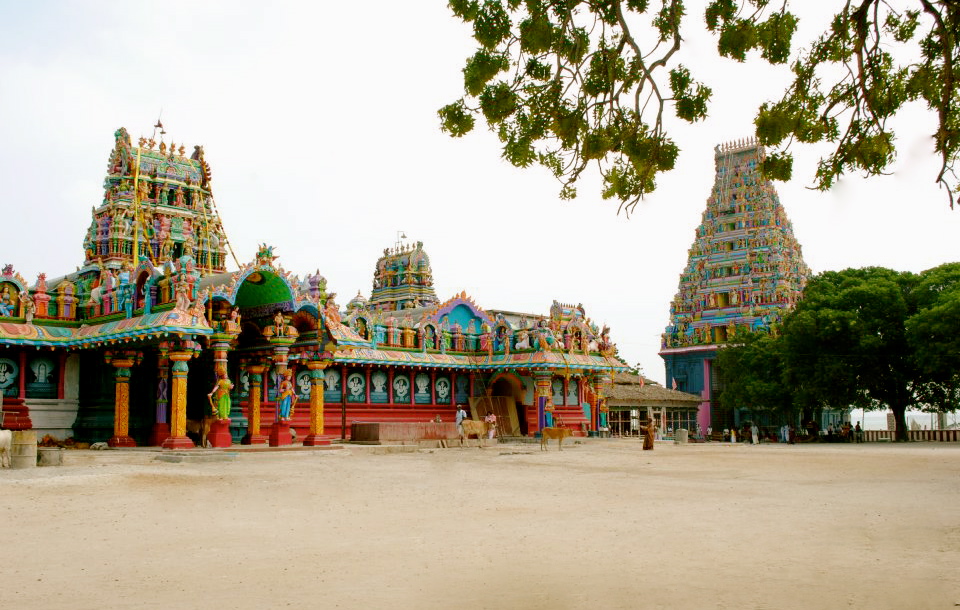
A tiny island hosts both one of Buddhism's 16 sacred sites and an important Hindu temple. The religious geography documents centuries of peaceful coexistence rarely studied academically.
Wikinamaste, CC BY-SA 3.0, via Wikimedia Commons
A shared sacred geography
The island of Nainativu, covering approximately four square kilometers in the Palk Strait, is a place of religious convergence. It contains two of Sri Lanka's most significant pilgrimage sites: the Nagadeepa Purana Viharaya for Buddhists and the Nagapooshani Amman Temple for Hindus. This small landmass, whose name translates to "Island of the Nagas," has a history recorded in ancient texts, including the Tamil epic Manimekalai and the Sinhalese chronicle Mahavamsa.
The Nagadeepa Purana Viharaya is one of the 16 holiest Buddhist sites in Sri Lanka. Its origin is linked to the second visit of the Buddha, which occurred in the fifth year of his enlightenment, around 523 BCE. According to the Mahavamsa, the Buddha journeyed to the island to mediate a war between two Naga kings, Chulodara and Mahodara, who were disputing ownership of a gem-studded throne. After the Buddha's intervention, the pacified kings offered the throne to him. It was later enshrined within the Rajayathana stupa, which is the central point of veneration at the Viharaya.
A short distance away stands the Nagapooshani Amman Temple, a Hindu shrine dedicated to a form of the goddess Parvati. This temple is identified as one of the 64 Shakti Peethams, sacred sites where parts of the goddess Sati's body are believed to have fallen. Specifically, traditions associate this location with the falling of her silambu (anklets). The temple's history is also ancient, with legends stating the original idol was consecrated by the Hindu deity Indra.
Structures of devotion and resilience
The architecture of the two sites reflects their distinct traditions. The Nagapooshani Amman Temple has Dravidian architecture, with four large gateway towers, or gopurams. The tallest of these, the Raja Raja Gopuram, stands at 108 feet (33 meters) and is covered with an estimated 10,000 sculptures depicting Hindu deities and mythological scenes. The current structure dates largely to a reconstruction that began in 1788, after the original temple was destroyed by the Portuguese in 1620.
The Nagadeepa Purana Viharaya is centered around the Rajayathana stupa, a dome-shaped structure enshrining the sacred throne. The stupa is painted a distinct silver color, a practical measure to protect its limestone structure from the constant salty sea breeze. The complex also includes an ancient Bodhi tree and a shrine room built in a traditional Jaffna architectural style. Like the Hindu temple, the Viharaya also suffered periods of destruction and was rebuilt over centuries, with significant restoration taking place in the 1930s. The peaceful proximity of these two major religious centers for generations shows a model of interfaith coexistence on the island.
💡Fun Facts
The Hindu temple is considered one of the 64 Shakti Peethams, where the anklets of the goddess Sati are believed to have fallen to earth.
The Buddhist temple commemorates the Buddha's visit in the 5th year of his enlightenment (c. 523 BCE) to prevent a war between two kings.
The island's name, Nainativu, means "Island of the Nagas," referring to an ancient serpent-worshipping people mentioned in early texts.
A stone inscription from the 12th-century king Parakramabahu I was found at the Hindu temple, providing instructions to local officials on how to treat shipwrecked foreign traders.