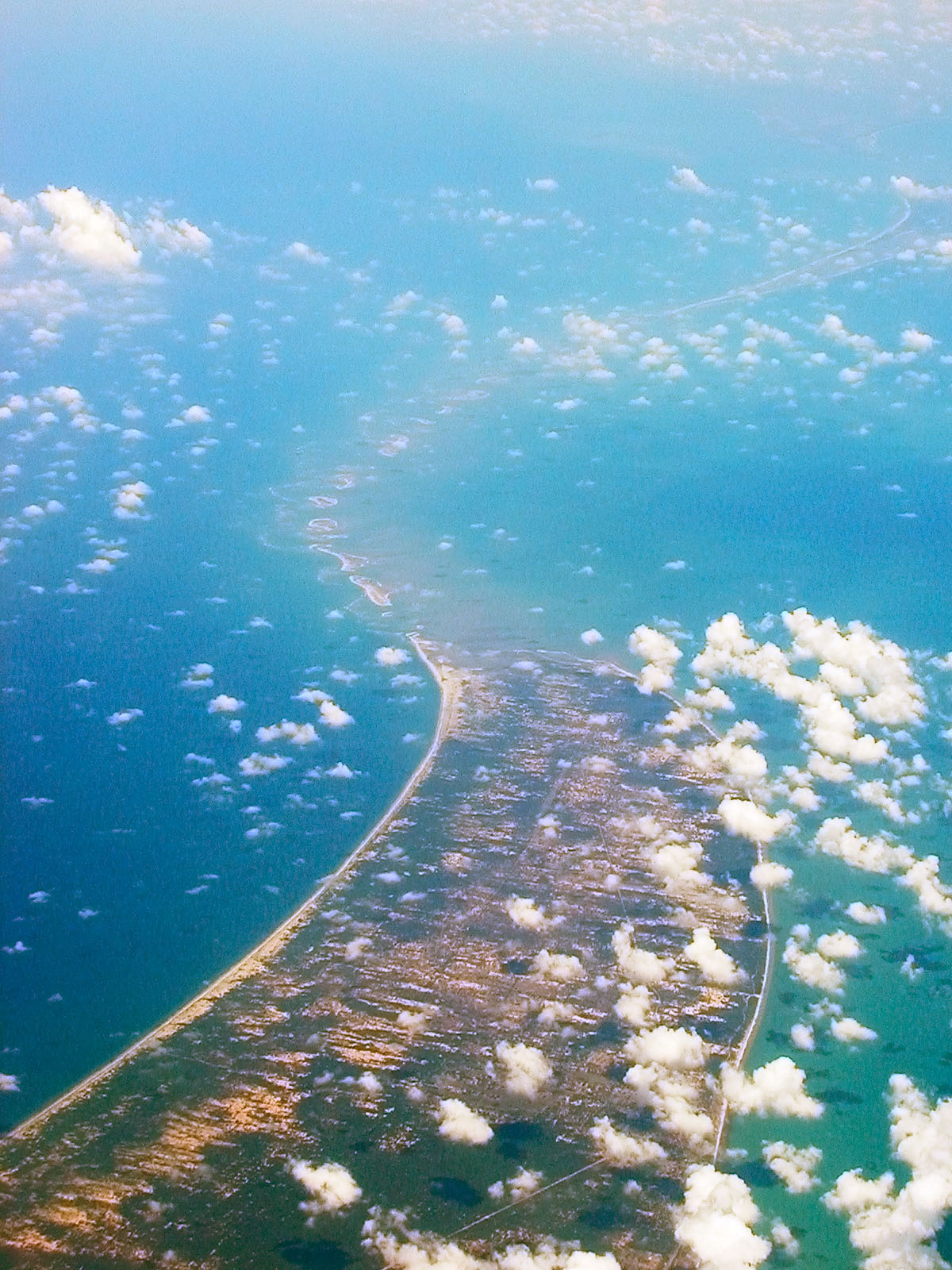
An ice age land bridge
Elephant Pass is the narrow gateway to Sri Lanka's Jaffna Peninsula, but is part of a larger and more ephemeral structure: a land bridge that once connected Sri Lanka to the Indian subcontinent. This connection, often called Adam's Bridge, is a 48-kilometer chain of limestone shoals running from Mannar Island in Sri Lanka to Pamban Island in India. For much of the Pleistocene, this was not a string of islands but a continuous land corridor.
During the Last Glacial Maximum, around 20,000 to 26,000 years ago, massive ice sheets locked up vast amounts of water. Global sea levels dropped by as much as 120 to 130 meters, exposing the shallow floor of the Palk Strait and creating a wide bridge between the two landmasses. This land connection appeared and disappeared multiple times in cycles of glacial and interglacial periods. The Palk Strait, with a maximum depth of only 35 meters, became a freshwater basin fed by rivers when sea levels were at their lowest. The final land link was likely severed by rising seas around 7,000 years ago.
The DNA record
The repeated connection and separation filtered for animal migration. One example is the Asian elephant. Genetic analysis shows a split between the mainland Indian elephant (Elephas maximus indicus) and the Sri Lankan elephant (Elephas maximus maximus). Genome analysis estimates this divergence occurred approximately 48,000 years ago, a time corresponding to a period when rising sea levels would have submerged the land bridge and isolated the Sri Lankan population.
While elephants successfully made the crossing and became a distinct population, other large Indian fauna did not. The land bridge was an arid habitat, which would have been unsuitable for species adapted to dense forests. This environmental filtering explains why animals like tigers and other megafauna, present in India, but never established long-term populations in Sri Lanka. The island's fossil record shows evidence of extinct hippos and rhinoceroses that did cross during earlier connections, but the fauna today is a distinct subset of what is found on the mainland.
The genetic story of Sri Lanka's elephants is complex; some studies show they cluster closely with elephants from Myanmar, possibly due to ancient trade routes. Within Sri Lanka itself, there are at least three genetically distinct elephant clusters, shaped by internal barriers and social organization.