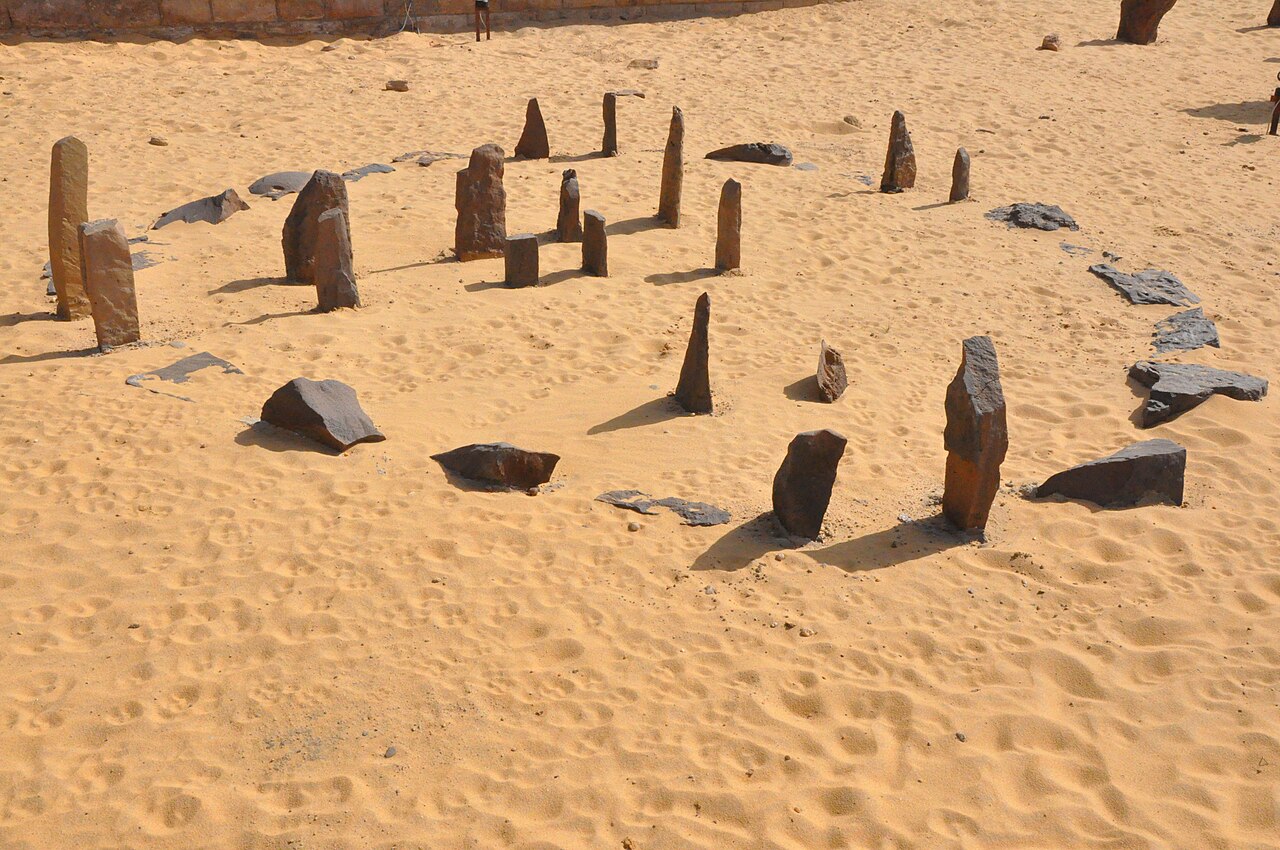
A 7,000-year-old stone circle predating Stonehenge by a millennium, built when the Sahara was green savanna. The stones align to summer solstice sunrise. Humanity's oldest known astronomical observatory, built by cattle herders in what is now lifeless desert.
Raymbetz, CC BY-SA 3.0, via Wikimedia Commons
An observatory in a vanished world
Deep in the hyper-arid Nubian Desert, about 100 kilometers west of Abu Simbel, lies the remnant of a different world. Today, the area is largely uninhabited, but during the African Humid Period, it was a savanna filled with life. Beginning around 10,000 BCE, stronger African monsoons filled a large basin, creating a seasonal lake that attracted nomadic peoples. These early inhabitants dug wells, built villages of small huts in straight rows, and survived on wild plants like sorghum and millet.
Around 5000 BCE, as the climate began to dry, the people of Nabta Playa constructed a small but significant stone circle. This structure, known as the Calendar Circle, is roughly four meters in diameter and consists of smaller, narrow stone slabs. It is the oldest known astronomical observatory on Earth, predating Stonehenge in England by at least 1,000 years. Its primary function was to mark the summer solstice. Two pairs of stones create a "gate" that frames the rising sun on this day, an event that likely coincided with the arrival of the life-giving summer monsoon rains. This astronomical knowledge was a practical tool for survival in a changing environment.
Cattle, stars, and ceremony
The Calendar Circle was part of a much larger ceremonial site. The people who built it were pastoralists who valued their cattle highly. Beginning around 5500 BCE, a group known as the "Cattle Herders" established a complex social system at the site, which became a regional ceremonial center. They performed ritual sacrifices of cattle, burying the animals in elaborate, clay-lined chambers covered by stone mounds called tumuli. One excavated tumulus contained the complete skeleton of a cow, carefully placed in its chamber. Some Egyptologists suggest this "cattle cult" may be a precursor to the worship of the goddess Hathor in dynastic Egypt, who was often depicted as a cow.
The astronomical alignments at Nabta Playa extend beyond the sun. The site also contains larger megalithic structures and lines of standing stones. Researchers have demonstrated that various stones align with the rising of bright stars, including Sirius, Arcturus, and the stars of Orion's Belt. Alignments to Orion's belt may date as early as 6400 BCE. These Neolithic people had a sophisticated understanding of the sky's movements. The construction of these megaliths, some of which were transported from over a kilometer away, required significant social organization and a shared belief system. As the Sahara continued to dry out after 3000 BCE, the people of Nabta Playa likely migrated, possibly carrying their knowledge of astronomy and ritual north to the Nile Valley, just as the first pharaohs were rising to power.
💡Fun Facts
The site was rediscovered in 1973 when an archaeology team stopped for a bathroom break in the desert and noticed ancient pottery on the ground.
One underground burial chamber contained a large, naturally shaped rock that had been sculpted to look like a cow.
Early inhabitants of the playa created some of the first known ceramic pottery in the Saharan region, including sophisticated decorated bowls.
To protect them from damage, the original stones of the Calendar Circle were moved and reconstructed inside the Nubian Museum in Aswan.
The original site is in a remote, restricted military area of the open desert and is not accessible to the public without special permits and a guided expedition. The reconstruction is viewable during the Nubian Museum's hours.
Admission
Access to the original site is by private tour only, with costs varying significantly.
Accessibility
The original site is extremely inaccessible, requiring specialized 4x4 vehicles to cross rough desert terrain. The museum reconstruction is accessible.
The Nabta Playa Calendar CircleNew Valley Governorate, Egypt