Generations of launch vehicles
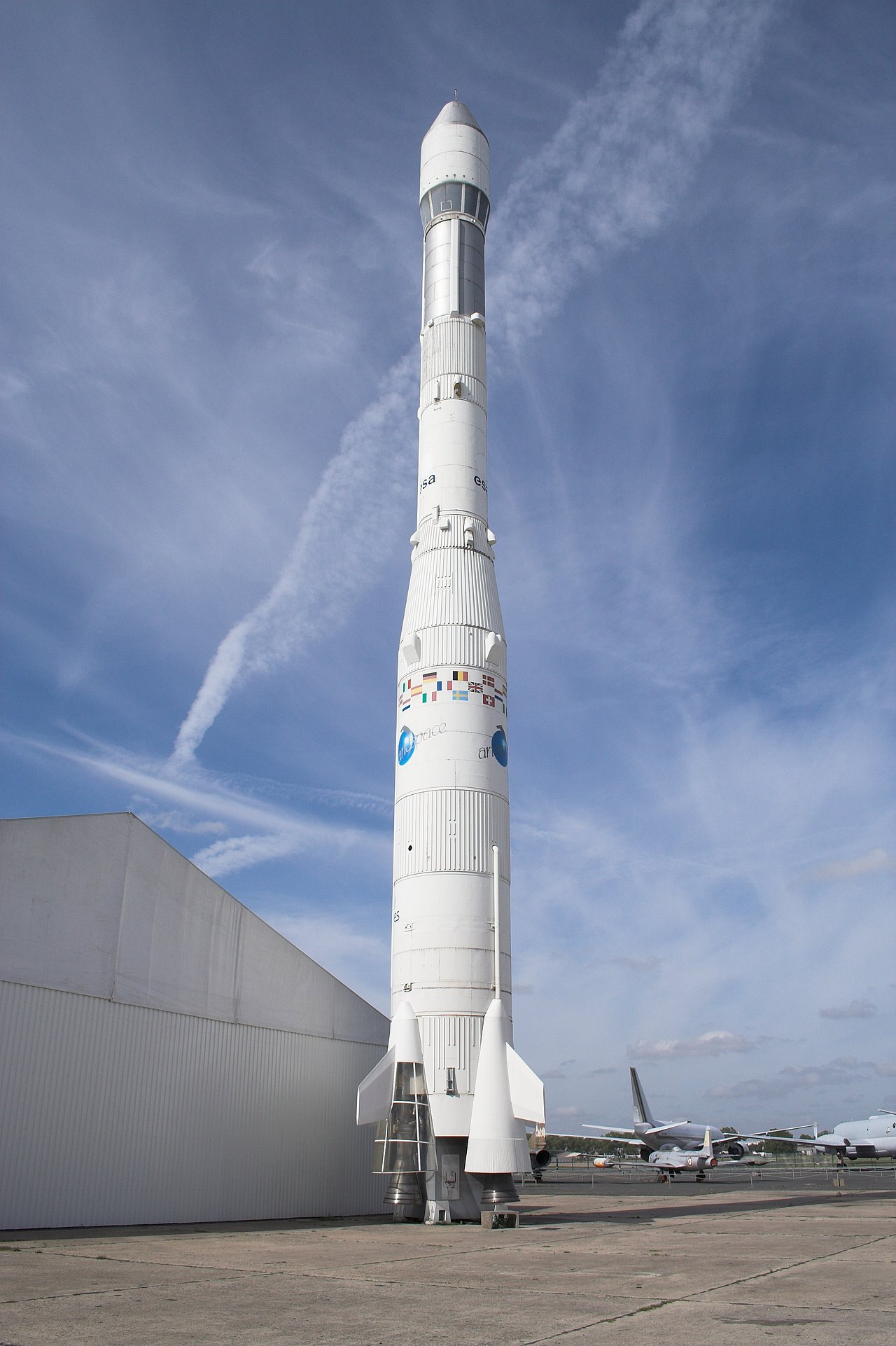
On the tarmac of the Musée de l'Air et de l'Espace stand two towering white structures: full-scale models of the Ariane 1 and Ariane 5 rockets. These are not replicas, but original 1:1 scale engineering models that required building permits to install. They represent two distinct eras of European spaceflight, developed by the European Space Agency (ESA) to provide independent access to space.
The Ariane 1, standing about 50 meters tall, was Europe's first successful launcher. Its inaugural flight took place on December 24, 1979, from the Guiana Space Centre. This three-stage rocket was designed to carry a payload of up to 1,850 kg into geostationary transfer orbit (GTO), enough for two small telecommunications satellites at once, which helped reduce launch costs. The first stage used four Viking 5 engines, burning a mix of nitrogen tetroxide and a fuel called UDMH (Unsymmetrical dimethylhydrazine). The Ariane 1 program had 11 launches, with nine successes, before its final flight in 1986.
Nearby, the Ariane 5 model is larger and has more scale and capability. At approximately 54 meters high, this heavy-lift launcher was an entirely new design. In its most powerful ECA configuration, it could lift over 10,000 kg to GTO. Its power comes from a large central cryogenic main stage, fueled by liquid hydrogen and liquid oxygen, and two large solid rocket boosters strapped to its sides. These two solid boosters provide the majority of the thrust at liftoff. The Ariane 5 had a long and reliable career from 1996 to 2023, with 117 launches.
Engines, satellites, and space history
The Ariane program was established in 1973 with France taking a leading role under the ESA's authority. The rockets are named after the French spelling of Ariadne, a figure from Greek mythology. The hall and surrounding exhibits place these launch vehicles in the context of European space exploration.
Inside the museum, visitors can see the complex machinery that powers these rockets, including a Vulcain engine that powers the Ariane 5's main stage. The Vulcain 2 engine produces up to 137 tonnes of thrust. The museum's collection also includes numerous satellites that were carried into orbit by Ariane launchers. Missions include the Giotto probe to Halley's Comet and the Rosetta comet rendezvous mission.
The Ariane 5 proved to be a versatile workhorse for the international space community. Between 2003 and 2017, it completed a streak of 82 successful launches. One of its most high-profile missions occurred on December 25, 2021, when it launched the James Webb Space Telescope into its orbit at the Earth-Sun L2 Lagrange point. The final Ariane 5 flight, the 117th, took place on July 5, 2023.