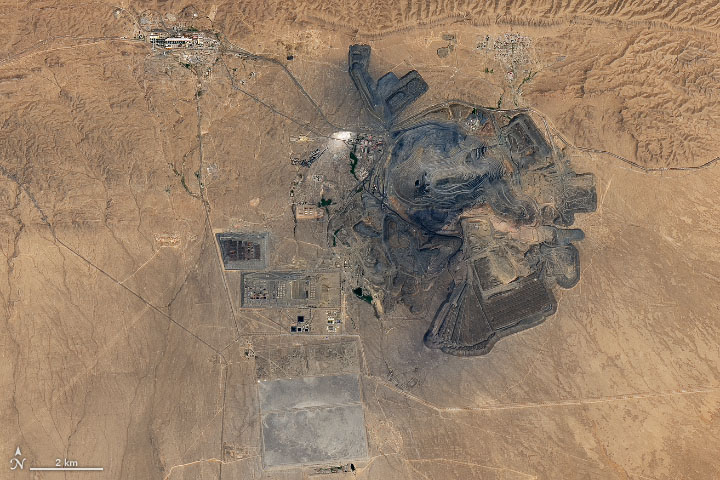
This colossal pit in the Uzbek desert, visible from orbit, holds the world's largest single gold reserve.
NASA Earth Observatory, Public domain
A scar of incredible wealth
In the flat expanse of Uzbekistan’s Kyzylkum Desert, a massive hole in the ground is an immense concentration of wealth. The Muruntau open-pit mine is a vast excavation, measuring approximately 3.5 by 2.5 kilometers and descending to a depth of over 600 meters. The scale is so large that the mine is visible from orbit. This operation taps into the Muruntau deposit, which holds a total resource (including past production) of more than 170 million ounces of gold.
The deposit’s discovery in 1958 was not accidental. Soviet geologists conducting systematic surveys identified a large geochemical anomaly of gold and arsenic. Arsenic often is a pathfinder element for gold, and this chemical signal led prospectors to the site. Mining began in 1967 and has continued uninterrupted, and Muruntau is one of the most productive gold mines globally. The state-owned Navoi Mining and Metallurgical Combinat (NMMC) operates the mine, which produces around 2 million ounces of gold annually. The mine uses a truck and conveyor system to haul ore, which is then processed using heap leaching techniques.
The geology of a giant
The Muruntau deposit is classified as an orogenic gold deposit. Its formation is tied to immense geological forces that occurred over hundreds of millions of years. The gold is primarily hosted within rocks of the Besopan Suite, a thick sequence of carbonaceous shales and siltstones deposited in an ancient ocean during the Cambrian and Ordovician periods.
The mineralization happened much later, during the late Carboniferous and Permian periods, around 300 million years ago. Tectonic collisions associated with the formation of the Tien Shan mountain belt subjected these host rocks to intense heat and pressure. Hydrothermal fluids, heated by granitic intrusions deep within the crust, were forced through a network of faults and fractures. These fluids carried dissolved gold and other elements, including arsenic and tungsten. As the fluids cooled and depressurized in the upper crust, the gold precipitated out, becoming concentrated in a vast stockwork of quartz veins. The gold itself is often microscopic, finely disseminated within the quartz and associated sulfide minerals like arsenopyrite and pyrite. This geological history, involving multiple overlapping tectonic and thermal events over millions of years, created the unique conditions required to form such a supergiant deposit.
💡Fun Facts
While the gold was discovered in 1958, the area has been a known source of turquoise since the era of the Silk Road.
The mine's total gold resource, estimated at over 170 million ounces, is one of the largest for a single deposit on Earth.
The open pit's current dimensions are about 3.5 km by 2.5 km, with plans to extend the depth beyond 1,000 meters.
Arsenic, often toxic, was the important "pathfinder" element that led geologists to discover the hidden gold deposit.