The Planet's Pulse
Beneath thousands of meters of water, the muddy floor of the North Atlantic holds a definitive record of Earth's climate history. Sediment cores drilled from this region contain microscopic archives that confirmed a long-held theory; ice ages are driven by predictable changes in Earth's orbit. This idea was developed by Serbian mathematician Milutin Milanković, who spent decades performing painstaking calculations by hand. He proposed that three cyclical variations in Earth's movement combine to alter the amount of solar energy reaching the polar regions.
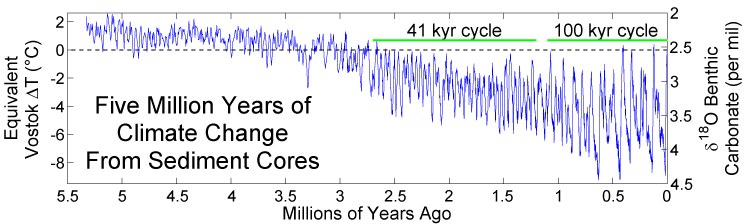
These movements are known as the Milankovitch cycles. The first is eccentricity, the shape of Earth's orbit, which shifts from nearly circular to more elliptical over a 100,000-year period. The second is obliquity, the tilt of Earth's axis, which varies between 22.1 and 24.5 degrees over 41,000 years. The third is precession, the wobble of the Earth's axis, with a period of about 23,000 years. Milanković calculated that these combined cycles create periodic cool summers in the Northern Hemisphere, allowing snow and ice to persist and accumulate into massive ice sheets. For decades, his work remained a hypothesis, waiting for physical proof.
A Library of Mud
The proof arrived in 1976. A landmark paper in the journal Science, titled "Variations in the Earth's Orbit: Pacemaker of the Ice Ages," presented data from deep-sea sediment cores that perfectly matched the frequencies of Milankovitch's predicted cycles. The evidence was found in the shells of foraminifera, tiny single-celled organisms that float in the ocean. When these organisms die, their calcium carbonate (CaCO₃) shells sink and become part of the sediment, accumulating in layers over millennia.
Scientists analyze the oxygen isotopes within these ancient shells. Oxygen comes in a common, lighter form (¹⁶O) and a rare, heavier form (¹⁸O). During cold periods, vast amounts of the lighter ¹⁶O evaporate from the ocean and get locked away in continental ice sheets. This leaves the oceans enriched with the heavier ¹⁸O. Foraminifera incorporate this ocean oxygen into their shells, creating a direct chemical record of global ice volume. By measuring the ratio of ¹⁸O to ¹⁶O in shells from different sediment layers, researchers can reconstruct past climate conditions with remarkable precision. The data from cores in this part of the world showed clear cycles of 23,000, 41,000, and 100,000 years, confirming that Earth's orbit is the pacemaker of the ice ages.