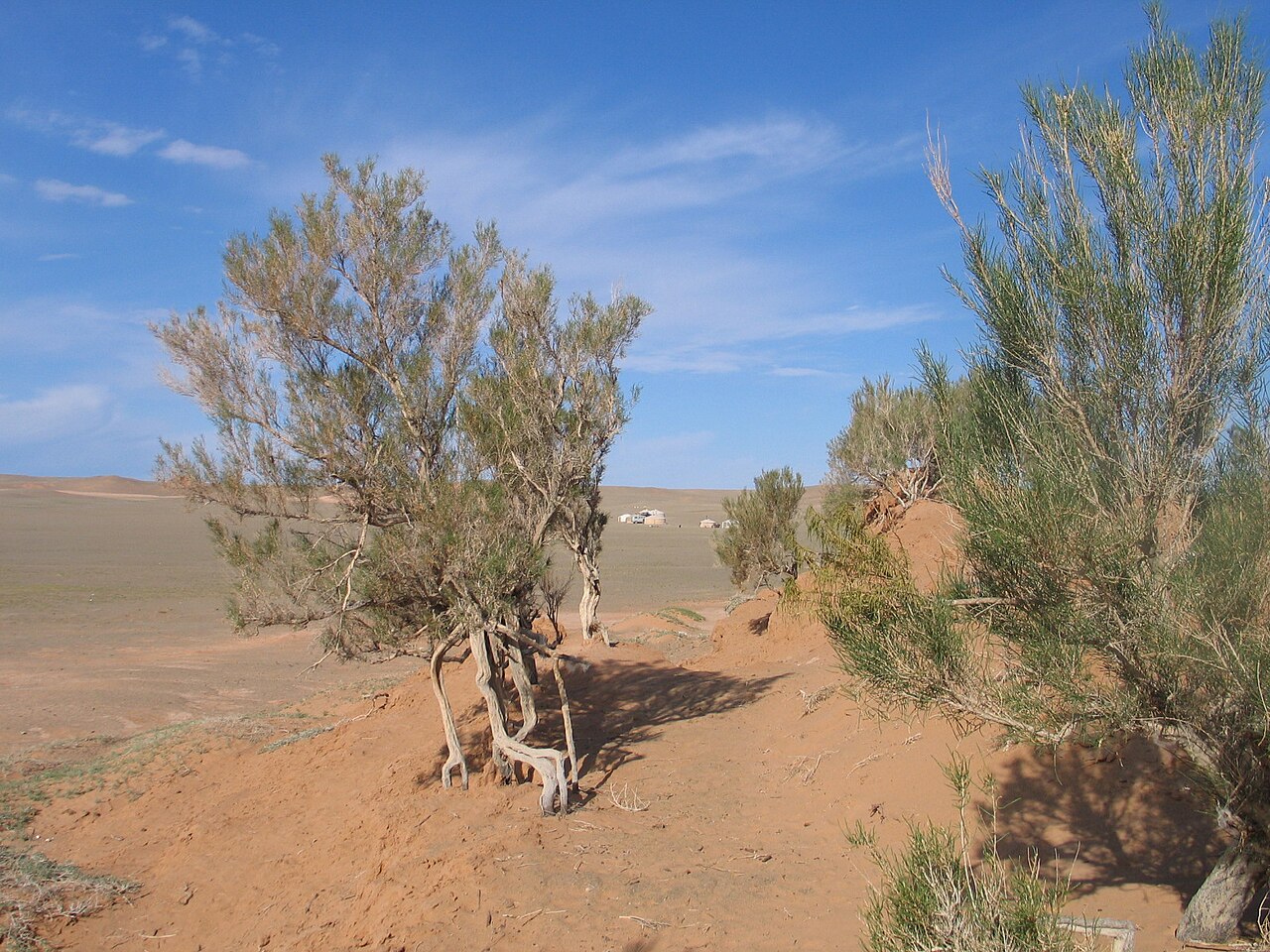
A forest without leaves
In the Kyzylkum Desert, one of the world's largest, stands a forest that defies convention. The dominant trees, black saxaul (Haloxylon ammodendron), have almost no leaves. To survive the extreme heat and aridity, they have reduced their leaves to tiny, scale-like structures to minimize water loss. Instead, photosynthesis occurs in the young, green branches and stems. This corticular photosynthesis, or photosynthesis in bark, is an adaptation to an environment where summer sand temperatures can reach 72°C.
The saxaul's physiology is finely tuned for desert life. It employs the C4 photosynthetic pathway, a more efficient carbon fixation method that reduces water loss in hot, dry conditions. Its trunk and branches are covered in a thick, spongy, water-saturated bark that is an important reservoir. Below ground, an extensive root system pushes deep into the sand, sometimes reaching 15 meters to tap into subterranean moisture. This robust root network also anchors the plant against strong desert winds. An individual black saxaul can live for 50 to 60 years, growing up to 12 meters tall with a trunk diameter of 25-50 cm.
A desert carbon sink
The Kyzylkum saxaul forests are significant carbon sinks. A single hectare of saxaul plantation can sequester over 30 tons of carbon, with about 16.6 tons in the plant biomass and 13.9 tons in the soil. This is a substantial increase compared to barren desert land, which might hold only around 5.9 tons per hectare in its soil. This makes saxaul plantations a tool for mitigating climate change. One adult saxaul tree can anchor up to four tons of sand with its root system.
These unique forests are part of one of the largest ecological restoration projects on Earth. The drying of the Aral Sea, once the world's fourth-largest lake, has created a new 6 million hectare desert called the Aralkum. Winds pick up an estimated 100 million tons of toxic salt and dust from the exposed seabed annually, creating devastating storms. To combat this, Uzbekistan and Kazakhstan have undertaken massive afforestation efforts, planting millions of saxaul seedlings across the former seabed. So far, Uzbekistan has planted forests over 1.7 million hectares of the Aralkum. These new forests are designed to stabilize the toxic sediment, reduce the intensity of dust storms, and create a new, functional ecosystem.