A Cliff-Dwelling Specialist
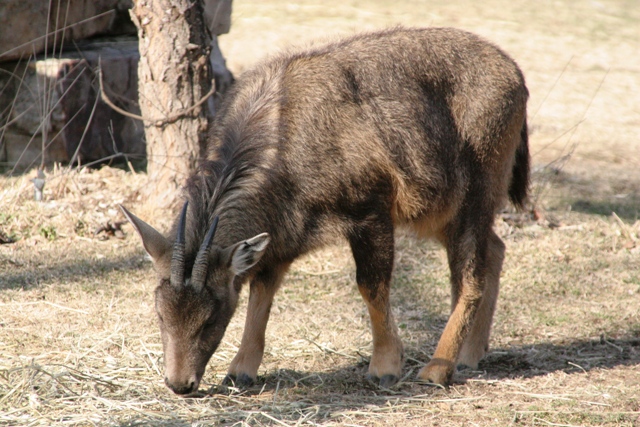
The Korean goral (Naemorhedus caudatus) is a species of goat-antelope uniquely adapted to the treacherous, rocky landscapes of East Asia. Found in Seoraksan National Park, this bovid is built for a life at altitude. It has a stocky body, a short neck, and stout legs that provide a low center of gravity for navigating steep inclines. Adults typically stand 55 to 80 centimeters at the shoulder and weigh between 22 and 47 kilograms.
Both males and females possess short, sharp, backward-curving horns that are approximately 13-18 centimeters long. Their coats consist of long, gray-brown fur, which provides insulation against the harsh mountain winters. A distinctive feature is a white patch on the throat. the goral's primary defense is its remarkable agility. It uses specialized hooves to grip rock surfaces, allowing it to access ledges and crags that are inaccessible to predators like lynx or wolves.
Survival at Altitude
Life in the mountains of Seoraksan demands extreme adaptations. During the resource-scarce winters, the goral employs a strategy of energy conservation by slowing its metabolic rate. This reduction allows it to survive periods of low food availability. Its diet is flexible, shifting with the seasons. In warmer months, gorals graze on grasses and herbs. During winter, they switch to browsing on evergreen leaves, lichens, acorns, and woody stems, sometimes using their muzzles to push away snow to find food.
Gorals are generally crepuscular, active at dawn and dusk. They are often solitary or live in small groups of two to five individuals, though larger groups of up to 12 have been observed. They maintain home ranges of about 40 hectares. This species has a strong sense of territory and tends to remain in a fixed location. Historically, their main predators included tigers and leopards, but today, human activity presents the most significant threat.
A Precarious Existence
The Korean goral is classified as a vulnerable species by the IUCN and is legally protected in South Korea as Natural Monument #217. The total population in South Korea is estimated to be critically low, with fewer than 1,000 individuals remaining in fragmented habitats. Seoraksan National Park is an important refuge, supporting a population estimated at around 260 individuals.
Major threats include habitat loss due to development and human disturbance. Poaching has also contributed to their decline. Extreme weather events, particularly heavy snowfall, can lead to mass mortality events by making foraging impossible. Conservation efforts focus on habitat protection, managing Special Protection Zones within the park, and operating a restoration center for endangered ungulates.