The Abode of Dissolving Rock
Meghalaya, a state in northeastern India, translates from Sanskrit to "Abode of the Clouds." The name is fitting. The region receives some of the highest rainfall on Earth, with annual averages exceeding 11,000 millimeters. This intense, sustained precipitation is the primary architect of one of the planet's most extensive networks of karst cave systems. Over millennia, the rainwater, made slightly acidic by atmospheric carbon, has dissolved vast deposits of Eocene-epoch limestone, carving out more than 1,700 known caves. The total surveyed length of these passages exceeds 427 kilometers.
The longest single cave system in India is Krem Liat Prah, located in the Jaintia Hills district. Ongoing exploration by the "Caving in the Abode of the Clouds Project," a collaboration of international and Indian cavers, has mapped its length to over 31 kilometers (30,957 meters). This extensive network features immense passages, including a chamber so large it is nicknamed the "Aircraft Hangar." The state also contains the world's longest sandstone cave, Krem Puri, which measures 24,583 meters and contains fossils of Mosasaurs, marine reptiles that lived 66-76 million years ago.
Life in Permanent Darkness
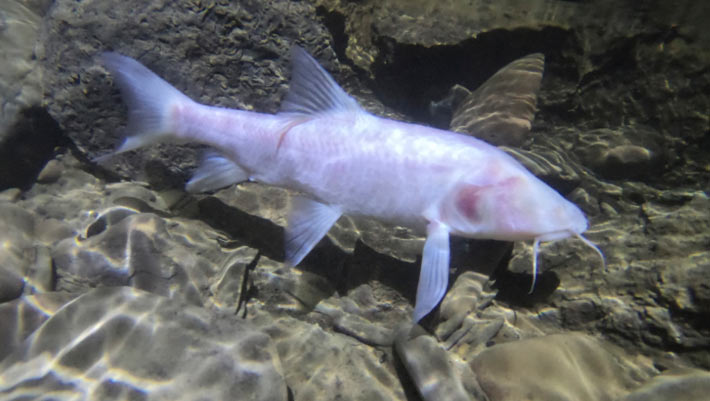
The isolation and constant darkness of the Meghalayan caves have created a unique biological laboratory. The subterranean ecosystems host a variety of troglobites, animals that are evolutionarily adapted to life without light; these adaptations often include a lack of pigmentation and the complete loss of eyes. In 2019, researchers exploring a cave in the Jaintia Hills identified the world's largest known subterranean fish. Formally described in 2023 as Neolissochilus pnar, individuals have been observed exceeding 400 mm in standard length. The fish is completely blind and lacks pigmentation, appearing pinkish-white.
Other endemic cave dwellers include multiple species of loaches, such as Schistura sijuensis and Schistura papulifera. These ecosystems are fragile. The organisms depend on nutrients washed in from the surface and the guano of bat colonies. The unique geology and hydrography create a specialized environment where even a small disruption can have significant consequences. Exploration continues to reveal new species, with a new troglophilic loach, Schistura densiclava, being identified in 2025.
Climate Archives in Stone
The caves are high-resolution climate archives. As water drips from the cave ceiling, it deposits minuscule layers of calcium carbonate, slowly forming stalactites and stalagmites, known as speleothems. The chemical composition of these layers, specifically the ratios of oxygen isotopes, records information about the intensity of rainfall at the time of their formation. Mawmluh Cave, one of the most studied in the region, contains speleothems that hold a detailed record of past monsoon strength. Analysis of a stalagmite from this cave provided the defining evidence for the start of the Meghalayan Age—the current chapter in Earth's geological history, which began with a mega-drought event 4,200 years ago.