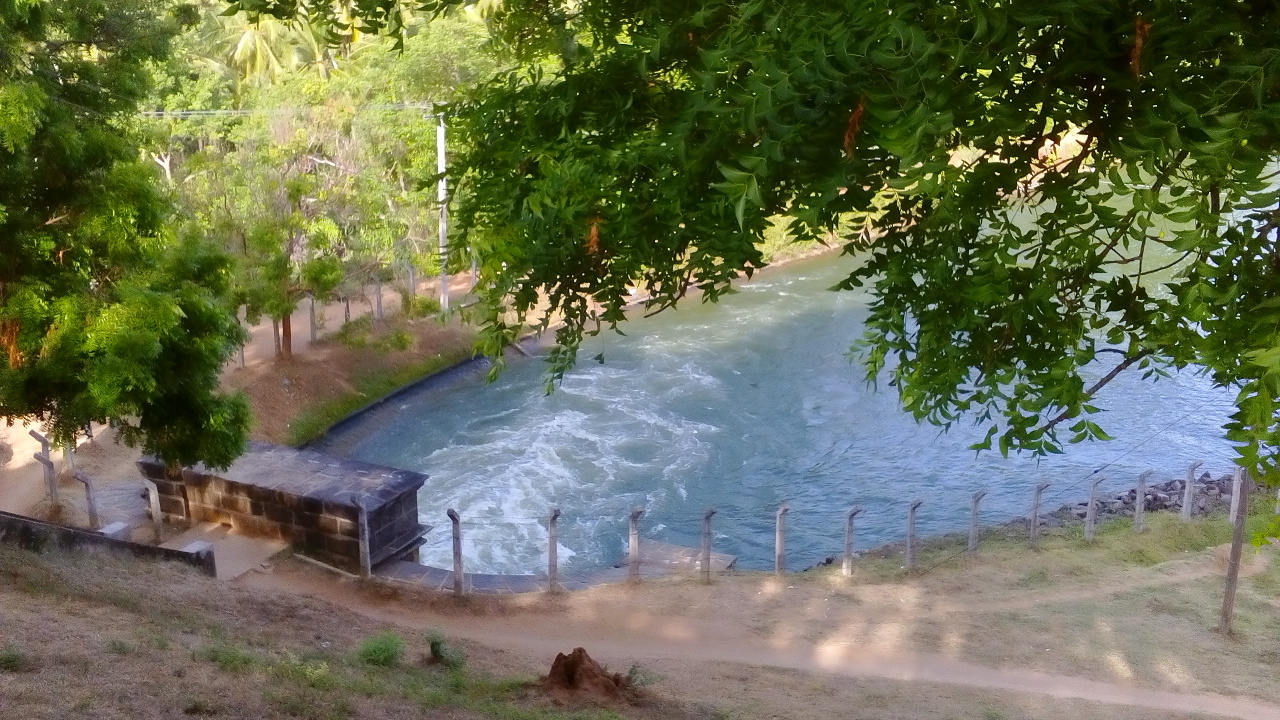
A reservoir of power
In the 5th century CE, King Dhatusena ruled a kingdom centered in Anuradhapura, a city dependent on sophisticated water management for its survival in Sri Lanka's dry zone. To secure the region's agricultural and domestic water supply, he commissioned the construction of the Kala Wewa, or "Black Tank". This massive earthen reservoir was created by building a dam nearly 7 kilometers long and up to 14.6 meters high. At full capacity, the Kala Wewa holds 123 million cubic meters of water and covers a surface area of 18.1 square kilometers.
The reservoir's primary function was irrigation. Its water fed the legendary Yoda Ela, or "Giant Canal," an 87-kilometer-long channel that supplied water to the city tanks of Anuradhapura. The Yoda Ela is an engineering feat in its own right, constructed with a gradient as precise as 10 to 20 centimeters per kilometer. This gentle slope ensured a slow, steady flow of water, minimizing erosion and maximizing distribution to smaller village tanks along its route. The entire system shows an advanced understanding of hydraulic principles, forming the backbone of the kingdom's prosperity.
Water as a weapon
Beyond its agricultural purpose, the Kala Wewa system contained a secondary, military application. Historical records and archaeological studies point to a network of sluices and canals with a strategic defensive function. The ancient capital of Anuradhapura was protected by city walls and moats. Evidence suggests that specific channels leading from the Kala Wewa's network were designed to rapidly fill these dry moats in the event of an invasion.
This system acted as a force multiplier for the city's defenses. An approaching army would face a formidable dry ditch, which could be transformed into a significant water barrier by activating the sluices. This method of hydraulic warfare turned the kingdom's greatest asset, its mastery over water, into a powerful defensive weapon. The ability to control and weaponize the flow from a 123-million-cubic-meter reservoir would have presented a daunting obstacle to any siege. This dual-use design, integrating civil irrigation with military defense, shows the complex planning of Anuradhapura's engineers. Specialized monastic complexes in the area, known as Padhanagara, also featured their own surrounding moats, indicating this was a common defensive architectural feature that could be leveraged by the larger water network.