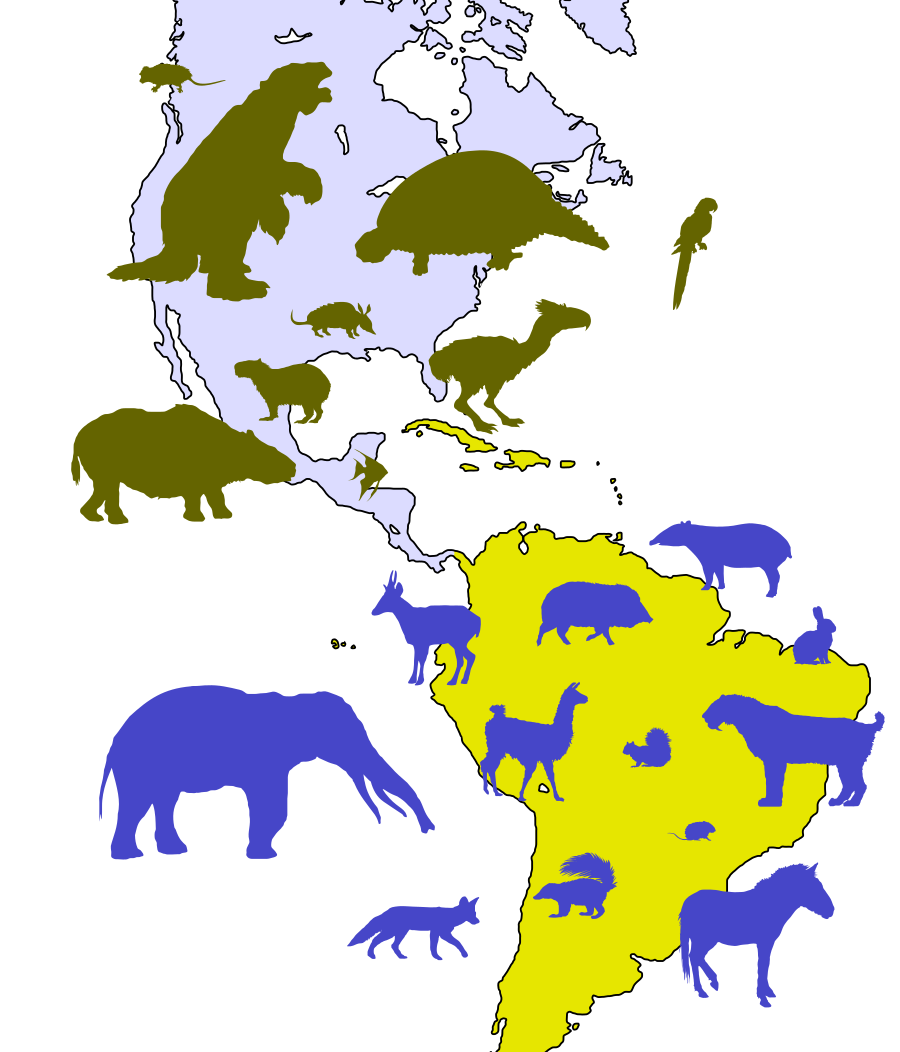
The land bridge connecting North and South America became the site of a massive two-way animal migration starting about 3 million years ago. Animals flooded in both directions, and many species that had thrived for millions of years in isolation went extinct within a geological instant.
Woudloper, CC BY-SA 1.0, via Wikimedia Commons
A bridge between worlds
For millions of years, North and South America were separate continents, allowing unique animal populations to evolve in isolation. South America was a land of strange marsupial predators, giant ground sloths, and car-sized armadillo relatives called glyptodonts. North America had the ancestors of modern bears, cats, dogs, camels, and horses. This separation ended when the Isthmus of Panama fully formed around 2.8 million years ago.
The formation was a slow, geological process. Beginning around 15 million years ago, volcanic activity between the Pacific and Caribbean tectonic plates created a series of islands. Over millennia, sediments washed from the continents and filled the gaps between these islands, creating a continuous strip of land, the Darién isthmus being the final link. This new land bridge connected two continents; it severed the connection between the Atlantic and Pacific oceans. This event rerouted ocean currents, leading to the formation of the Gulf Stream and altering global climate patterns.
The great migration begins
With the land bridge in place, animals began to move in both directions in an event called the Great American Biotic Interchange. From the north came waves of invaders. Gomphotheres (four-tusked elephant relatives), saber-toothed cats (Smilodon), deer, camels, horses, and bears all pushed south. These newcomers were highly successful. Today, South American animals like llamas, guanacos, and jaguars are all descendants of these northern migrants.
The southern migration was less successful but included some spectacular animals. Giant ground sloths like Eremotherium, some the size of elephants, lumbered north. Armadillos, porcupines, and opossums also migrated, and their descendants still exist in North America today. Perhaps the most formidable southern migrant was Titanis walleri, a flightless "terror bird" that stood over 2 meters tall and became a predator in what is now Texas and Florida.
The interchange was lopsided. The North American mammals proved to be better competitors and colonizers. Many of South America's unique native species, including most of its marsupial predators and strange hoofed mammals (notoungulates), went extinct. Today, roughly half of South America's mammal genera are descended from North American ancestors, while only about 10% of North American mammals came from the south.
💡Fun Facts
The formation of the Isthmus of Panama created the Gulf Stream, a powerful ocean current that brings warm water to Northern Europe and influences global climate.
The terror bird *Titanis walleri* made it as far north as Florida and Texas, where it competed with mammalian predators.
Giant ground sloths (*Eremotherium*) migrated from South America and reached the size of modern elephants, with fossils found as far north as South Carolina.
The car-sized, club-tailed *Glyptodon*, a relative of the armadillo, was another southern migrant that spread into North America.
Darién National Park is accessible only with certified guides and proper permits from the National Environmental Authority (ANAM). There are no set hours; access depends on guide arrangements and river conditions.
Admission
Park entrance fees, guide fees, and transportation costs apply. Independent travel is not recommended.
Accessibility
This is a remote, undeveloped wilderness area with no paved roads or facilities. Access is via small planes, boats, and strenuous hiking on muddy, difficult trails. It is not accessible for wheelchairs.