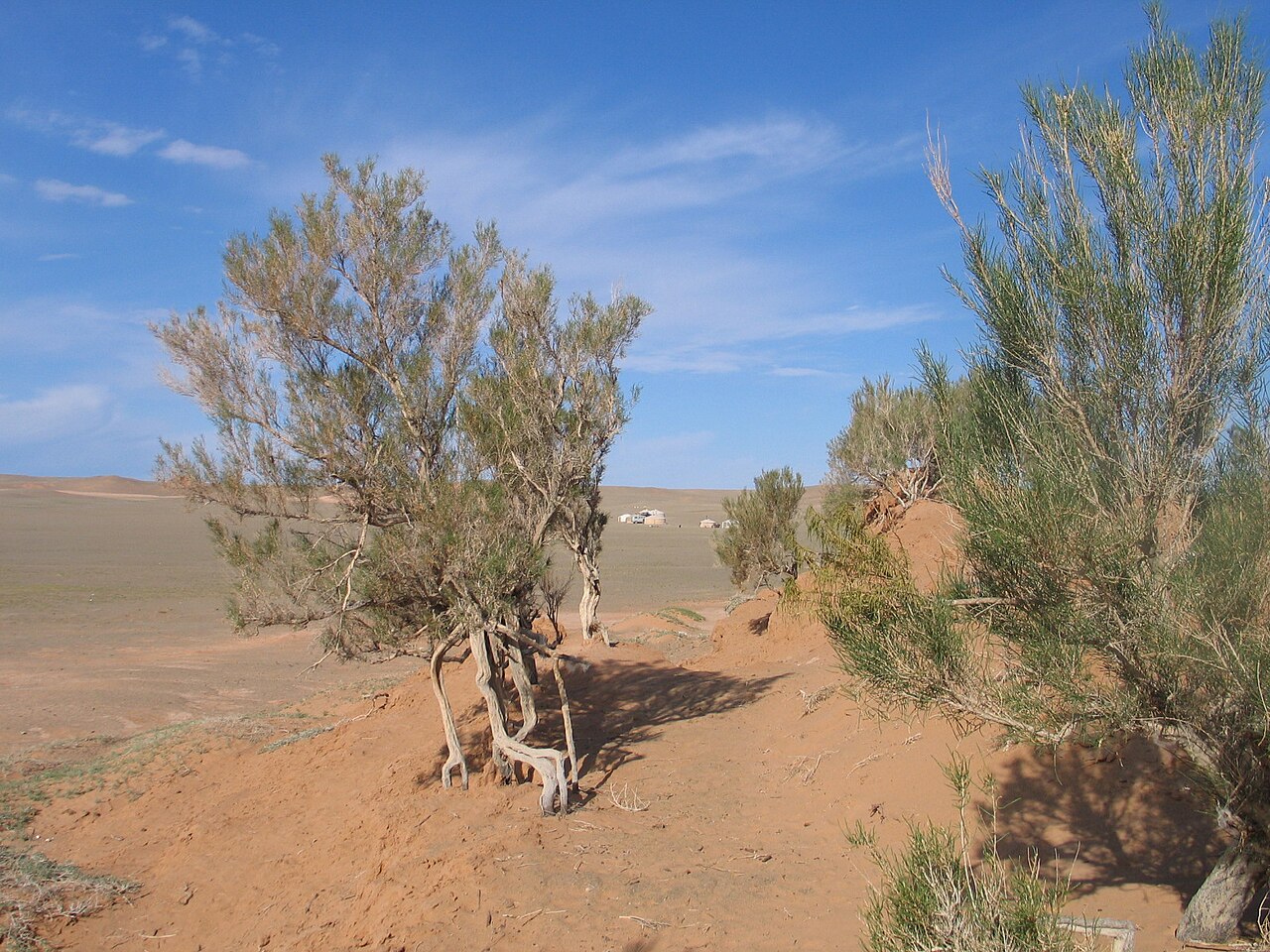
Forests of saxaul trees in extreme continental desert support unique mammals including Przewalski's horses. The trees survive on groundwater and create the only shade for hundreds of kilometers.
CC BY-SA 2.5, via Wikimedia Commons
A forest without rain
In the vast Gobi Desert, where annual precipitation is often less than 200 millimeters, dense forests of saxaul trees (Haloxylon ammodendron) survive. These aren't typical trees, but large, gnarled shrubs that can grow up to 8 meters tall. Their defining feature is an immense root system that bypasses the need for rain by tapping directly into deep groundwater reserves. This adaptation allows them to flourish in an environment with extreme temperature fluctuations, from scorching summer highs to freezing winters.
The saxaul tree is a psammophyte, a plant that thrives in shifting sand. To conserve water, it has almost no visible leaves; photosynthesis occurs in its green, succulent-like branches and twigs. The tree's trunk is often crooked and heavy, with a thick, spongy bark that can be pressed to extract drinkable water—a resource for nomadic peoples. This unique physiology makes the saxaul the dominant, and often only, tree-like plant across all five ecoregions of the Gobi.
An ecological anchor
Saxaul forests are the backbone of the Gobi ecosystem. They provide the only significant shade and shelter for hundreds of kilometers, creating a microclimate that supports a surprising variety of life. One of its inhabitants is Przewalski's horse (Equus ferus przewalskii), the last truly wild horse. Declared extinct in the wild in 1969, these horses have been successfully reintroduced to their native habitat, including areas like the Great Gobi B Strictly Protected Area. They rely on the saxaul groves for shelter from the harsh sun and winds.
Other mammals, like wild Bactrian camels and the rare Gobi bear (Ursus arctos gobiensis), also use the forest for cover. The ecosystem supports specialized species such as the Saxaul sparrow (Passer ammodendri), which feeds heavily on the tree's seeds. The tree's extensive root network helps in combating desertification by binding the sandy soil and preventing wind erosion, a process that helps stabilize the entire landscape. These root systems create stable ground, allowing other, smaller plants to grow and further enriching the habitat.
💡Fun Facts
Saxaul wood is so dense and resinous that it sinks in water.
The tree's scientific name, *Haloxylon ammodendron*, translates to "salt-tree" and "sand-tree," perfectly describing its tolerance for saline, sandy soils.
A parasitic plant called *Cistanche deserticola*, or "ginseng of the desert," grows on saxaul roots and is highly valued in traditional Chinese medicine.
The tree appears leafless because its leaves are reduced to tiny, cusp-like scales to minimize water loss.
The Gobi Desert is an open, unfenced region. Access is possible 24/7, but travel is limited by daylight, weather, and the need for a guide.
Admission
Access to the general desert is free. Fees may be required to enter protected areas like the Gobi Gurvansaikhan National Park.
Accessibility
The region is extremely remote with no paved roads. Access requires a 4x4 vehicle, typically as part of a guided tour. The terrain is rugged and sandy.