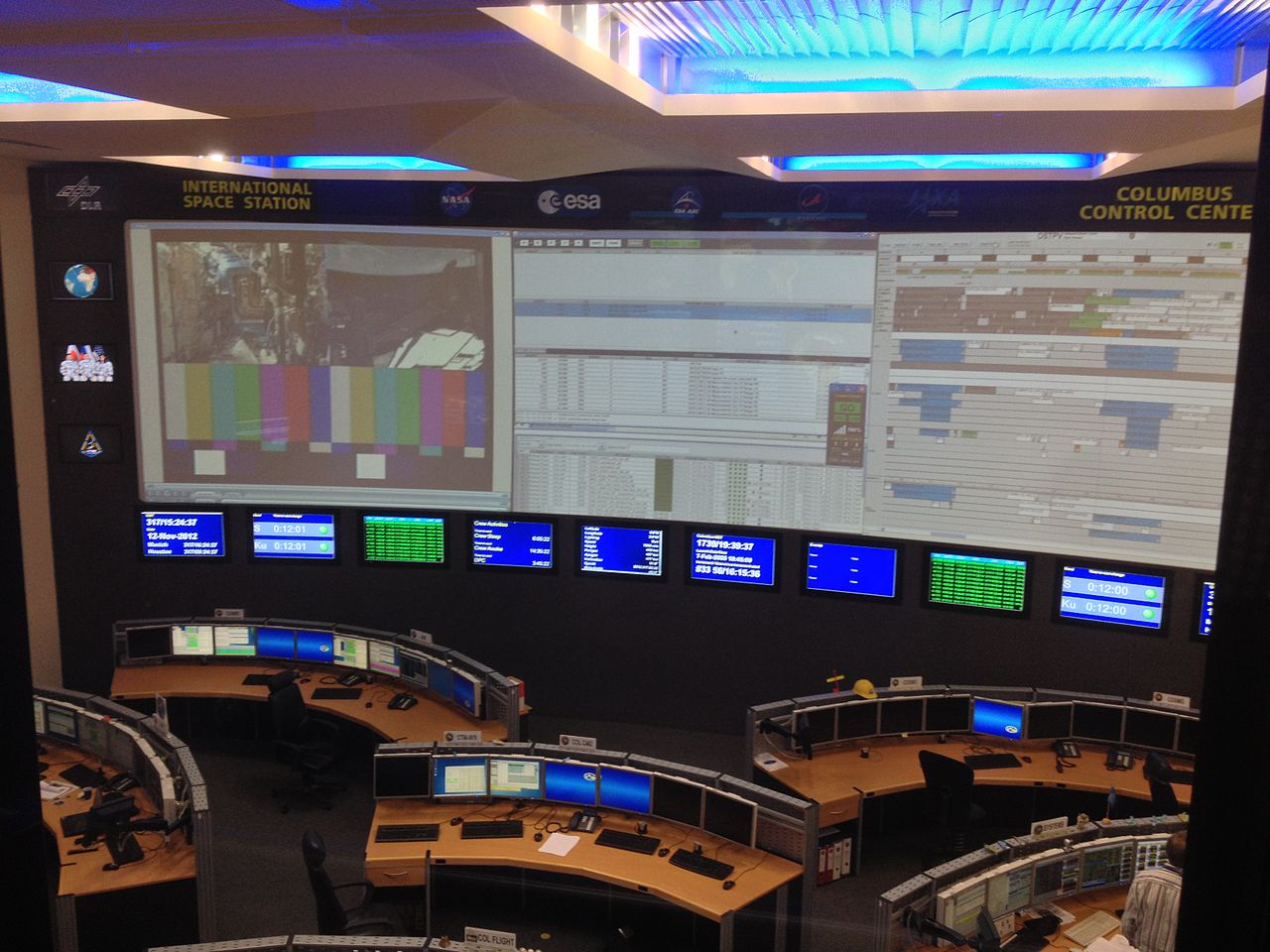
This Bavarian facility controls the European Columbus module on the ISS and developed the robotic arm that services satellites in orbit. Technology that may one day clean up space debris.
DLR German Aerospace Center, CC BY 2.0, via Wikimedia Commons
Europe's voice to the space station
In a complex of buildings in the Bavarian countryside, a team of flight controllers works 24 hours a day, 365 days a year, speaking directly to the International Space Station (ISS). This is the Columbus Control Centre (Col-CC), located at the German Aerospace Center's (DLR) Oberpfaffenhofen site. Since 2008, this facility has been the operational heart of the European Columbus laboratory, a 4.5-meter diameter science module permanently attached to the ISS. When astronauts on the station use the radio callsign "Munich," this is the room that answers.
The flight control team at Oberpfaffenhofen manages all systems on the Columbus module. They are responsible for everything from life support and power distribution to the cooling systems for the scientific payloads. The center coordinates the multitude of European experiments conducted inside the laboratory, which spans research in fluid physics, material science, and human physiology. Data from these experiments flows through Oberpfaffenhofen to User Support and Operations Centres across Europe. The control center is in constant contact with international partners, including NASA's mission control in Houston and Roscosmos in Moscow, making it a node in the ISS's global ground network.
Robots for orbit
The Oberpfaffenhofen site is also a center for robotics and mechatronics, developing technologies for on-orbit servicing (OOS). Scientists here design and test robotic systems intended to perform complex tasks in space, such as maintaining, repairing, and assembling satellites. One of the main facilities is the On-Orbit Servicing Simulator (OOS-SIM), which uses two large industrial robots to simulate the zero-gravity dynamics of two satellites interacting in space.
On this simulator, engineers test sensitive lightweight robot arms and specialized grippers. The goal is to perfect the autonomous capture of a tumbling, non-cooperative satellite. This capability for future missions that refuel aging satellites or remove hazardous space debris. The robotic arms and control strategies developed here are designed with extreme dexterity and often incorporate haptic feedback, allowing a ground operator to "feel" what the robot is touching hundreds of kilometers away. Projects like DEOS (German Orbital Servicing Mission) have started this technology, which aims to extend the life of valuable space assets and ensure the long-term sustainability of orbital environments.
Charting Earth and space
Beyond human spaceflight and robotics, the German Space Operations Center (GSOC) at Oberpfaffenhofen commands a fleet of robotic Earth observation satellites. Among these are the twin radar satellites TerraSAR-X and TanDEM-X. Launched in 2007 and 2010 respectively, they fly in close formation, just a few hundred meters apart. This configuration allows them to act as a single-pass radar interferometer. Together, they have generated a global 3D digital elevation model of Earth's entire land surface with a vertical accuracy of better than two meters.
The site also hosts one of the two Galileo Control Centres, which manages Europe's global satellite navigation system. This facility is responsible for controlling the Galileo satellites, maintaining the constellation, and ensuring the precise timing and positioning signals that are broadcast to users worldwide.
💡Fun Facts
Astronauts aboard the ISS use the radio callsign "Munich" to speak with the Columbus Control Centre.
The TanDEM-X and TerraSAR-X radar satellites flying in formation have mapped Earth's entire landmass of 150 million square kilometers to create a 3D elevation model with a vertical accuracy better than 2 meters.
Since its installation in 2008, the Columbus module has hosted around 1,800 different scientific experiments.
During the 1985 Spacelab mission STS-61-A, GSOC became the first control center outside of the USA or the Soviet Union to have partial operational control of a human spaceflight mission.
The DLR site is an active research facility. Free public tours of the German Space Operations Center (GSOC) are typically offered on the last Friday of each month, but registration is required and spots are limited. Check the official website for availability and booking.
Admission
Tours are free of charge.
Accessibility
The tour involves walking through a large research campus and its buildings.