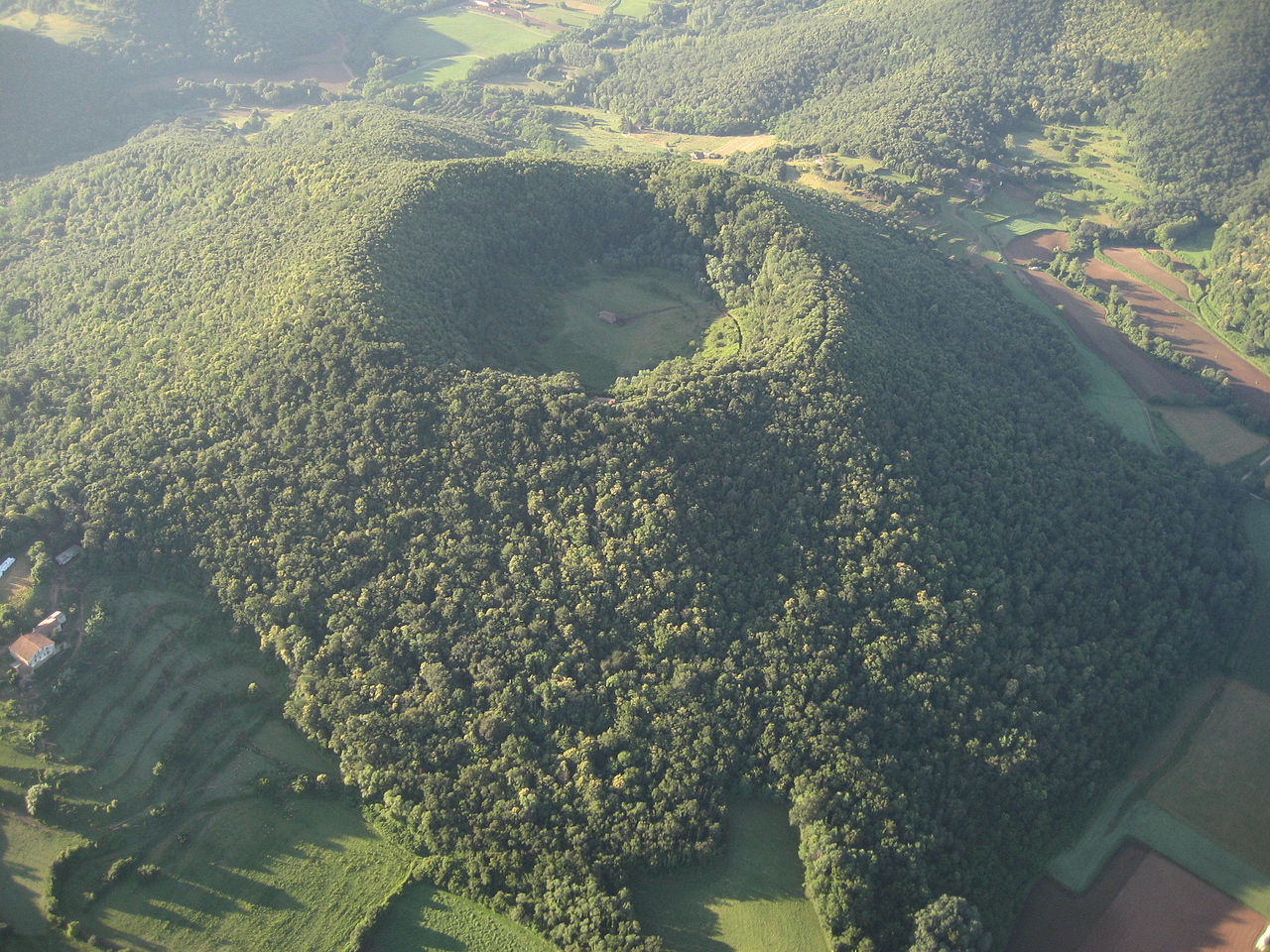
40 dormant volcanoes that last erupted 11,000 years ago. Paleomagnetic dating of lava flows shows eruptions occurred in clusters separated by millennia of quiet, a pattern suggesting renewed activity is geologically plausible.
Carquinyol from Badalona, Catalunya, CC BY-SA 2.0, via Wikimedia Commons
A Landscape of Fire and Water
The Garrotxa volcanic field is the best-preserved volcanic landscape on the Iberian Peninsula. Volcanic activity in this region began around 700,000 years ago, creating a landscape of over 40 distinct volcanic cones and more than 20 basaltic lava flows. The field's monogenetic nature means each volcano erupted only once, over a period of days to months. The most recent confirmed eruption occurred approximately 11,500 years ago, involving a complex event that formed both the Croscat and Santa Margarida volcanoes.
Two main eruption styles define Garrotxa's geology. The first is Strombolian, characterized by the explosive ejection of gas and pyroclasts (scoria, lapilli, and volcanic bombs)which build up classic cinder cones. The Croscat volcano is a prime example, rising 160 meters above the plain. The second, more explosive style is phreatomagmatic. This occurs when rising magma at over 1000°C encounters underground water, causing violent steam explosions. This activity creates wide, circular craters called maars. Santa Margarida volcano, with its 500-meter-wide crater, resulted from such a phreatomagmatic phase. This interaction between magma and water shaped much of the region's topography.
A Timeline Written in Magnetism
The volcanic field was not continuously active but experienced bursts of eruptions separated by long periods of dormancy. Scientists unravel this timeline using techniques like paleomagnetic dating. As lava cools, magnetic minerals within the basalt align with the Earth's magnetic field at that specific moment in time. Since the magnetic field's orientation and intensity shift over millennia, this "frozen" magnetic signature dates the lava flow. By comparing these signatures from different flows to a known timeline of Earth's magnetic field changes, geologists can constrain the age of eruptions.
This method, combined with advanced radiometric dating, has refined the history of the Garrotxa field. For instance, the two lava flows that form the dramatic 50-meter-high cliff upon which the town of Castellfollit de la Roca is built have been dated to approximately 217,000 and 192,000 years ago, respectively. More recent studies have dated the last eruption of the Croscat volcano to between 13,000 and 15,000 years ago. While the field is currently quiet, the pattern of clustered activity suggests that the underlying geodynamic conditions that allow magma to reach the surface have not changed, making future eruptions a possibility.
💡Fun Facts
A Romanesque hermitage dedicated to Santa Margarida sits in the center of the Santa Margarida volcano's grassy crater. The original building was destroyed by an earthquake in 1428 and rebuilt in 1865.
The medieval town of Castellfollit de la Roca is built on a narrow basalt cliff, just 50 meters high and one kilometer long, formed by two separate ancient lava flows.
The Croscat volcano was extensively quarried for volcanic gravel, which sliced the cone open and exposed its internal layers of red and black lapilli, creating a living geology textbook.
The nutrient-rich volcanic soil and humid climate support lush forests, including the Fageda d'en Jordà, a unique beech forest that grows on the cooled lava flow from the Croscat volcano at an unusually low altitude.
The Natural Park is always open. Visitor centers, like the one at Can Serra (near Fageda d'en Jordà) and Can Passavent (Croscat volcano), have specific hours, typically from 10:00 AM to 4:00 PM.
Admission
Free. There are fees for parking in the main designated areas near Santa Margarida and the Fageda d'en Jordà.
Accessibility
The park has a network of marked trails of varying difficulty. Some areas, like the path into the Santa Margarida crater, are considered gentle and family-friendly. Access to the Croscat quarry for persons with disabilities can be arranged with prior authorization.