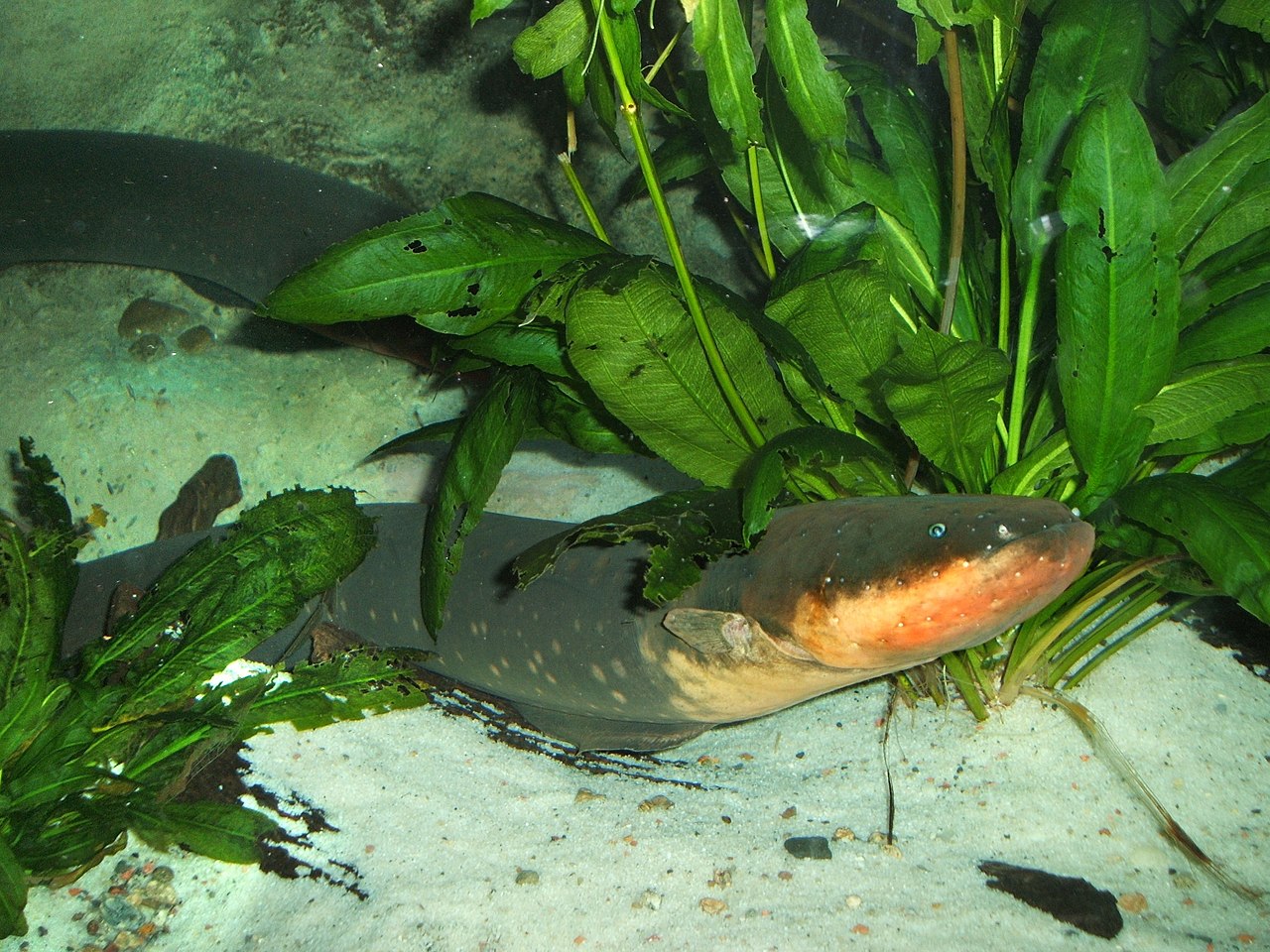
Despite its name, it's not an eel but a knifefish. It has three electric organs that can generate 860-volt shocks. Enough to stun a horse. It uses low-voltage pulses for navigation and communication, ramping up to high voltage only for hunting or defense.
Steven G. Johnson, CC BY-SA 3.0, via Wikimedia Commons
The Anatomy of a Shock
The electric eel is not a single species, nor is it a true eel. It belongs to a group of fish called knifefish, and a 2019 study expanded the genus Electrophorus into three distinct species. The most powerful of these, Electrophorus voltai, is the strongest known bioelectricity generator, capable of producing a discharge of 860 volts. This incredible ability comes from three pairs of specialized electric organs that constitute about 80% of the fish's body: the Main organ, the Hunter's organ, and the Sach's organ. The important organs are compressed into only the front 20% of its body.
These organs are composed of thousands of modified muscle cells called electrocytes, which are stacked in long columns. Each electrocyte produces only a small voltage, about 0.15 V, but when they are discharged in near-perfect synchrony, the voltages add up. When the eel's brain sends a nerve signal, ion channels open, and positively charged sodium ions flow into the cells, momentarily reversing their polarity and generating a current. This biological circuitry, with its thousands of cells acting like batteries connected in series, is what produces the stunning high-voltage output.
An Electrical Multi-Tool
The electric eel's triple-organ system is a tool for life in the murky waters of the Amazon. The different organs produce discharges for distinct purposes. The Sach's organ is the low-voltage power plant, emitting pulses of around 10 volts. These weak signals generate an electric field around the fish. Receptors in its skin detect distortions in this field, a process called electrolocation, which allows the eel to "see" its surroundings, find prey, and navigate in the dark. These low-voltage pulses are also used to communicate with other electric eels.
For hunting and defense, the eel unleashes the full power of the Main and Hunter's organs. The attack is sophisticated. An eel may first emit a quick, high-voltage doublet or triplet of pulses. This causes hidden prey to twitch involuntarily, revealing their location. Once the target is identified, the eel unleashes a continuous, high-frequency volley of high-voltage electricity that can last for several milliseconds. This massive shock overpowers the prey's nervous system, causing total muscle paralysis and allowing the eel to swallow it whole. The same powerful discharge is a defense against predators.
💡Fun Facts
The research that identified *Electrophorus voltai* in 2019 was the first time a new electric eel species had been described in over 250 years.
Electric eels are obligatory air-breathers. They get up to 80% of their oxygen by gulping air at the surface every 10 minutes or so, an adaptation for the often oxygen-poor waters of the Amazon.
The 19th-century naturalist Alexander von Humboldt famously documented an encounter where local fishermen herded horses into a pond to exhaust the eels, which leaped from the water to press themselves against the horses and deliver their shocks.
The Italian scientist Alessandro Volta was inspired by studies of the electric eel when he invented the first electric battery around 1800. The record-breaking species *E. voltai* is named in his honor.
This is a wild animal in its natural habitat. It can be observed on guided ecotours or research expeditions, which operate year-round, subject to weather and river conditions.
Admission
Not applicable. Costs are associated with booking a guided boat tour or expedition, which vary widely by operator and duration.
Accessibility
The Amazon River and its tributaries are remote environments. Access requires boat travel, and excursions into the forest or along riverbanks involve rough, uneven, and often muddy terrain. It is not wheelchair accessible.