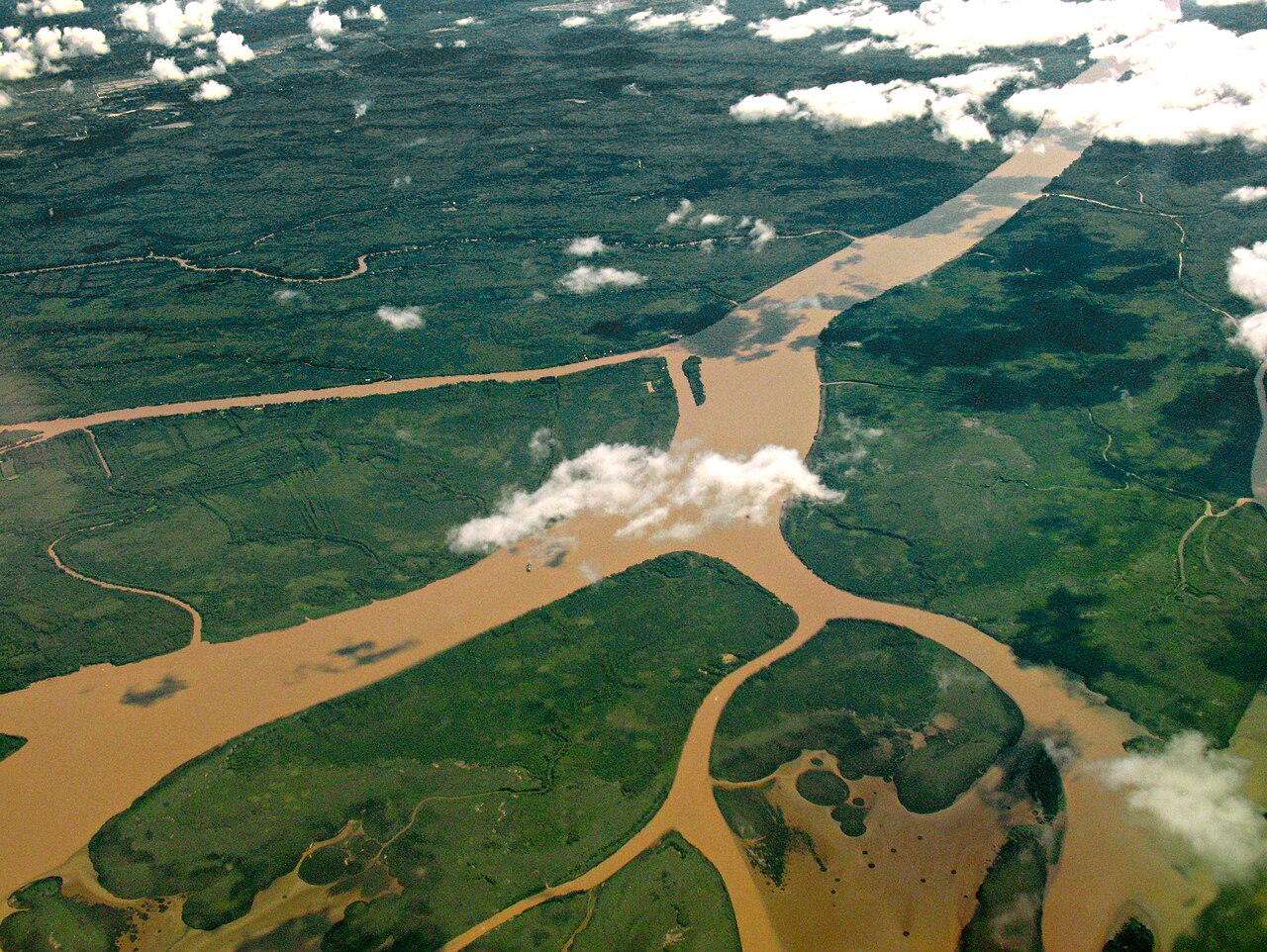
The delta grows 70 meters annually as the Paraná delivers 160 million tons of sediment yearly. Satellite time-series document land formation in real time over decades.
Martin Terber, CC BY 2.0, via Wikimedia Commons
A River That Builds Islands
The Paraná Delta is a massive geological machine, covering an area of approximately 14,000 square kilometers. It is the world's only major river delta that does not empty directly into the sea, but into another river—the wide estuary of the Río de la Plata. The engine of this constant creation is the Paraná River itself, which transports about 160 million metric tons of suspended sediment each year. This immense load consists mainly of fine sand, silt, and clay.
The primary source of this sediment is the Bermejo River, a tributary that originates in the Andes. The Bermejo's waters are so sediment-rich they contribute about half of the Paraná's total load, giving the water a distinct reddish color. As the fast-flowing Paraná broadens and slows upon meeting the Río de la Plata, it loses its capacity to carry this material. The sediment settles out of suspension, accumulating on the riverbed. Over time, these deposits form sandbars and then islands, a process of land formation called fluvial progradation that advances at a rate of 50 to 90 meters per year.
This network of land is over 350 rivers and streams that weave between thousands of low-lying islands. The process is not static; river channels migrate, new islands emerge, and the entire delta front pushes steadily into the estuary. Scientists use satellite imagery, particularly from the Landsat program, to track these changes, watching in near real-time as Argentina's landmass expands.
An Ever-Changing Ecosystem
The newly formed land is quickly colonized by life, creating a variety of unique habitats. The first plants to take root on the soft, muddy banks are often pioneer species like the Humboldt's willow (Salix humboldtiana) and the ceibo (Erythrina crista-galli). Their roots bind the loose sediment, stabilizing the new islands and paving the way for more complex plant communities. This results in dense gallery forests along the levees and marshy interiors. The delta supports over 700 species of vascular plants.
This dynamic environment hosts fauna. The region's most famous resident is the capybara (Hydrochoerus hydrochaeris), the world's largest rodent. It shares the wetlands with the endangered marsh deer (Blastocerus dichotomus), the neotropical river otter (Lontra longicaudis), and the coypu (Myocastor coypus). Until the early 20th century, the area also had jaguars (Panthera onca), for which the nearby town of Tigre was named. The delta is an important habitat for more than 300 bird species and around 200 fish species, including the commercially important dorado and surubí. This biodiversity results from the delta's unique position, where subtropical species moving down the river corridor meet species from more temperate zones. In 2000, parts of the delta were designated a UNESCO Biosphere Reserve to protect this distinct ecological zone.
💡Fun Facts
The delta is so large it has a total area comparable to the state of Connecticut.
The name of the main sediment-supplying river, Bermejo, is Spanish for "vermilion," a reference to the water's high concentration of red-colored sediment.
The delta is one of the few on Earth that empties into another river, the Río de la Plata, rather than directly into the open ocean.
Some of the sediment creating new land in the delta originates in the Andes mountains and travels over 1,300 kilometers down the Bermejo River.
The natural area is always accessible; boat tours and visitor centers operate on specific schedules, generally during daylight hours.
Admission
Access to the delta via public waterways is free; guided boat tours, private water taxis, and entry to specific reserves have associated costs.
Accessibility
The delta is primarily explored by boat. Terrain on the islands is often uneven, unpaved, and can be muddy. Some lodges and visitor areas may have accessible boardwalks.