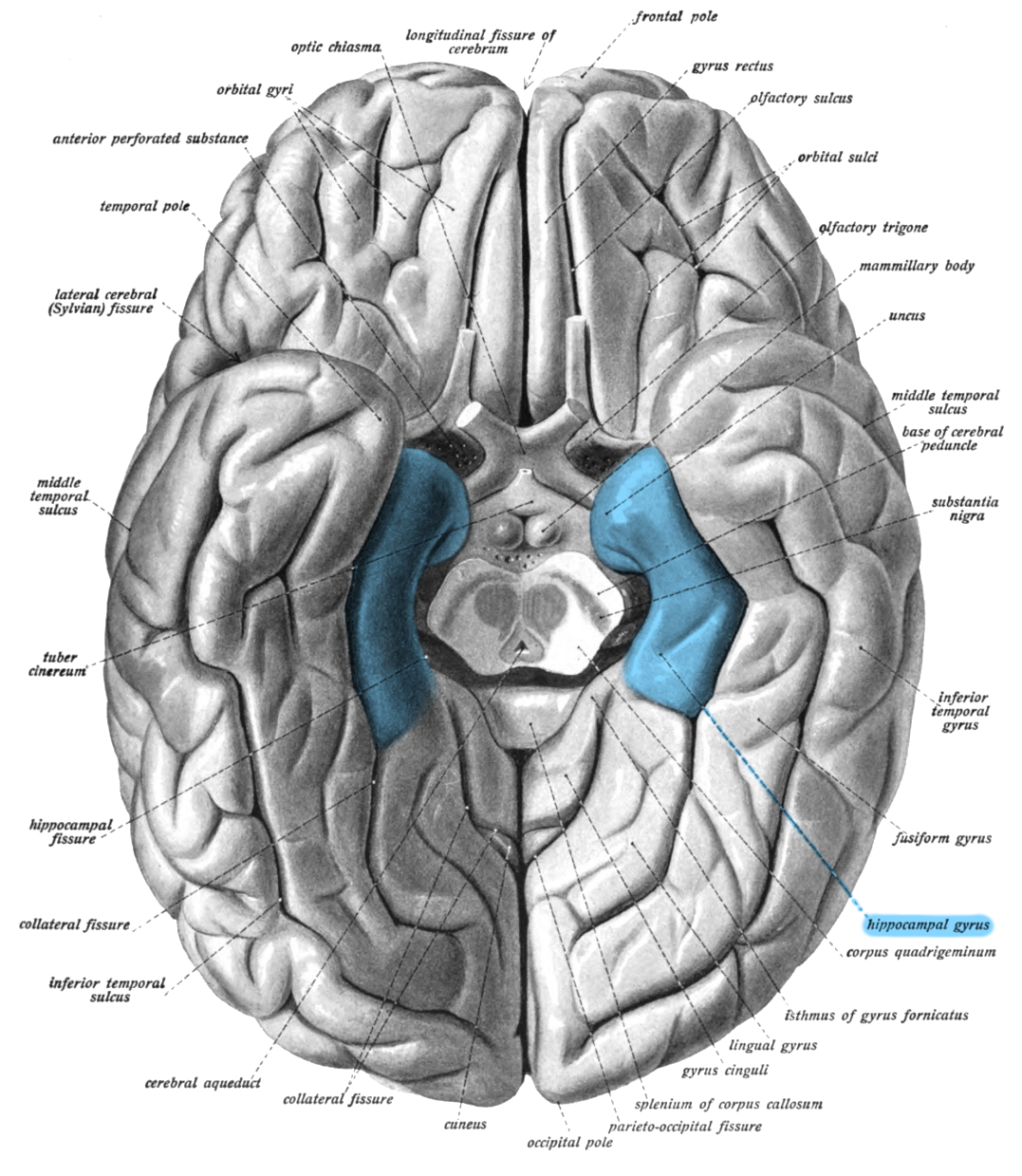
fMRI studies show déjà vu activates the temporal lobe's familiarity circuits without the recollection circuits. It's a glitch in memory formation, and not past life recall.
Sobotta's Textbook and Atlas of Human Anatomy 1908, Public domain, via Wikimedia Commons
A memory system misfire
Déjà vu, French for "already seen," originates from a brief dissonance within the brain's memory systems, primarily located in the medial temporal lobe. Functional magnetic resonance imaging (fMRI) reveals the neural mechanics behind this common and unsettling sensation. The experience arises from a disconnect between two distinct types of memory processing: familiarity and recollection. Familiarity is a rapid, context-free feeling of knowing, managed largely by the rhinal and parahippocampal cortices. Recollection is the slower, more detailed retrieval of specific events and their context, a process heavily dependent on the hippocampus.
During a déjà vu episode, the brain's familiarity circuits fire intensely, but the hippocampal recollection system does not. This creates a strong but baseless feeling that a new situation has happened before. The parahippocampal cortex, which is important for processing scenes and spatial contexts, shows increased activity, contributing to the feeling that a place is familiar. Without corresponding hippocampal engagement, no specific memories are retrieved to explain why it feels familiar. This results in a confusing conflict: a powerful sense of recognition without any evidence. The brain registers this mismatch, producing the distinct "glitch" sensation that defines déjà vu.
Studying a spontaneous sensation
Because déjà vu is spontaneous and fleeting, studying it presents obvious challenges. Neuroscientists have developed clever laboratory methods to induce the experience. One common technique is the Deese-Roediger-McDermott (DRM) paradigm. In these studies, participants are shown lists of thematically related words, such as "bed," "dream," and "tired," but the central theme word—"sleep"—is deliberately omitted. Later, when asked if "sleep" was on the list, participants often falsely remember seeing it, and this moment of incorrect familiarity can trigger a déjà vu-like state.
Research, including studies by Akira O'Connor at the University of St Andrews, suggests that this sensation might be a sign of a healthy brain's error-checking mechanism. The brain creates a false sense of familiarity and then another brain region, possibly in the prefrontal cortex, checks this signal against actual memories. Finding no match, it flags the error, and the conscious experience of that conflict is déjà vu. Evidence for the temporal lobe's role comes from clinical observations of temporal lobe epilepsy, where déjà vu is a common symptom of seizure activity. PET scans in these patients show metabolic changes in the parahippocampal region and superior temporal gyrus, cementing the link between these brain structures and the phenomenon.
💡Fun Facts
Roughly two-thirds of people report having experienced déjà vu at least once.
The phenomenon is most common between the ages of 15 and 25 and its frequency declines with age.
The opposite of déjà vu is "jamais vu" (never seen), where a familiar person or place suddenly feels completely new and unrecognized.
People who travel frequently or have higher levels of education report a slightly higher incidence of déjà vu.