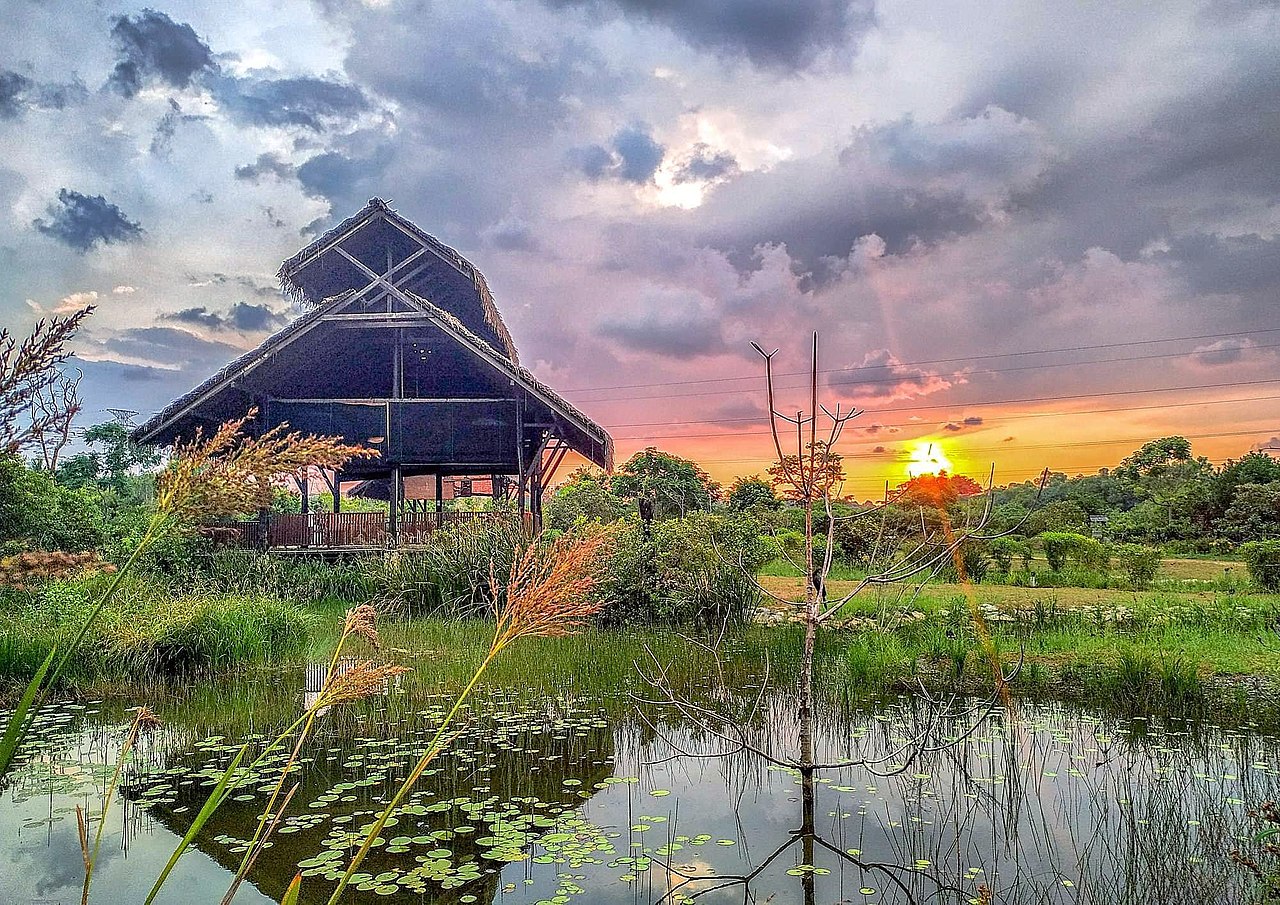
Urban wetlands in Sri Lanka's largest city support over 100 bird species including migrants from Siberia. The green corridors function as stepping stones across the urban matrix.
Randikachat, CC BY-SA 4.0, via Wikimedia Commons
An accredited wetland capital
In Sri Lanka's capital is a network of marshes, lakes, and flooded woodlands that form the Colombo Wetland Complex. This system is so ecologically significant that in 2018, Colombo was named one of the world's first 18 Ramsar Wetland Cities, and it remains the only nation's capital with this accreditation. These wetlands are not pristine preserves; they are integrated into the urban fabric, with dedicated areas like the 18-hectare Beddagana Wetland Park and the 60-acre Diyasaru Park are important biodiversity hotspots.
These green spaces have important hydrological functions for the city. Colombo is built on a low-lying river estuary and is prone to flooding. The wetlands act as natural sponges, absorbing and storing millions of cubic meters of rainwater during heavy storms. Studies have shown that the wetland system retains about 39% of flood waters during a major storm event, a service that would otherwise require costly engineered infrastructure. Before a concerted management strategy was implemented in 2016, Colombo was losing its wetlands at a rate of 1.2% per year. Since the devastating floods of 2010, policy has shifted to recognize these areas as important green infrastructure.
A rest stop for long-haul travelers
The Colombo wetlands are an important stopover point on the Central Asian Flyway, a major migration corridor for birds traveling between their breeding grounds in the Arctic and wintering grounds in the Indian Ocean. Sri Lanka is the final landmass at the southern end of this route. Migratory species begin arriving around August and September, departing again by April or May. These long-distance travelers, some coming from as far as Siberia, include the Heuglin's Gull (Larus fuscus heuglini), which can fly over 7,000 kilometers to reach the island.
The wetlands support a remarkable diversity of avian life, with some parks like Diyasaru hosting over 80 bird species, including about 50 migratory types. Among the resident birds are numerous water-dependent species. The Purple Heron (Ardea purpurea), White-breasted Waterhen (Amaurornis phoenicurus), and Lesser Whistling Duck (Dendrocygna javanica) are common sights. The dense vegetation also provides a habitat for multiple reclusive bittern species, including the Yellow, Black, and Cinnamon Bitterns. Beyond birds, the wetland ecosystem supports a wide array of other animals, including more than 40 species of butterflies and mammals like the Eurasian Otter.
💡Fun Facts
One of the wetlands' most elusive residents is the Fishing Cat (*Prionailurus viverrinus*), a globally vulnerable wild cat twice the size of a domestic cat that has adapted to the urban environment.
Colombo is the only capital city in the world to be accredited as a "Wetland City" by the Ramsar Convention on Wetlands.
Some resident herons have been observed using bait to hunt; a Striated Heron at Beddagana Park was seen dropping a grasshopper onto the water's surface to attract fish.
The wetlands are an important flood buffer; losing them entirely would risk flood damages costing 1% of the Colombo Metropolitan Region's GDP each year.