An uplifted ancient seabed
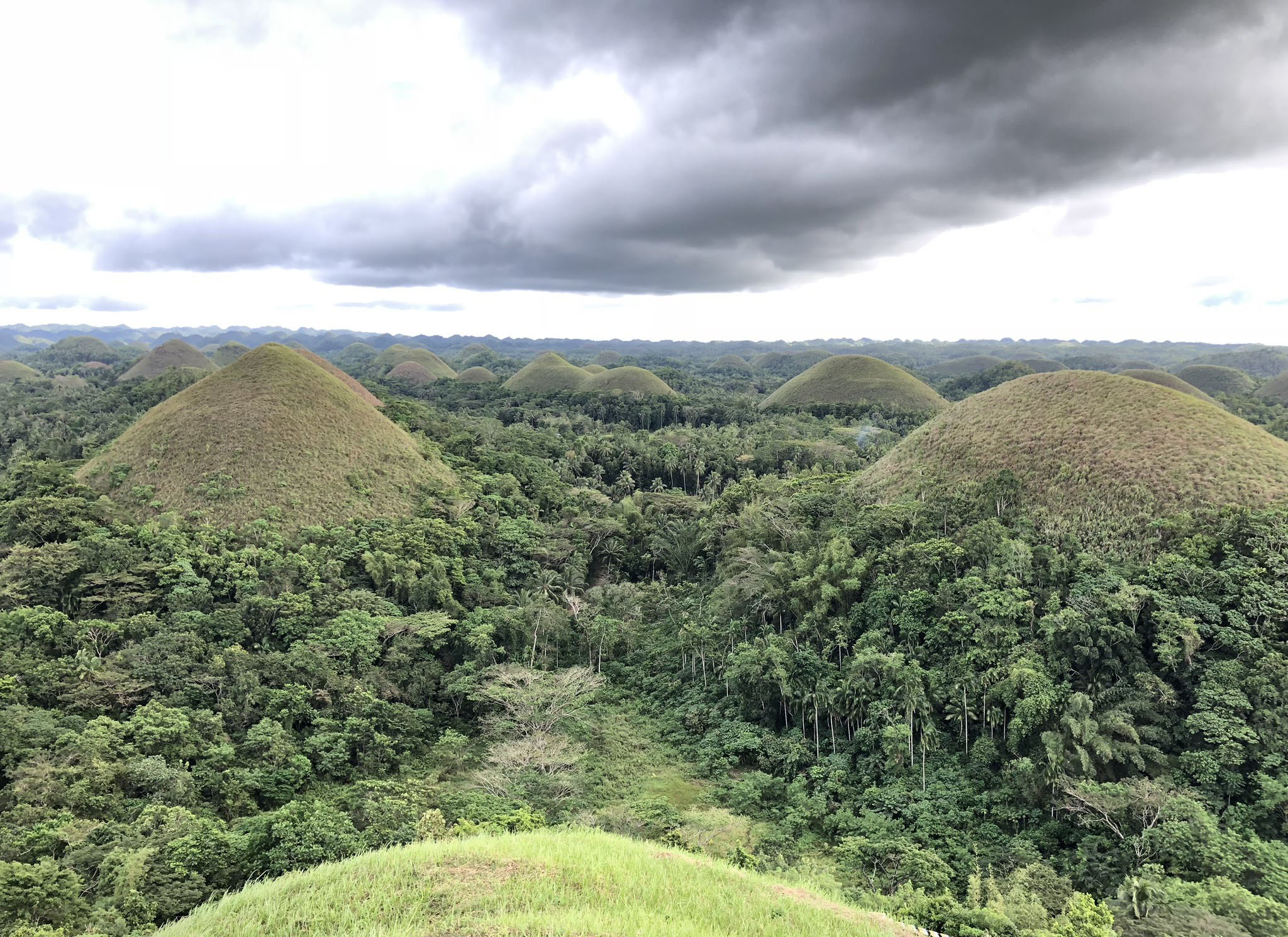
The Chocolate Hills are a geological anomaly spread across more than 50 square kilometers of Bohol island. There are at least 1,260, and perhaps as many as 1,776, near-perfectly conical mounds dotting the landscape. These are not volcanic, but are a rare type of landform called conical karst topography. The hills are the weathered remnants of a thick marine limestone platform that formed from coral reefs and shell deposits during the late Pliocene to early Pleistocene epochs, roughly two to three million years ago. This ancient seabed was pushed above sea level by tectonic activity.
Over millennia, slightly acidic rainwater dissolved the soluble limestone, a process called karstification. The water carved channels and underground drainage, washing away softer materials and leaving behind the more resistant, uniformly shaped limestone cores we see today. The hills themselves range in height from 30 to 50 meters, with the largest reaching 120 meters. Their surfaces are covered in a thin layer of soil that supports hardy grasses, which turn a distinctive cocoa color during the dry season from December to May.
Islands of grass in the sky
The unique topography of the Chocolate Hills creates a network of terrestrial "islands." Each hill is a distinct, isolated habitat, separated from its neighbors by flat, cultivated plains. This isolation drives evolution. Species with limited mobility, such as insects, land snails, and certain plants, can become genetically separated from populations on adjacent hills. Over long periods, this can lead to allopatric speciation—the formation of new species due to geographic isolation.
The dominant vegetation on the hills consists of grass species like Imperata cylindrica (cogon grass) and Saccharum spontaneum (wild sugarcane), which are well-adapted to the thin, calcium-rich soil and seasonal drought. While the grassy hills themselves have a specific ecology, the surrounding forested areas are a biodiversity hotspot. These forests provide a habitat for endemic species, including the near-threatened Philippine tarsier (Carlito syrichta), a tiny nocturnal primate has enormous eyes. The preservation of the entire landscape—both the grassy cones and the wooded valleys between them—is necessary for protecting the region's unique biological heritage.