The Physics of an Underwater Glow
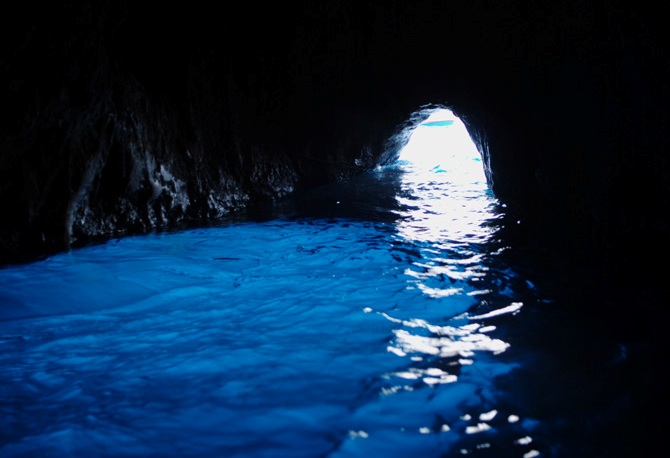
The vivid blue light inside the Grotta Azzurra at Capo Palinuro comes from simple physics acting on a grand scale. The phenomenon is created by sunlight entering the cave primarily through a submerged channel located about 8 meters below the surface. As sunlight penetrates the seawater, the water acts as a natural color filter. It absorbs the longer wavelengths of light, reds, oranges, and yellows—while allowing the shorter, higher-energy blue wavelengths to pass through.
This filtered blue light then illuminates the cavern. The effect is amplified by the geology of the cave itself. The light-colored carbonate rock and sandy bottom reflect the blue light, causing the entire volume of water to glow with an intense, uniform color. The cave is a large cavity, measuring approximately 85 meters long, 90 meters wide, and containing a volume of about 120,000 cubic meters. The most intense color is typically observed in the afternoon when the sun is in the optimal position to shine through the underwater passage.
A Chemosynthetic Ecosystem
The Grotta Azzurra, the Grotta Azzurra contains a distinct biological environment. The cave system is influenced by the presence of hydrothermal sulfur springs. This influx of hydrogen sulfide (H₂S) supports a unique ecosystem based on chemosynthesis rather than photosynthesis. With very little light available in the main part of the cave, sulfur-oxidizing bacteria become the primary producers. These microorganisms harness chemical energy from the sulfide springs to create organic matter, forming the base of a food web that is independent of the sun.
This rare environment supports a diverse collection of fauna not typically found in Mediterranean sea caves. Researchers have documented various species of sponges and cnidarians, some of which show specific distribution patterns related to their distance from the sulfur sources. For example, the abundance of the coral Leptosammia pruvoti decreases closer to the sulfur boundary, while the sponge Aplysilla sulfurea thrives in these conditions. The cave's geology is that of a karst system, formed by the dissolution of carbonate rock over millennia, with a maximum water depth of about 30 meters.