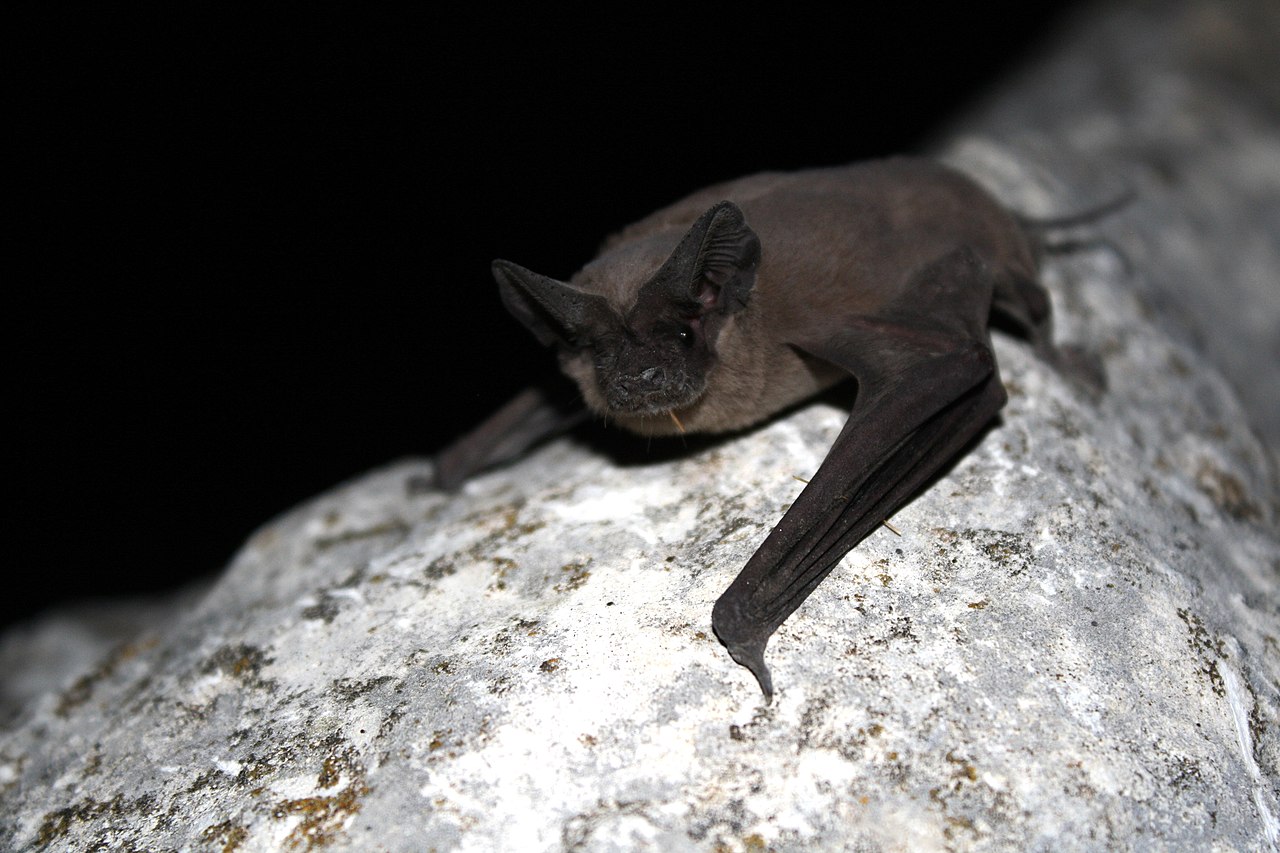
A Storm of Bats
Each evening at dusk in Mato Grosso do Sul, something appears on regional weather radar that isn't a storm. It is a massive, expanding circle of life, a "bloom" of biomass so dense that meteorological equipment interprets it as a cloud. This is the nightly emergence of the Brazilian free-tailed bat, Tadarida brasiliensis. Millions of individuals pour from their cave roosts in columns that ascend up to 3,000 meters into the sky. The sheer number of bats creates a radar signature that can be tracked as they disperse outwards in a circular pattern, often mistaken for a weather event by the uninitiated.
This species is one of the most abundant mammals in the Americas, forming enormous colonies. While the largest documented colonies, reaching nearly 20 million individuals, are in Texas, substantial populations exist throughout their range, including the agricultural heartland of Brazil. The bats are built for long-distance, high-altitude flight, with long, narrow wings suited for rapid travel. They can cover over 50 kilometers in a single night to reach foraging grounds. Their flight is high and incredibly fast; Tadarida brasiliensis holds the record for the fastest horizontal flight speed of any animal, clocked at 160 kilometers per hour (99 mph). This speed is achieved through powerful wing beats, and not by riding tailwinds.
Unseen Pest-Control Service
The nightly exodus is driven by a voracious appetite for insects. A single lactating female can eat up to two-thirds of her body mass in insects each night. Their diet is varied but consists primarily of moths, beetles, and other night-flying insects. Many of their prey are significant agricultural pests. DNA analysis of their feces and direct observation confirm they consume huge quantities of insects like the corn earworm moth (Helicoverpa zea) and the cotton bollworm, whose larvae are destructive to crops.
This mass consumption of pests provides a valuable, ecosystem service to agricultural regions like Mato Grosso do Sul. Studies in North American cotton-growing regions have attempted to quantify this benefit. In one eight-county region of Texas, the bats' pest control was valued at an average of $741,000 annually, preventing millions of dollars in crop damage and reducing the need for chemical pesticides. A single bat can provide a service worth about $0.02 per night just by eating moths that would otherwise damage cotton bolls. When scaled to millions of bats over a growing season, the economic impact is substantial. They are a critical, natural component of integrated pest management, operating on a continental scale.