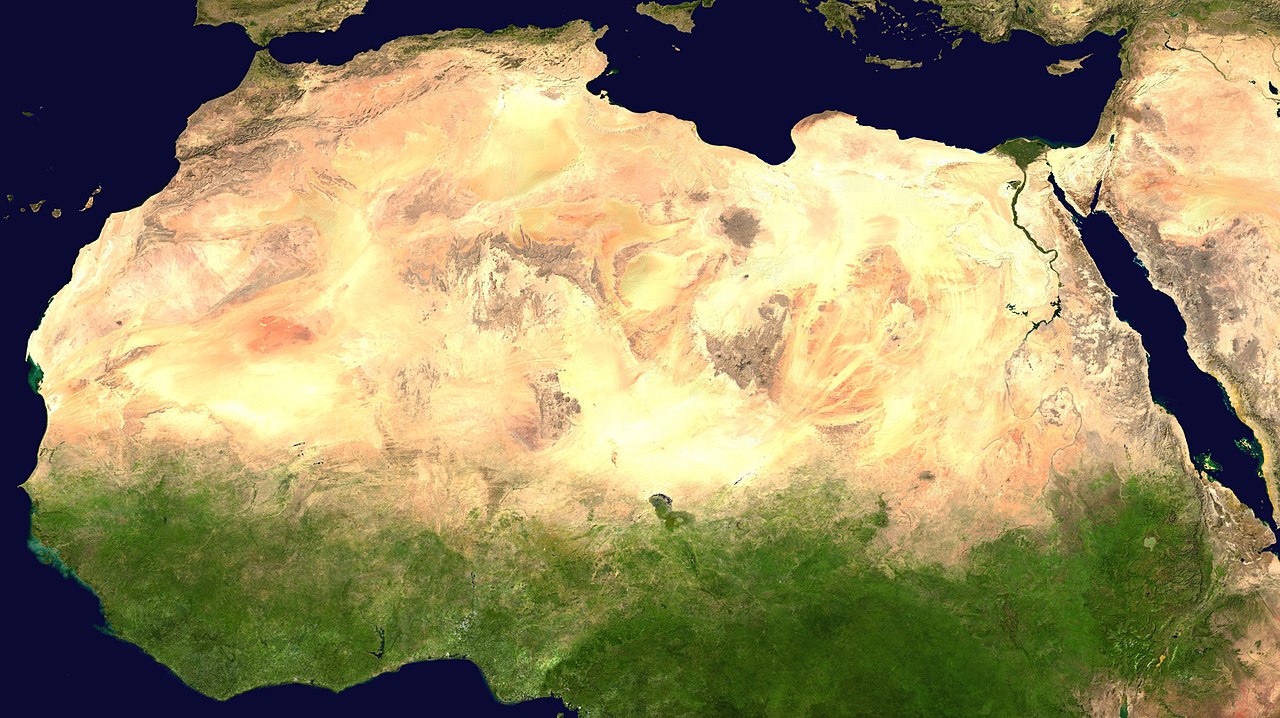
Sand dunes migrating 4m per year inland. Grain size analysis shows sand originates from Sahara dust that settles in the sea, gets pushed ashore by waves, then blown inland by wind.
NASA, Public domain, via Wikimedia Commons
A desert on the move
Within the La Breña y Marismas del Barbate Natural Park, a steady geological drama unfolds. A system of mobile dunes is relentlessly advancing inland, burying a pine forest in its path. This migration is powered by the persistent Levante wind, an easterly wind that gains speed as it funnels through the Strait of Gibraltar. The wind picks up sand from La Hierbabuena beach and pushes it landward, forming dunes that can reach heights of over 100 meters.
This moving area is part of a protected area covering over 5,000 hectares, which includes terrestrial and marine ecosystems. The dunes themselves are a major feature, constantly reshaping the boundary between the coast and the extensive stone pine forest. This forest, largely planted in the 19th century to help stabilize the sand, now fights a losing battle against the inexorable march of the dunes. The advance is visible in the partially buried trunks of Pinus pinea trees at the dune system's leading edge.
An African origin story
The sand itself shows the history of its movement across continents and oceans. Analysis of the sand's physical and mineralogical properties reveals its origin is not local. The fine, well-sorted quartz grains are characteristic of aeolian dust—dust carried by the wind. Specifically, this sand began as dust swept up from the Sahara Desert, the world's largest source of such material.
Carried west over the Atlantic, a portion of this dust settles into the ocean. Ocean currents then transport these particles toward the Iberian coast. In the Gulf of Cádiz, waves and tides push the sand ashore onto beaches like La Hierbabuena. From there, the powerful Levante wind takes over, lifting the grains and driving them inland to form the migrating dunes. This multi-stage process creates a direct geological link between the deserts of North Africa and the coast of southern Spain. The dunes are a physical record of immense and ongoing natural transport systems.
💡Fun Facts
The Levante wind that moves the dunes can blow for 4 to 7 days at a time, with gusts sometimes exceeding 100 kilometers per hour.
The park's cliffs provide nesting sites for various birds, including cattle egrets, jackdaws, and peregrine falcons.
The dune system hosts one of Andalusia's most significant populations of the endangered prickly juniper (*Juniperus oxycedrus*).
The park contains several 16th-century watchtowers, like the Torre del Tajo, built to defend against pirates.
The park is a natural, open area, generally accessible 24/7. Specific recreational areas or information points may have set hours.
Admission
Free.
Accessibility
Terrain consists of uneven, sandy paths. The dune fields are not accessible to wheelchairs. Reaching the area requires walking on soft sand and marked trails.