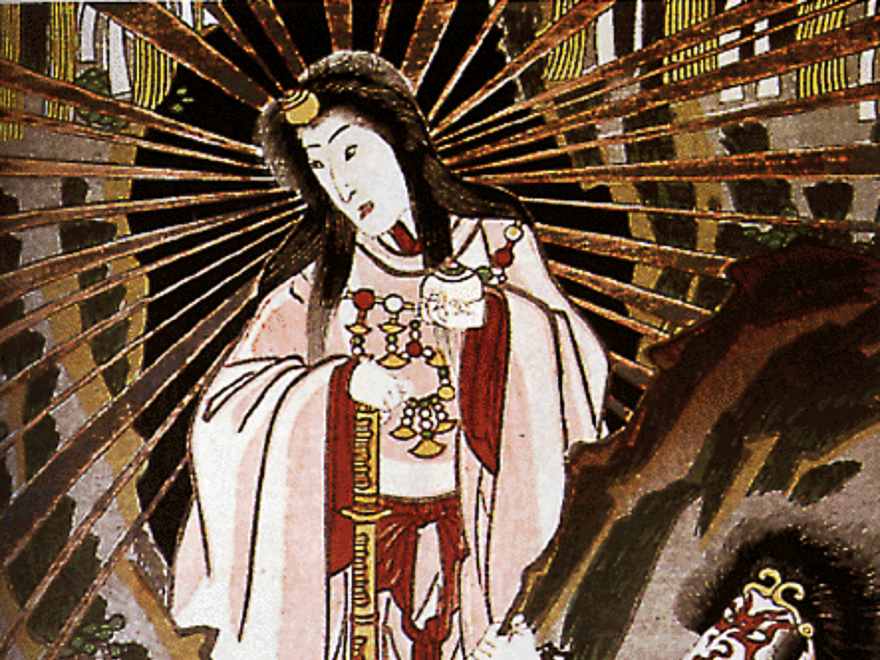
A sword, a serpent, and a watery grave
Deep within Nagoya's Atsuta Jingu, one of Japan's most sacred shrines, rests an object of immense legendary importance: the Kusanagi-no-Tsurugi, or "Grass-Cutting Sword". This blade is one of the three Imperial Regalia of Japan, symbols of the emperor's divine authority. Myth traces its origin to the tail of an eight-headed serpent, Yamata-no-Orochi, slain by the storm god Susanoo. For centuries, the sword's story was clear. It passed through generations of emperors until the 12th century and the Genpei War.
The epic naval Battle of Dan-no-ura in 1185 was a turning point. Facing defeat, the grandmother of the child Emperor Antoku reportedly leaped into the sea with him, taking the sacred sword and jewel with her to prevent their capture. While the jewel was recovered, the Kusanagi was believed to have been lost to the saltwater of the Shimonoseki Strait forever. Accounts differ, with some claiming the lost blade was a replica, but the story of its ocean burial became central to its history. The sword currently housed at Atsuta Jingu is officially considered the original, but it is never displayed publicly.
The science of rust tells a different story
Modern analytical techniques offer a way to test this legend without ever unsheathing the blade. The field of archaeometry applies scientific methods to historical artifacts, and the story of the Kusanagi's loss presents a testable hypothesis. Metal corrodes differently depending on its environment. Saltwater corrosion is an electrochemical process accelerated by the high conductivity and chloride ions in seawater. This typically results in faster, more uniform degradation of iron-based alloys.
Freshwater corrosion is often slower and can produce different mineralisation patterns. Non-destructive methods like X-ray fluorescence (XRF) analysis can detect the chemical composition of an object's surface, including its corrosion layers. By bombarding the object with X-rays, scientists can identify the elements present based on the characteristic secondary X-rays emitted. The presence or absence of significant chlorine compounds and other saltwater markers in the sword's patina could show the difference between submersion in the ocean versus a river, lake, or even a long burial in damp soil. The analysis of the Kusanagi's corrosion points to a past spent in freshwater, directly contradicting the famous account of its loss at sea.