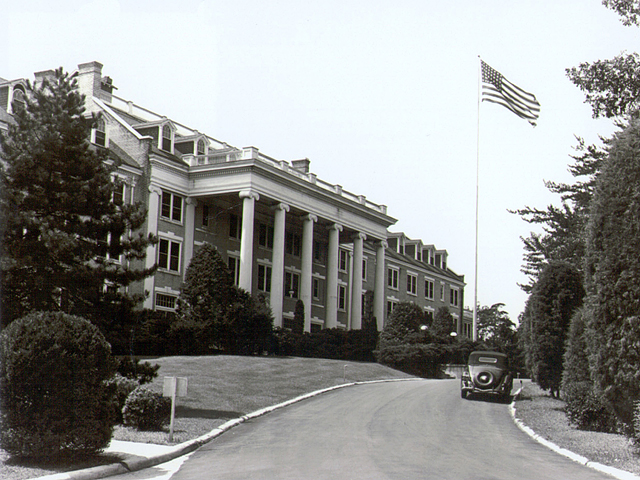
From Finishing School to Codebreaking Factory
In 1927, Arlington Hall opened as a junior college for young women, its colonial-style main building looking over a 100-acre campus of landscaped gardens and lawns. This quiet academic setting was completely transformed by World War II. In April 1942, officers from the U.S. Army's Signal Intelligence Service (SIS), the nation's codebreaking division, happened upon the school while searching for a new headquarters. They had outgrown their cramped offices in Washington D.C. and needed a location that was both accessible and secure.
On June 10, 1942, the U.S. Army acquired the college under the War Powers Act. A double chain-link fence was erected, and the school for "genteel young ladies" became a top-secret intelligence facility known as Arlington Hall Station. The campus rapidly expanded with the construction of barracks, new operations buildings, and support facilities to accommodate a massive influx of personnel. By the end of the war, the workforce had swelled to nearly 8,000 military and civilian staff, the majority of whom were women recruited from colleges and teaching professions for their aptitude in mathematics and languages.