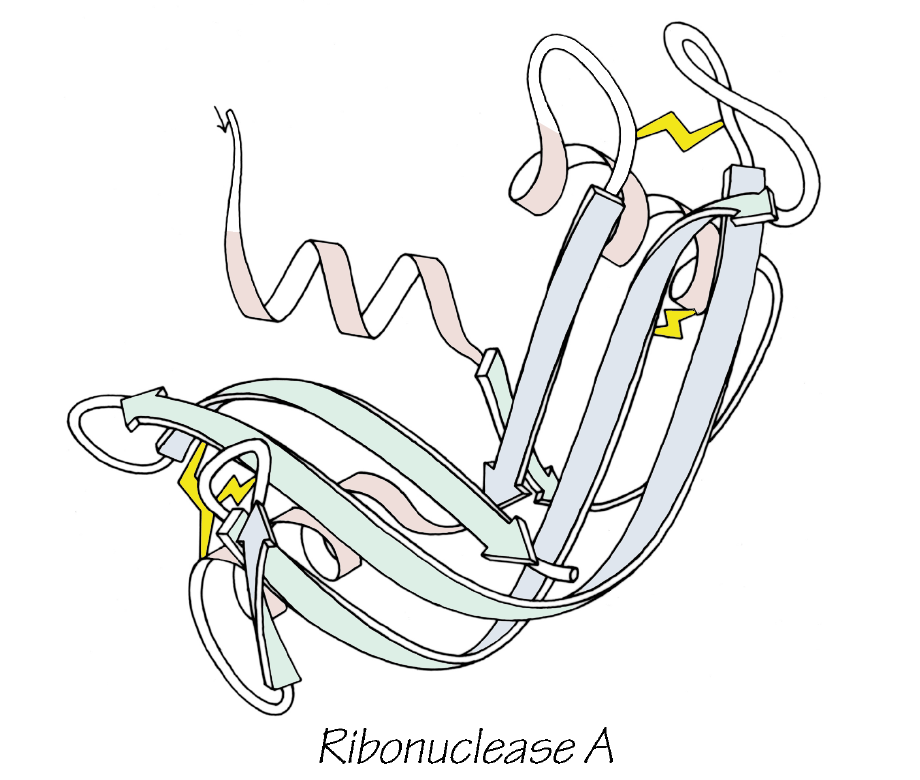
How amino acid chains fold into precise 3D shapes in milliseconds remains unsolved. The search space is astronomical, yet biology does it effortlessly.
Dcrjsr, CC BY 3.0, via Wikimedia Commons
The Impossible Timescale
Every living process depends on proteins, molecular machines that perform countless tasks from digesting food to replicating DNA. Each protein is first built as a linear chain of amino acids, but it only becomes functional when it folds into a three-dimensional structure. This folding happens spontaneously, often in microseconds or milliseconds. This speed is a paradox.
In 1969, biologist Cyrus Levinthal calculated the sheer impossibility of this process. A modest protein of 100 amino acids, with only three possible orientations for each amino acid's bonds, could exist in 3^200 (or about 10^95) different configurations. If the protein had to sample every possible shape to find the right one, even at a rate of trillions of conformations per second, it would take longer than the current age of the universe. This discrepancy is known as Levinthal's Paradox.
Yet, biology solves this problem constantly. The solution is that folding is not a random search. The amino acid sequence itself guides the process, following a kind of energy gradient that funnels the protein towards its final, most stable shape. In the 1950s, Christian Anfinsen demonstrated this principle in a series of experiments. He took the enzyme ribonuclease A, denatured it with chemicals to make it unfold, and then removed the chemicals. The protein spontaneously refolded into its correct, biologically active shape, showing the amino acid sequence contains all the necessary information.
When folding goes wrong
While the amino acid sequence dictates the final form, the cellular environment provides support. Special proteins called molecular chaperones, such as the GroEL-GroES complex in bacteria, assist in the folding process. GroEL forms a barrel-like cage that isolates a newly forming protein, preventing it from clumping together with other proteins and giving it a protected space to fold correctly.
Sometimes, this process fails. When proteins misfold, they can become non-functional or toxic. These errant proteins can aggregate, forming clumps that damage cells and tissues. several neurodegenerative diseases are linked to specific misfolded proteins. In Alzheimer's disease, amyloid-beta proteins form plaques and tau proteins form tangles in the brain. In Parkinson's disease, the culprit is aggregated alpha-synuclein.
Some misfolded proteins, known as prions, are infectious. A prion is an abnormally folded version of a normal protein (PrP) that can induce correctly folded PrP proteins to change shape, setting off a chain reaction. This process leads to fatal transmissible spongiform encephalopathies like Creutzfeldt-Jakob disease in humans and bovine spongiform encephalopathy (BSE), or "mad cow disease," in cattle. Unlike viruses or bacteria, prions contain no genetic material like DNA or RNA.
Computational biology has improved at predicting protein structures from their amino acid sequences. DeepMind's artificial intelligence system, AlphaFold, has predicted the structures of over 214 million proteins from across the tree of life, a task that would take centuries with traditional experimental methods. This database provides researchers with powerful tools to understand protein function and design new drugs.
💡Fun Facts
A single prion, a misfolded infectious protein, can trigger a chain reaction that converts healthy proteins into diseased forms.
Cyrus Levinthal calculated that a small protein sampling all its possible shapes would take 10^27 years, vastly longer than the age of the universe.
The AI system AlphaFold has predicted the 3D structures for over 214 million proteins, a massive expansion from the roughly 200,000 structures determined experimentally over decades.
Some proteins fold in microseconds, among the fastest known chemical reactions in biology.