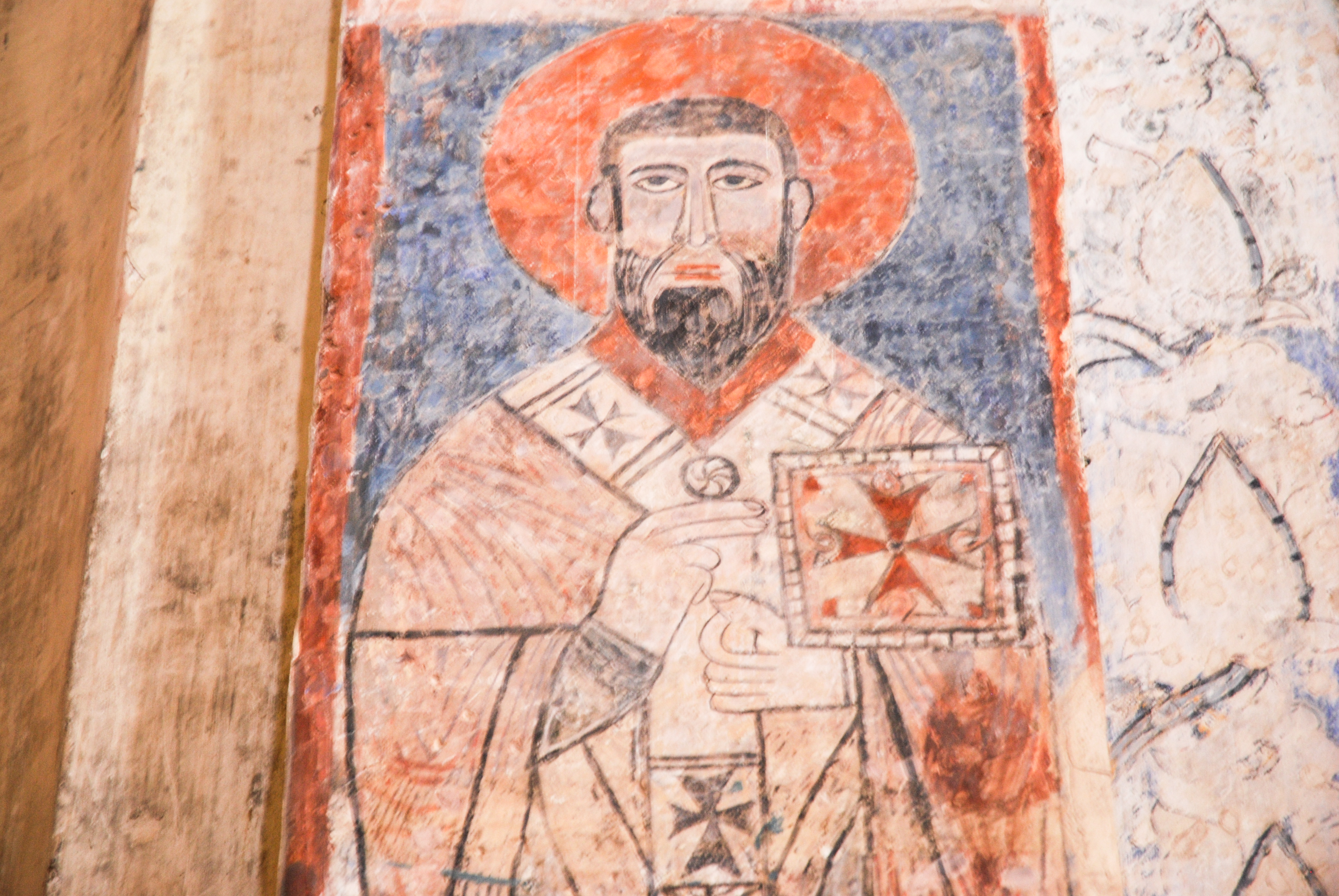
10th-century frescoes survive 1,000 years of weather due to egg tempera binding. Chemical analysis shows pigments were ground with specific particle sizes to optimize light scattering - medieval painters understood wave optics empirically.
Zorka Sojka, CC BY-SA 4.0
A Millennial-Durability Binder
On Akdamar Island in Turkey's Lake Van sits the Cathedral of the Holy Cross, a church built between 915 and 921 AD. Its interior walls are covered with frescoes that have survived for more than 1,100 years. The paintings depict the story of Creation and scenes from the life of Christ. The remarkable longevity of these images comes from their material composition: they are painted in egg tempera.
Egg tempera is a simple but highly effective paint made by mixing powdered pigments with egg yolk and water. The science behind its durability lies in the chemistry of the egg yolk. Yolk contains emulsifying proteins and lipids that create a stable, water-resistant adhesive binder for the pigment particles. As the paint dries, the water evaporates, and the egg yolk components polymerize, forming a tough, cross-linked matrix that locks the pigment to the wall. This process happens quickly and creates a paint layer that is not affected by humidity or temperature, a critical factor for its survival in a region with harsh continental weather. The interior of the church, built from volcanic tufa, measures 14.80 by 11.5 meters, with its dome reaching 20.40 meters high.
Medieval Wave Optics
The painters of Akdamar Church did more than create durable images; they practiced a form of materials science. Chemical analysis of the frescoes, combined with the physics of light, reveals an empirical understanding of optics. The color and brightness of a pigment are not determined solely by its chemical makeup, but also by the size and shape of its particles. Different particle sizes scatter and absorb light in different ways.
For light to be scattered most efficiently, the diameter of the pigment particle should be approximately half the wavelength of the light itself. Finer particles, for instance, are better at scattering blue light, which can give a color a cooler, more brilliant tone. Conversely, coarser particles may result in colors with higher saturation but lower lightness. The medieval artisans who created the Akdamar frescoes controlled these properties by carefully grinding their pigments to specific dimensions. Through methodical experimentation, they learned how to produce particular optical effects, manipulating the wave properties of light to achieve their desired artistic results. This control over particle size demonstrates a practical, if not theoretical, mastery of concepts that modern science describes with wave optics and light scattering theory.
💡Fun Facts
The church was originally part of a larger palace complex commissioned by King Gagik I Artsruni, though only the church still stands.
The name "Akdamar" derives from a local legend about a princess named Tamar and her lover, who drowned in the lake calling out "Akh, Tamar!" (Oh, Tamar!).
The church's exterior is covered in extensive and unique bas-relief carvings of biblical scenes, including David and Goliath, and Jonah being thrown to a great fish.
Egg tempera paint was a primary medium for painters from antiquity through the medieval period, used by well-known Renaissance artists like Botticelli.
The island is generally open to visitors daily from 8:00 AM to 5:00 PM or 6:00 PM.
Admission
There is an entrance fee for the island/museum, payable in cash. Ferry transport from the town of Gevaş requires a separate ticket.
Accessibility
Access to Akdamar Island is by a 20-30 minute ferry ride from a port in the Gevaş district. The terrain on the island can be uneven, and comfortable shoes are recommended.