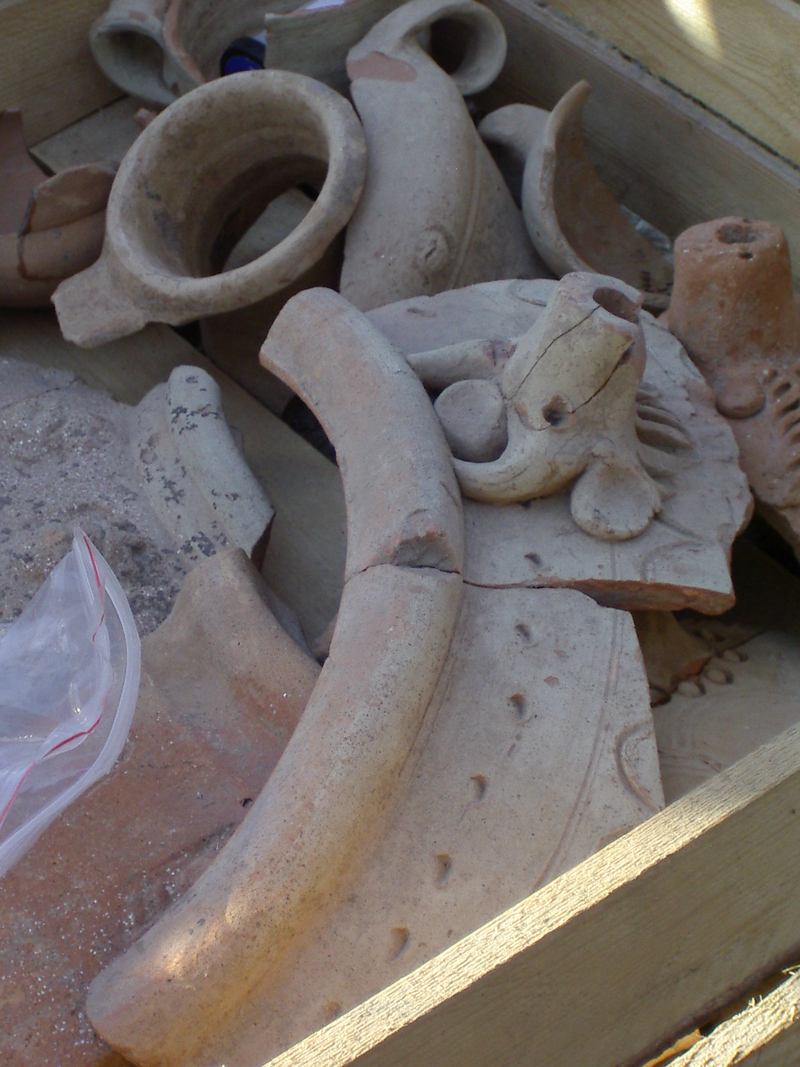
Ancient pottery sherds found near Samarkand contain invisible chemical signatures that rewrite the history of Central Asian economies.
faqparigine, CC BY-SA 2.0
Atomic clues in ancient clay
The Zarafshan River valley, the agricultural heartland of ancient Sogdiana, has long been a focal point for archaeologists studying the Silk Road. For centuries, Samarkand was a major center for producing beautiful glazed ceramics. But the visual characteristics of this pottery only tell its history. Beneath the surface, locked within the clay itself, is a precise chemical signature that reveals where a pot was made. By analyzing this "fingerprint," researchers can map the economic networks of Central Asia with precision.
The primary technique used is Instrumental Neutron Activation Analysis (INAA). This method involves bombarding a small sample of a pottery sherd with neutrons. The atoms in the clay absorb these neutrons, become radioactive for a short time, and then decay, emitting gamma rays. Each chemical element emits gamma rays with a unique energy signature, allowing scientists to determine the exact concentration of up to 40 different elements in the clay. Elements like scandium, chromium, cobalt, and lanthanum are particularly useful for creating a distinct profile for a specific clay source. Because the geology of every clay deposit is slightly different, this chemical profile is as unique as a human fingerprint.
Mapping markets and workshops
This analytical power allows archaeologists to answer questions that were previously unresolvable. By comparing the chemical fingerprint of pottery found at a consumer site—like a home or a bazaar—to a library of fingerprints from known kiln sites and clay sources, they can pinpoint its origin. This has led to a much more detailed understanding of the Sogdian and early Islamic economies in the Zarafshan Valley.
For example, analysis can distinguish between pottery made in urban centers like Samarkand and wares produced in smaller, rural workshops. It can track the distribution range of a single workshop's products, showing how far up or down the river its goods traveled. This data helps reconstruct trade routes and determine the market share of different production centers. Researchers can see if the market was dominated by a few large producers or supported many small, local artisans. The results show that entire quarters of Samarkand were dedicated to pottery masters who produced high-quality wares that influenced styles in other cities like Tashkent and Bukhara. This technique shows the organization of craft production and the scale of regional commerce centuries before written economic records became common.
💡Fun Facts
Instrumental Neutron Activation Analysis is so sensitive it can often distinguish between clay sources located only a few kilometers apart.
The technique can measure the concentration of some elements down to the parts-per-billion level.
The Zarafshan River, which supplied the clay and water for the region's potters, flows from the mountains of Tajikistan and ends in the Kyzyl-Kum Desert.
Some of the earliest pottery production in the Samarkand region dates back thousands of years before the Silk Road.