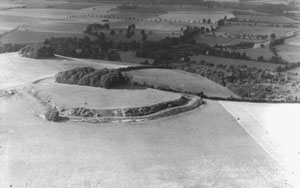
Twin Iron Age hillforts guarding the Thames crossing. Excavations revealed a massacre. Dozens of bodies with sword cuts and spear wounds dumped in ditches around 100 BCE.
Major George Allen (1891–1940), Public domain, via Wikimedia Commons
An Iron Age crime scene
The Wittenham Clumps are a pair of prominent chalk hills, Castle Hill and the slightly taller Round Hill, that rise above the River Thames. For thousands of years, their strategic position made them a center of human activity. The story of this landscape is written in its earthworks and the artifacts buried within. While there is evidence of occupation dating to the Bronze Age (around 1000 BCE), the most dramatic chapter belongs to the Iron Age.
Around 600 BCE, inhabitants constructed a formidable hillfort on Castle Hill, digging deep, U-shaped ditches and raising earthen ramparts for protection. This settlement thrived for centuries. The community farmed wheat and barley, managed herds of cattle and sheep, hunted wild boar, and fished from the Thames. Excavations across the valley have uncovered Iron Age rubbish pits, suggesting a widespread and bustling population.
This period of stability ended violently. The hook for this location describes dozens of bodies found dumped in the defensive ditches. These remains, dating to around 100 BCE, show clear evidence of a massacre. Osteological analysis reveals numerous sword cuts, spear wounds, and other traumatic injuries inflicted around the time of death. The discovery makes the landmark the site of a brutal prehistoric conflict, a case over two millennia old. Later excavations at the base of the hills have revealed a large, open settlement with at least 10 roundhouses, some up to 14 meters in diameter, showing a substantial community was present during this volatile period.
From Roman villas to Victorian poems
After the massacre, the hillfort appears to have been abandoned for a time. Activity resumed during the Roman period, when the focus of settlement shifted from the exposed hilltops to the surrounding lowlands. A geophysical survey and subsequent excavations on the slopes of Round Hill uncovered the remains of a substantial Roman corridor villa, at least 36 meters across. Finds from this period include pottery, coins, and even a corn-drying kiln, which may have been used for malting barley to brew beer. This suggests a high-status Roman farmstead existed here from the 3rd to 4th century CE.
The hills themselves are a geological feature of Upper Greensand and Chalk, formed between 65 and 145 million years ago and pushed up by tectonic plate collision. Their distinctive wooded caps are not ancient and wild, but rather deliberate plantings. The "clumps" of beech trees that give the hills their name are the oldest known planted hilltop beeches in England, dating to the 1740s.
One of these beeches, which died in the 1990s, became known as the "Poem Tree." Between 1844 and 1845, a local man named Joseph Tubb carved a poem into its bark reflecting on the area and its history. Though the original tree is gone, a commemorative stone preserves his words, adding another layer to the history of this site.
💡Fun Facts
The site has several colloquial names, including the "Berkshire Bubs" and, more unusually, "Mother Dunch's Buttocks," after a 17th-century lady of a local manor.
The Celtic name for the hills is Sinodun, which means "Old Fort".
An oval bronze shield from the Iron Age was recovered from the nearby river in 1836, and a decorated Iron Age sword and scabbard were found in 1982.
The site is the most visited free-to-access outdoor space in Oxfordshire, attracting over 200,000 visitors annually.