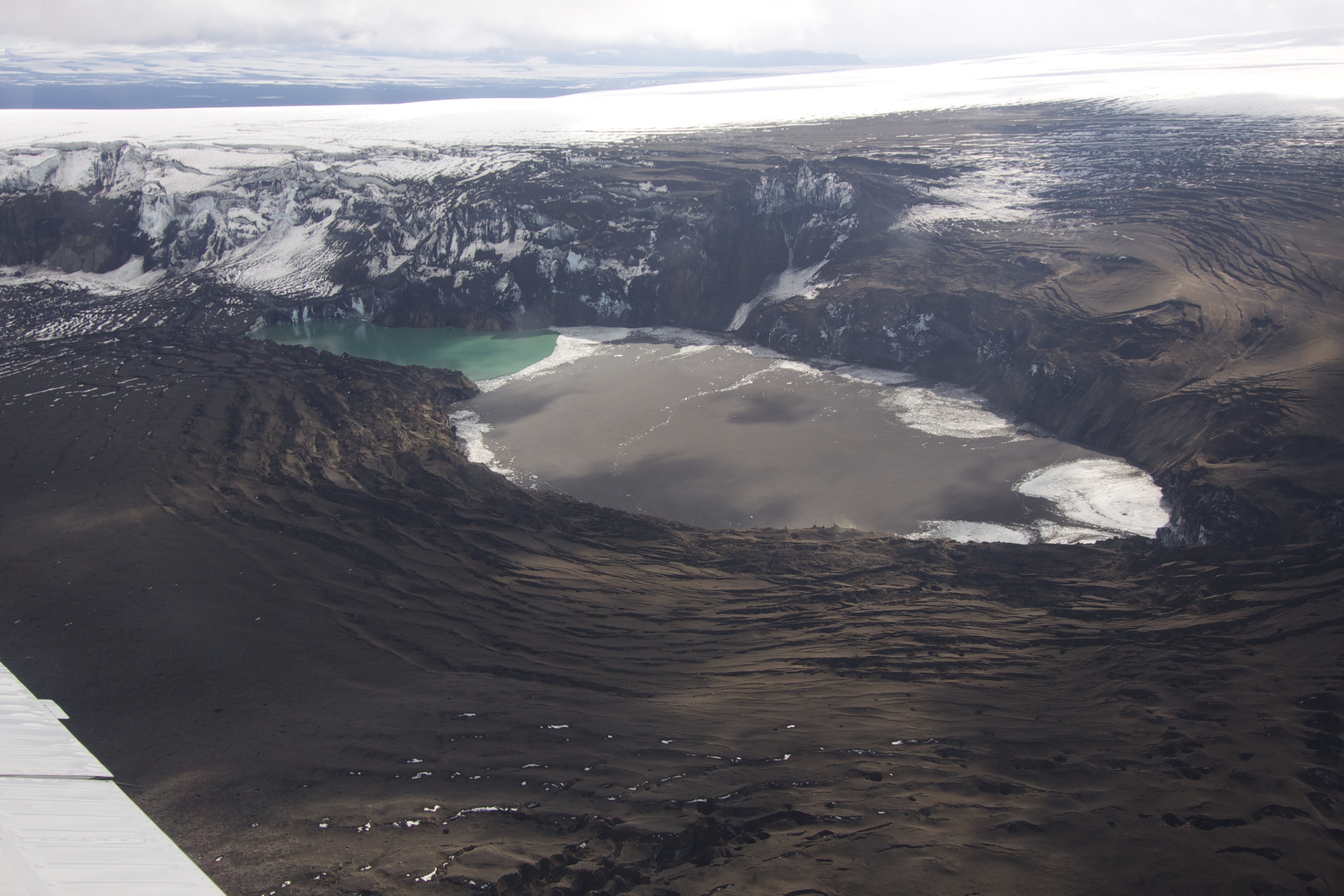
A world beneath the ice
Underneath Vatnajökull, Europe's largest ice cap by volume, lies a hidden world of liquid water. Several active volcanic systems, including Grímsvötn and Bárðarbunga, sit directly beneath the ice. The constant geothermal heat they produce melts the base of the glacier, forming dozens of subglacial lakes insulated from the surface by hundreds of meters of ice.
The best-known of these are the Grímsvötn lakes, which lie within a volcanic caldera, and the two Skaftárkatlar lakes. The ice above the Skaftárkatlar is 350 to 400 meters thick. These lakes are not static; they grow as meltwater accumulates and then drain periodically in immense glacial outburst floods known as jökulhlaups. A major jökulhlaup from Grímsvötn in 1996 released water at a peak flow of 50,000 cubic meters per second, temporarily making it one of the largest rivers on Earth by volume. These powerful events are a fundamental force in shaping the Icelandic landscape, creating the vast sandur plains south of the glacier.
A paradox of life
The complete darkness, low nutrient levels, and immense pressure under the ice create an extreme environment. Yet, these lakes host unique microbial ecosystems. Scientists have found communities of bacteria that are specially adapted to the cold, dark conditions. These organisms are chemosynthetic, meaning they derive energy from chemical reactions involving sulfur and iron compounds released by the geothermal vents, rather than from sunlight. This process is a basis for life completely independent of the sun.
The most unusual feature is the coexistence of two opposite types of extremophiles. The bulk of the lake water is near freezing, ideal for psychrophiles (cold-loving microbes). Simultaneously, geothermal hotspots on the lakebed create zones of much warmer water, providing a habitat for thermophiles (heat-loving microbes). Studies of accretion ice from Lake Vostok in Antarctica—ice formed from the lake water freezing to the bottom of the glacier—have also revealed signatures of thermophilic bacteria, suggesting geothermal systems may be a common feature of subglacial lakes. The Vatnajökull lakes, with their sharp temperature gradients, show how these two distinct life strategies can operate in the same isolated system. The low-diversity bacterial communities found here are dominated by just a handful of taxa, including Sulfuricurvum and Acetobacterium. These subglacial ecosystems are used as analogs to study how life might exist in the sub-surface oceans of icy moons like Jupiter's Europa and Saturn's Enceladus.