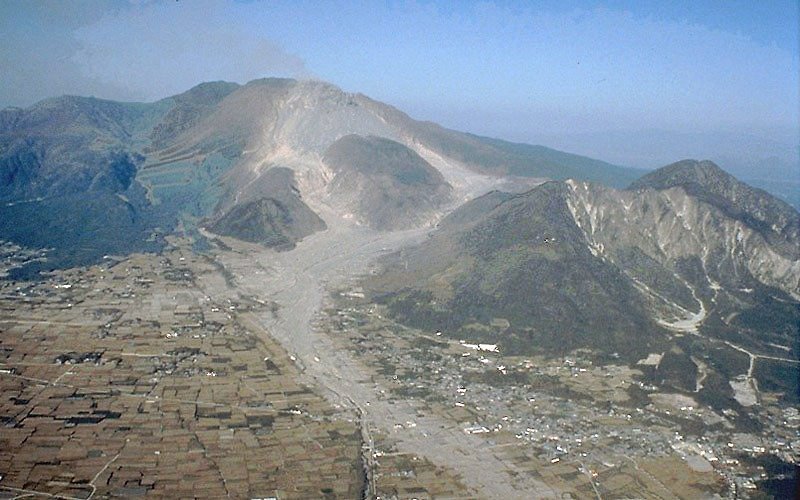
Deadly pyroclastic flows from a collapsing lava dome. Analysis shows half the debris came from crushing rock; not explosive magma.
Public domain, via Wikimedia Commons
A dome of destruction
After 198 years of quiet, Mount Unzen reawakened in November 1990. The initial phreatic, or steam-blast, eruptions were small, but by May 1991, thick, viscous dacite lava began to squeeze out of the summit of Fugendake peak. This high-silica lava was too thick to flow far, so it piled up, creating a mound of hot rock called a lava dome. This dome grew unstably on the mountain's shoulder. As more lava pushed from below, the dome's steep flanks would frequently crumble under gravity.
On June 3, 1991, a larger section of the dome collapsed. This triggered a block-and-ash flow, a type of pyroclastic flow, that accelerated down the mountain. This avalanche of hot rock, ash, and gas reached 4.5 km from the crater and claimed the lives of 43 people, including volcanologists Katia and Maurice Krafft and Harry Glicken. Over the course of the eruption, which lasted until 1995, the volcano produced nearly 10,000 such pyroclastic flows, destroying more than 2,000 buildings in its path. The total volume of erupted magma was 210 million cubic meters, with about half of that volume collapsing into pyroclastic flows.
An avalanche of ground rock
The pyroclastic flows at Unzen were a specific type known to geologists as a nuée ardente, or "glowing cloud." These are generated by the mechanical collapse of a lava dome rather than the explosive disintegration of magma in an eruption column. The material in the Unzen flows consists of dense, blocky fragments from the pre-existing dome, mixed into a matrix of finer ash.
Detailed scientific analysis of the ash deposits from the Unzen flows revealed a surprising origin. A significant portion of the fine ash particles were not created by the explosive expansion of gas in magma. They were the product of mechanical grinding. As the massive, hot blocks of the collapsing dome tumbled and crashed against each other in the avalanche, they milled themselves down into fine dust through a process called comminution. This self-grinding of solid rock is what produced much of the ash. This discovery showed that dome-collapse pyroclastic flows are fundamentally different from those of Plinian eruptions, where ash is formed primarily by the fragmentation of frothy, gas-rich pumice. The 1990-1995 eruption was one of the most thoroughly documented lava dome eruptions in history, providing data on these hazardous processes.
💡Fun Facts
The 1990-1995 eruption built a new lava dome, named Heisei Shinzan, which at 1,486 meters is now the highest peak in Nagasaki Prefecture, surpassing the original Fugendake peak.
A 1792 catastrophe at Unzen began when the flank of the Mayuyama dome collapsed after an earthquake, triggering a landslide and a megatsunami in the Ariake Sea that killed an estimated 15,000 people, Japan's deadliest volcanic disaster.
Over the five-year eruption in the 1990s, the volcano produced approximately 9,400 pyroclastic flows, repeatedly burying the Mizunashi River valley.
The former Onokoba Elementary School, destroyed by a pyroclastic flow, has been preserved as a memorial to the disaster.
The Mount Unzen Disaster Memorial Hall is open from 9:00 to 18:00 (last admission at 17:00).
Admission
Admission to the Memorial Hall is 1,050 yen for adults. Admission to the preserved Buried Houses and the ruins of Onokoba Elementary School is free.
Accessibility
The Memorial Hall is an accessible modern museum. The surrounding area is a mountainous volcanic park with hiking trails of varying difficulty. A ropeway provides access part-way up the mountain.