A Sultan's Scientific Ambition
In the 1420s, Ulugh Beg, the Timurid ruler and grandson of the conqueror Timur, began construction on a scientific institution unparalleled in the medieval world. He was a skilled mathematician and astronomer himself, and he gathered more than 60 of the era's best scientific minds, including Jamshid al-Kashi and Ali Qushji, to work at his new observatory in Samarkand. The observatory was a three-story cylindrical building, approximately 46 meters in diameter and 30 meters high. Its primary purpose was to create the most precise astronomical measurements and star charts ever produced.
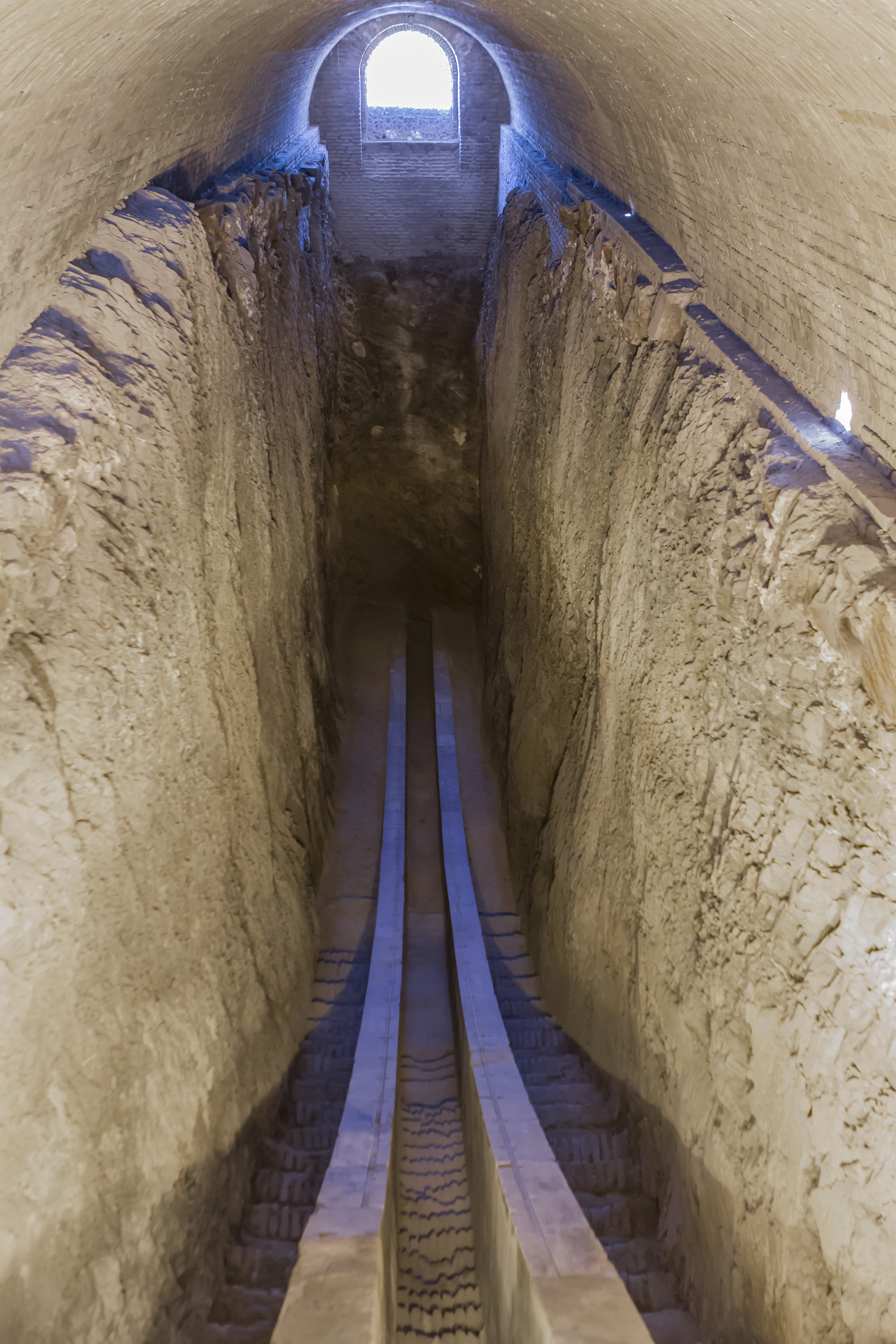
The centerpiece of the observatory was an enormous meridian arc known as the Fakhri sextant. With a radius of 40.04 meters, it was the largest astronomical instrument of its type in the world. To ensure its stability for making precise measurements, the massive marble-clad arc was built into a two-meter-wide trench dug into a rocky hill along the north-south meridian. The surviving underground portion of this instrument is the main feature of the site today. This design allowed astronomers to measure the angular position of celestial bodies precisely as they crossed the local meridian.
Charting the Cosmos with Unprecedented Accuracy
The main work produced at the observatory was the Zij-i Sultani, a star catalog and set of astronomical tables published around 1437. It took nearly two decades of meticulous observation to compile. The catalog listed the positions of 1,018 stars. Of these, 992 were newly re-determined from Samarkand, a significant update to the ancient works of Ptolemy that most earlier catalogs had relied upon.
The accuracy achieved was remarkable for an era before the invention of the telescope. The team calculated the length of the sidereal year to be 365 days, 6 hours, 10 minutes, and 8 seconds, a value only 58 seconds longer than modern calculations. Ulugh Beg also determined the Earth's axial tilt to be 23.5047 degrees (23°30'17"), a measurement so accurate it is still considered correct. These calculations were more precise than those made by Copernicus over a century later. After Ulugh Beg's assassination in 1449, the observatory was destroyed, and its work came to an end. The ruins were lost for centuries until rediscovered in 1908 by the Russian archaeologist Vassily Vyatkin.