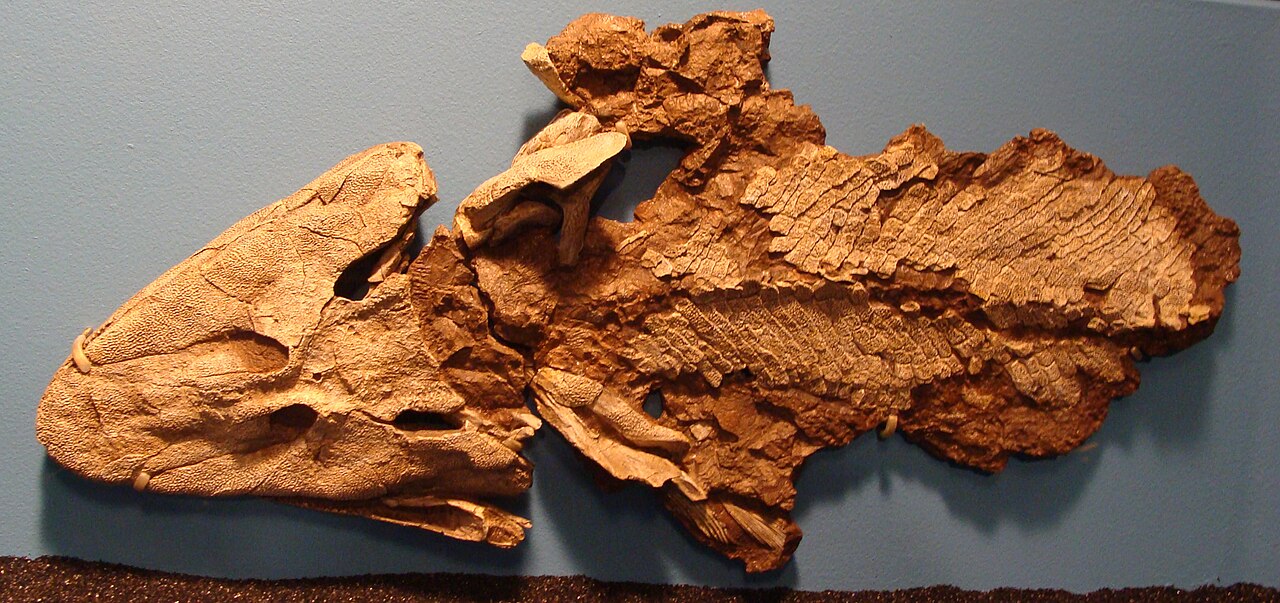
The 'fishapod'. A 375-million-year-old fossil showing the transition from fish to four-legged animals. It has fish scales and gills but also a neck, ribs, and limb-like fins with a primitive wrist. Evolution caught in the act.
Eduard Solà, CC BY-SA 3.0, via Wikimedia Commons
A fish does push-ups
In 2004, paleontologists searching the remote area of Ellesmere Island in Arctic Canada found the fossilized skeletons of a creature that blurred the line between fish and land animals. Named Tiktaalik roseae, this animal lived approximately 375 million years ago during the Late Devonian Period. The rocks of the Fram Formation, where the fossils were discovered, show that this region was once a warm, subtropical meandering stream system near the Devonian equator.
Tiktaalik had a mix of features. Like a fish, it had scales, gills, and fins with delicate fin rays. But its anatomy was also surprisingly similar to that of a tetrapod, or four-legged animal. It had a flattened, crocodile-like skull up to 9 feet long, with eyes positioned on top, suggesting it lived as a predator in shallow waters. Unlike fish before it, the bony connection between its head and shoulder girdle was gone, giving it the first known vertebrate neck. This mobile neck would have allowed it to hunt more effectively in the shallows. Its front fins contained a bone structure homologous to the arms of land animals, with a shoulder, elbow, and a functional wrist that would have allowed it to prop its body up on the substrate.
Stepping out of the water
The discovery of Tiktaalik provided a detailed look at an important evolutionary transition. It lived in a world where deciduous plants were newly flourishing, shedding leaves into the water and creating oxygen-poor shallows. This environment may have favored animals that could breathe air and maneuver in complex, shallow habitats. Tiktaalik had a robust ribcage, which could have helped support its body out of water and aided primitive lungs.
The scientific name Tiktaalik is an Inuktitut word suggested by Inuit elders of Nunavut, meaning "large freshwater fish" or "burbot". The species name, roseae, honors an anonymous benefactor who supported the research. Often called a "missing link," scientists see Tiktaalik as a clear intermediate form that shows the step-by-step changes that occurred as vertebrates moved from aquatic to terrestrial life. Subsequent discoveries of its pelvic girdle revealed it was large and robust, with a hip joint that connected to strong hind fins, suggesting that powerful rear appendages evolved before the move to land was complete. The fossils show the anatomical transition between earlier lobe-finned fish like Panderichthys (380 million years ago) and early tetrapods like Acanthostega (365 million years ago).
💡Fun Facts
The expedition team, led by Neil Shubin and Ted Daeschler, specifically targeted the 375-million-year-old rocks of the Canadian Arctic because they predicted it was the perfect place to find a fish-to-tetrapod transitional fossil.
The name *Tiktaalik* was suggested by the Inuit Qaujimajatuqangit Katimajiit, the Nunavut Council of Elders.
Researchers nicknamed the creature a "fishapod" because it's a mix between a fish and a four-legged tetrapod.
During the Late Devonian period, Ellesmere Island was located on the equator and had a warm, subtropical climate, very different from its icy conditions today.
The fossil site is in a remote, uninhabited wilderness area and is not a formal tourist destination. Access is generally restricted to scientific expeditions.
Admission
Free
Accessibility
Accessing Ellesmere Island requires a chartered flight and specialized arctic survival gear. The terrain is rugged and mountainous, with extreme weather conditions.