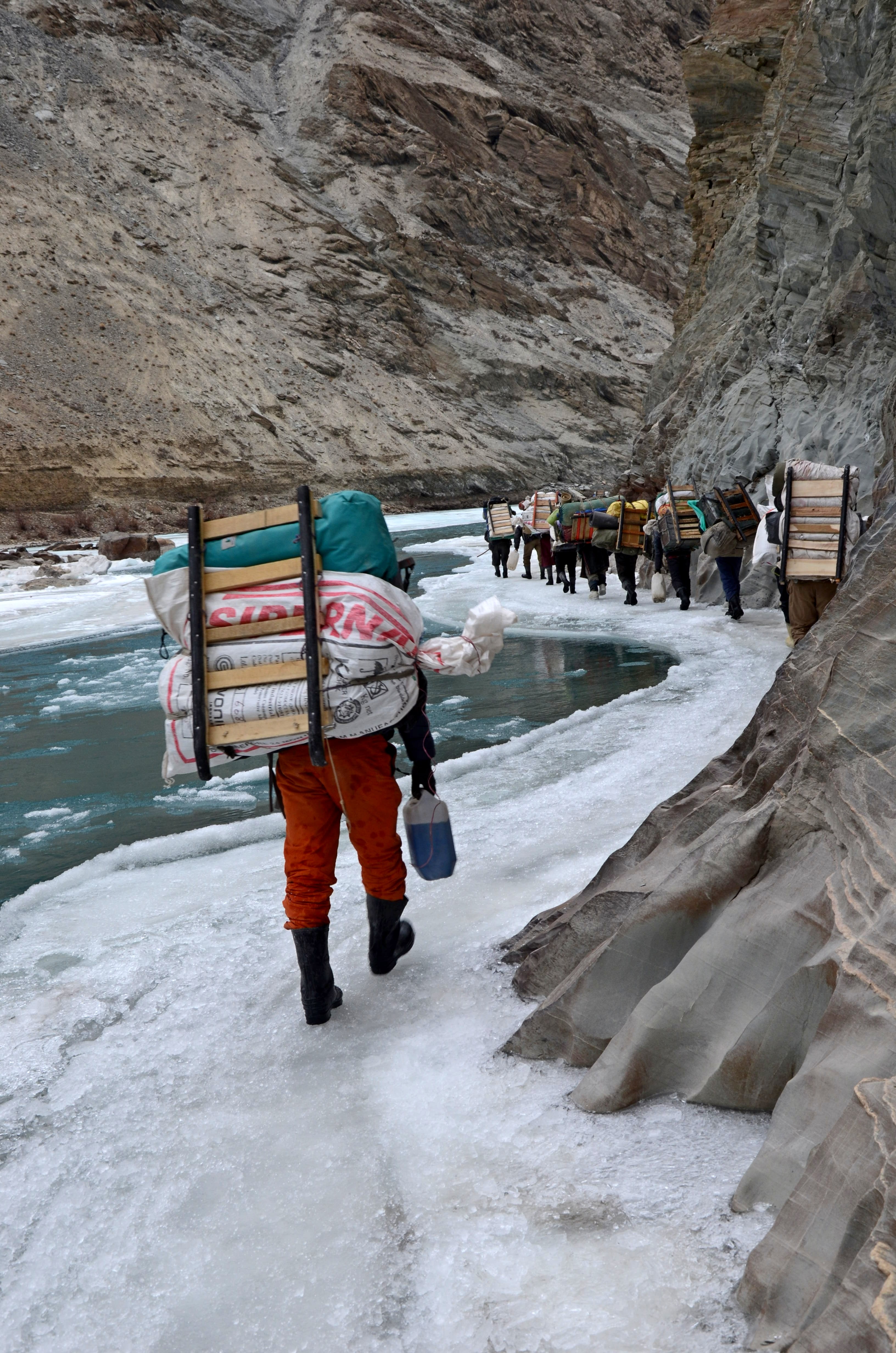
The physics of a frozen highway
Each winter, the Zanskar River in Ladakh transforms into a walkable path of ice known as the Chadar, a Hindi word for "blanket". This natural bridge forms not because the entire river freezes solid, but through a specific physical process called supercooling. For the Chadar to form, a delicate thermal balance is required: air temperatures must plummet to between -20°C and -35°C, while the turbulent, fast-flowing river water remains liquid below its standard 0°C freezing point.
Supercooling occurs because the constantly moving water lacks sufficient nucleation sites—impurities or still surfaces—for ice crystals to begin forming. Instead, the extreme cold from the overlying air rapidly extracts heat from the river surface. This energy loss lets a sheet of ice form on top, while the water continues to flow beneath. The heat flux at the heat flux at the air-water interface, where heat lost to the cold air must be balanced by the latent heat released during ice formation for the sheet to stabilize. The result is an ice sheet of highly variable thickness, from solid sections 30cm deep to fragile layers as thin as 3cm, often changing overnight.