A scar across the continent
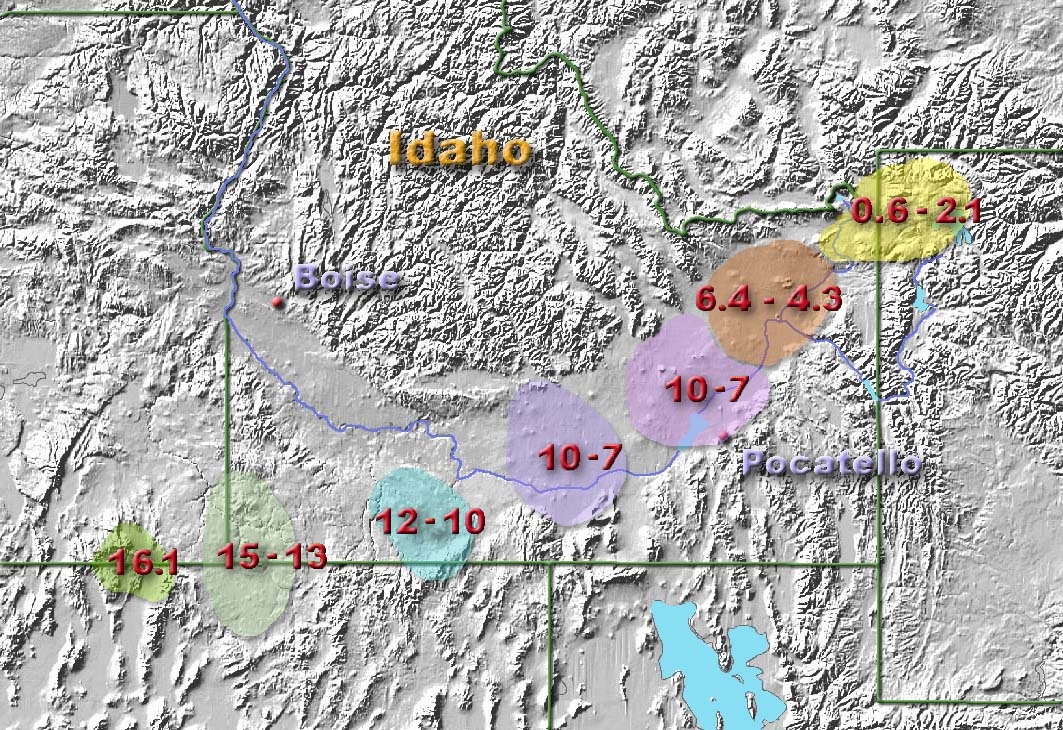
The geysers and hot springs of Yellowstone National Park are the youngest phenomena in a 700-kilometer-long chain of volcanic centers. This track begins 16-17 million years ago in northern Nevada and southeastern Oregon and ends in present-day Wyoming. The trail of extinct calderas records the southwestern movement of the North American tectonic plate over a stationary heat source in the Earth's mantle, known as a hotspot. The plate has moved at an average speed of about 4.6 centimeters per year over the last 16.5 million years.
The hotspot's first appearance is linked to a massive volcanic event. Between 14 and 17 million years ago, enormous fissures erupted floods of basalt lava, creating the Columbia River Basalt Group which covers over 210,000 square kilometers of the Pacific Northwest. Some of these lava flows are over 3,500 meters thick in places. As the North American plate continued its movement southwest, the hotspot generated a series of massive, caldera-forming eruptions across what is now Idaho's Snake River Plain. These ancient volcanic centers include the Bruneau-Jarbidge field (around 12 million years old), the Heise volcanic field (active between 6.6 and 4.4 million years ago), and the Island Park Caldera, which produced the 2.1 million-year-old Huckleberry Ridge Tuff eruption. This single eruption produced 2,500 cubic kilometers of ash, enough to bury a significant portion of the United States. The most recent super-eruption, the Lava Creek Eruption, occurred 640,000 years ago and formed the current Yellowstone Caldera.
The mystery of the missing plume
The conventional model for hotspots involves a mantle plume—a narrow column of hot rock rising from the deep mantle, possibly from as far down as the core-mantle boundary. For decades, geologists assumed a deep plume fed the Yellowstone hotspot. Modern geophysical imaging techniques have complicated this picture. Seismic tomography, which uses earthquake waves to create 3D maps of the mantle, has failed to find a clear, continuous plume extending deep beneath Yellowstone.
Some seismic studies show a tilted, low-velocity anomaly—interpreted as hotter rock—extending to a depth of about 660 kilometers, but it is not the classic vertical plume. This structure appears to be slanted to the west-northwest. Other imaging methods, like magnetotellurics which measure electrical conductivity, suggest the feature is much shallower.
This ambiguity has led to alternative hypotheses. One idea suggests the heat source is a shallower feature, perhaps related to the complex interaction between the remnants of the subducted Farallon oceanic plate and the western edge of the North American continent. Another model proposes that the volcanism is caused by processes within the upper mantle, not a deep plume. The debate continues, making the Yellowstone hotspot track records past volcanism, but an active scientific puzzle about the inner workings of our planet.